DSIP: named after an effect that later human work could not reproduce
Isolated from rabbit blood in 1977 and named for the EEG rhythm it enhanced. Four small human insomnia studies produced weak or null results, a 2009 anaesthesia study found it reduced delta rhythm, and no gene or receptor has ever been identified.
1 September 2026 · 3 min read
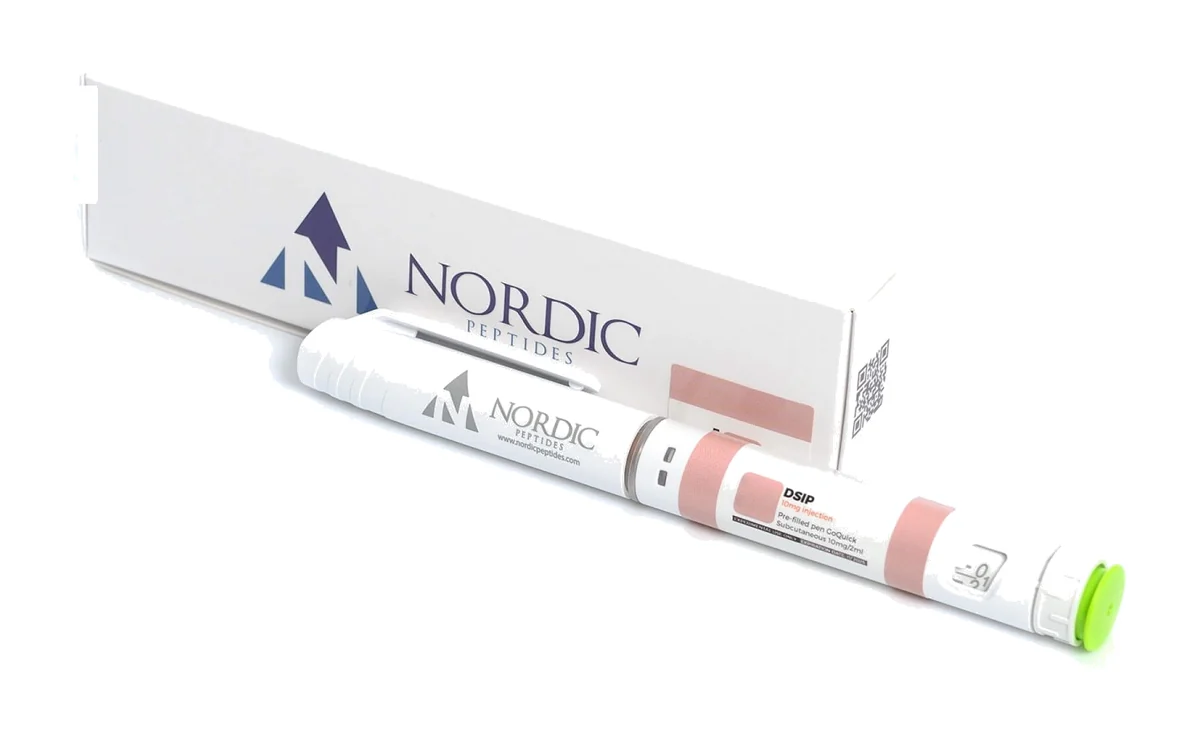 Delta-sleep-inducing peptide (DSIP) - 5mg
Some compounds carry a name that is a hypothesis. This is one of them, and the hypothesis has been under test for nearly fifty years without resolving. That makes it an unusually clear case for the thing this section exists to do: separate what was found from what the name implies.
It shares a shelf with Semax and Selank, and it shares their problem too: a literature that is real and old, small in every individual study, and never repeated to a modern standard.
Where the name comes from
In 1977, Schoenenberger and Monnier isolated a peptide from rabbit cerebral venous blood and reported the sequence Trp-Ala-Gly-Gly-Asp-Ala-Ser-Gly-Glu. Infused into the brain ventricles of rabbits under double-blind conditions — 58 animals in total, including controls — the synthetic nonapeptide enhanced delta and spindle EEG patterns. Five metabolic fragments, two substituted analogues and a related tripeptide were tested alongside it, and only the intact nonapeptide produced the effect. The sequence and synthesis were confirmed the following year.
That is a careful piece of work. It is also the high-water mark of the compound’s evidence, and everything after it complicates the picture.
The human insomnia studies
The insomnia literature is small, old and intravenous. Three studies carry the weight of it.
- Kaeser, 1984 — an open study of 7 patients with severe insomnia given a series of 10 injections. Sleep was reported as normalised in all but one, over 3–7 months of follow-up. Open-label, uncontrolled, n=7.
- Monti et al., 1987 — 25 nmol/kg intravenously over four nights, double-blind crossover, with polysomnography. Awakenings, sleep latency and waking time all moved in the right direction, but none of the differences reached significance against baseline or placebo. Total sleep time and NREM time increased, driven entirely by stage 2. The authors’ own conclusion: sleep improvement “is of little clinical significance.”
- Bes et al., 1992 — 16 chronic insomniacs, double-blind parallel groups, 25 nmol/kg on three consecutive afternoons. Sleep efficiency was higher and latency shorter than placebo, but the authors judged the effects weak and partly attributable to an incidental change in the placebo group. Subjective sleep quality did not move at all. Conclusion: short-term treatment “is not likely to be of major therapeutic benefit.”
The one enthusiastic report is the uncontrolled one. Both controlled looks came back negative or near-negative, from investigators who were trying to find an effect.
The 2009 result points the other way
The most recent controlled human administration is not a sleep study at all. Pomfrett et al. gave 24 patients either saline or intravenous DSIP at 25, 50 or 100 nmol/kg — once awake, once under propofol induction and isoflurane maintenance — while recording bispectral index, EEG and heart rate variability.
DSIP significantly increased heart rate, decreased heart rate variability and, in the authors’ word, paradoxically reduced delta rhythm, while reducing burst suppression and increasing BIS at 25 nmol/kg. The reading was that it lightened anaesthetic depth.
A peptide named for delta enhancement reduced delta activity in anaesthetised humans. That result is not decisive on its own — different state, different anaesthetic background — but it is the newest controlled human data there is, and it does not support the name.
The mechanism was never established
Kovalzon and Strekalova reviewed the field under the title “a still unresolved riddle.” Their assessment: the link between DSIP and sleep “has never been further characterized,” partly because no DSIP gene, no DSIP protein and no candidate receptor has been isolated. They describe the sleep hypothesis as extremely poorly documented and still weak, and propose that the biological activity attributed to DSIP may belong to some other, structurally related peptide.
Nearly fifty years after isolation, there is no receptor to talk about.
What the data does not show
There is no modern randomised trial. There is no oral or subcutaneous efficacy data — every human study above used the intravenous route. There is no approved DSIP medicine in the EU or the US. And there is no established mechanism connecting the peptide to sleep architecture in a human being.
What exists is a well-conducted 1977 rabbit EEG study, four small and mostly null human studies, and one modern human study whose result runs opposite to the name.
What we supply
Delta-sleep-inducing peptide (DSIP), Nordic Peptides pen, shipped as supplied by the manufacturer, batch documentation on request. Storage as printed by the manufacturer on the product page. Research use only — not for human or veterinary use, and nothing here is medical advice.
References.
- Schoenenberger GA, Monnier M. Characterization of a delta-electroencephalogram (-sleep)-inducing peptide. Proc Natl Acad Sci USA 1977;74(3):1282–1286 (PMID 265572).
- Schoenenberger GA, Maier PF, Tobler HJ, et al. The delta EEG (sleep)-inducing peptide (DSIP). XI. Amino-acid analysis, sequence, synthesis and activity of the nonapeptide. Pflugers Arch 1978;376(2):119–129 (PMID 568769).
- Kaeser HE. A clinical trial with DSIP. Eur Neurol 1984;23(5):386–388 (PMID 6391926).
- Monti JM, Debellis J, Alterwain P, et al. Study of delta sleep-inducing peptide efficacy in improving sleep on short-term administration to chronic insomniacs. Int J Clin Pharmacol Res 1987;7(2):105–110 (PMID 3583493).
- Bes F, Hofman W, Schuur J, Van Boxtel C. Effects of delta sleep-inducing peptide on sleep of chronic insomniac patients. A double-blind study. Neuropsychobiology 1992;26(4):193–197 (PMID 1299794).
- Pomfrett CJ, Dolling S, Anders NR, et al. Delta sleep-inducing peptide alters bispectral index, the electroencephalogram and heart rate variability when used as an adjunct to isoflurane anaesthesia. Eur J Anaesthesiol 2009;26(2):128–134 (PMID 19142086).
- Kovalzon VM, Strekalova TV. Delta sleep-inducing peptide (DSIP): a still unresolved riddle. J Neurochem 2006;97(2):303–309 (PMID 16539679).