Myostatin inhibitors: ACE-083 went to phase 2, follistatin-344 never left the lab
One follistatin-based molecule grew muscle in two randomised phase 2 trials and still failed where it mattered. The other has only animal data, a black market, and a retinal case series. The published record, side by side.
26 September 2026 · 4 min read
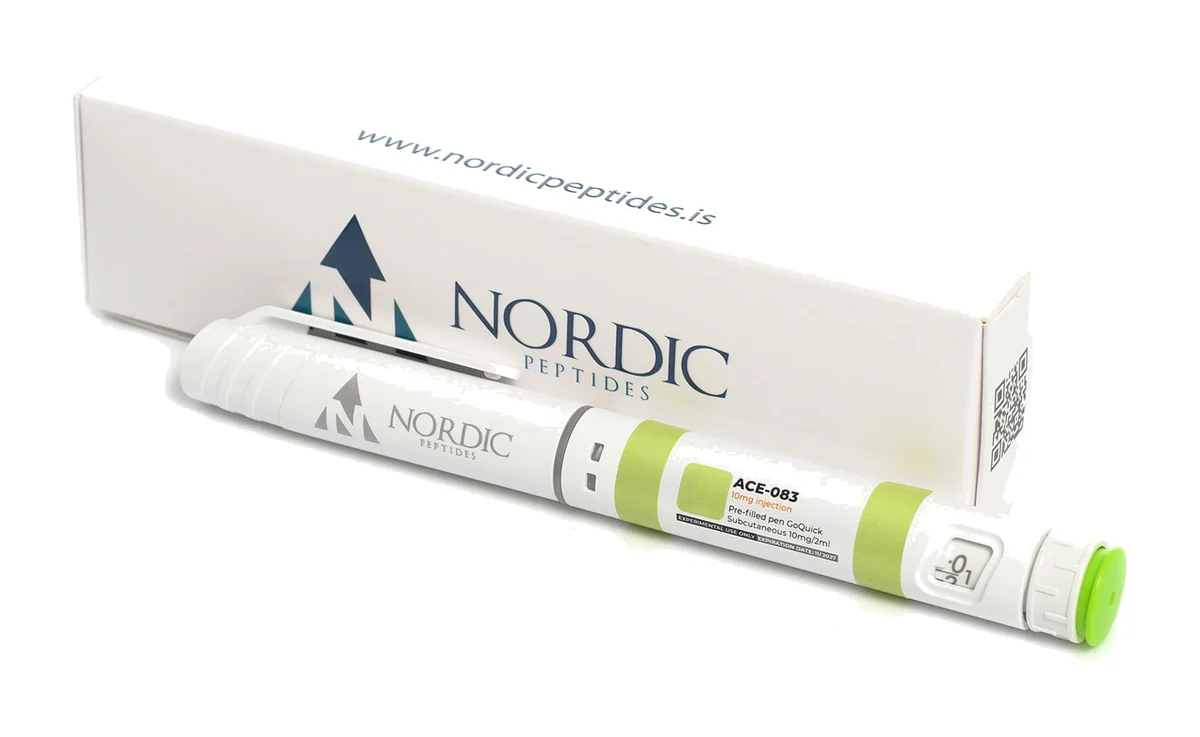 ACE-083 - 10mg
Myostatin is a brake pedal for muscle growth: a TGF-beta-family ligand whose job is to keep skeletal muscle from growing past its set point. Block the brake and muscle grows — mice without the myostatin gene are famously, grotesquely muscular. The therapeutic idea is obvious, and two follistatin-derived compounds tested it from opposite ends of the evidence ladder. One ran the full clinical course through two randomised phase 2 trials. The other was never tested for efficacy in a single human.
ACE-083: the molecule that did everything asked except the last thing
ACE-083 was Acceleron’s follistatin-based ligand trap: a fusion protein designed to sit in the injected muscle and soak up myostatin plus the related ligands activin A, activin B and GDF11. The preclinical paper showed it doing exactly that in vitro, and intramuscular injection caused localized, dose-dependent hypertrophy in wild-type mice and in mouse models of Charcot-Marie-Tooth disease and Duchenne dystrophy — with no systemic muscle effects, no endocrine perturbation, and measurable force gains in the injected muscle.
The first-in-human study put it into 58 healthy postmenopausal women: 50–200 mg injected unilaterally into the rectus femoris or tibialis anterior, one or two doses three weeks apart, against placebo. No serious adverse events, no dose-limiting toxicities, no discontinuations. Maximum mean volume gains of 14.5% in the rectus femoris and 8.9% in the tibialis anterior. But the sentence that foreshadowed everything: no significant changes in mean muscle strength were observed.
Then the two phase 2 trials, same design philosophy, same result pattern. In facioscapulohumeral muscular dystrophy (58 participants, 240 mg per muscle injected bilaterally every three weeks for six months double-blind plus six months open-label), total muscle volume beat placebo by 16.4% in the biceps and 9.5% in the tibialis anterior — both statistically significant — with contractile volume up and fat fraction down. In Charcot-Marie-Tooth disease types 1 and X (45 enrolled, 44 treated, same 240 mg regimen in the tibialis anterior), total muscle volume beat placebo by 13.5%, with contractile volume and ankle dorsiflexion strength also significantly improved.
And in both trials, the functional story stalled. FSHD: no consistent improvements in functional or patient-reported measures with up to 12 months of treatment. CMT: fat fraction and all other functional outcomes not significantly improved; no greater functional improvement than placebo. Bigger muscles that did not work better — twice, in two diseases, by two independent investigator groups. The published clinical record ends there: no phase 3 followed.
Follistatin-344: the molecule with no human efficacy data at all
Follistatin-344 is a splice variant of human follistatin — shorter than the circulating 315 form. The foundational molecule paper is a protein-engineering study: fusing follistatin-315 to an Fc fragment and removing its heparan-sulfate binding produced a variant with roughly 100-fold longer terminal half-life and 1,600-fold greater exposure than the native protein, with robust dose-dependent effects given subcutaneously once weekly — in mouse models of muscle atrophy and degeneration. Mice, not people.
The rest of the published record is not a development programme. One group expressed human follistatin-344 transgenically in pigs and reported increased skeletal muscle mass — a gene-therapy model, not an injectable drug study. Anti-doping laboratories have published detection methods for black-market follistatin-344, which tells you it circulates outside any trial. And one Turkish ophthalmology clinic published a retrospective case series of 11 male bodybuilders who developed central serous chorioretinopathy — fluid under the retina, blurred vision — after high-dose subcutaneous injections of 1 mg vials bought outside medicine. Ten unilateral, one bilateral; the eight single-injection cases resolved in about 2.3 months on average, while the three repeat users relapsed.
That is the entire human record for follistatin-344: eleven retinal cases from illicit use. No phase 1, no dose-finding, no efficacy trial, no safety database.
What the data do not show
- Muscle volume is not muscle function. ACE-083 proved the distinction twice: significant hypertrophy on MRI with no consistent functional gain. Any listing that treats the phase 2 volume figures as performance figures is misreading the papers.
- Nothing about follistatin-344 in humans comes from a trial. The pig study is a transgenic model, the PK/PD paper is mice, and the retinal series is retrospective with no control group — an association observed in eleven self-injecting bodybuilders, not a proven causal rate.
- The case series says nothing about lower exposures, other routes, or medical supervision: every patient injected complete 1 mg vials bought on the black market.
- No dosing guidance for either compound exists anywhere in the literature. ACE-083’s trial regimens (240 mg per muscle, bilateral, every three weeks) were administered by investigators into named muscles for named diseases — not a protocol, and the programme was discontinued.
What we supply
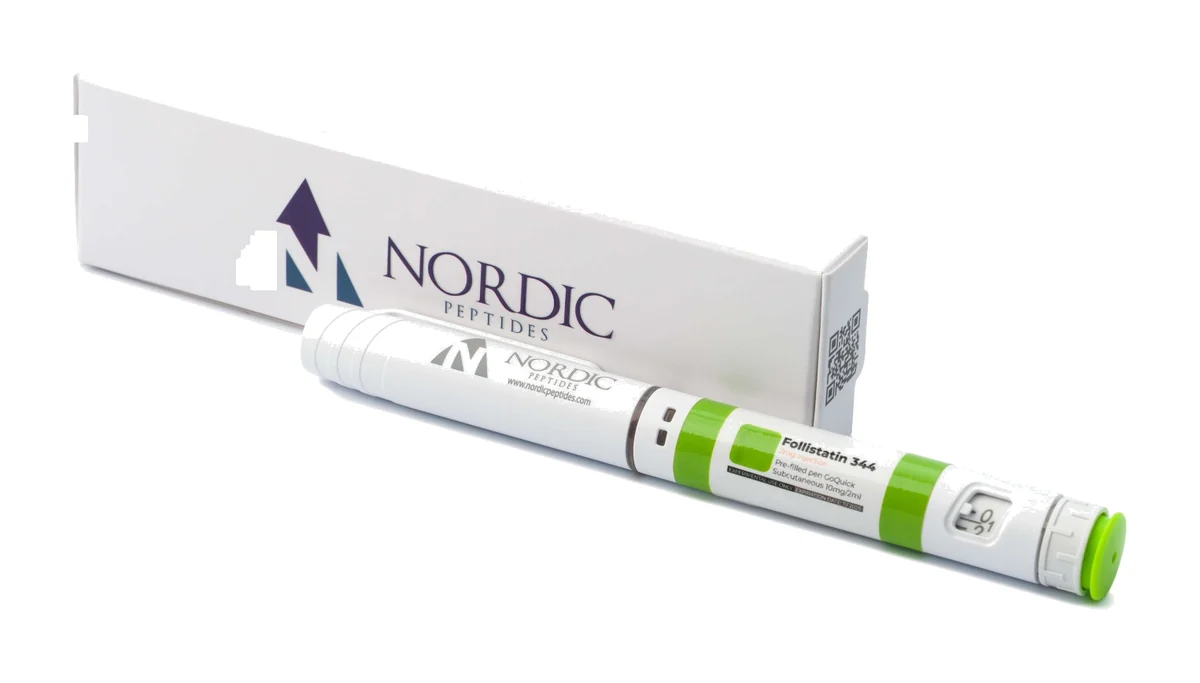
ACE-083 and follistatin-344 from Nordic Peptides, shipped as supplied by the manufacturer, batch documentation on request. Research use only — not for human or veterinary use, no exceptions.
References.
- Glasser CE, Gartner MR, Wilson D, et al. Locally acting ACE-083 increases muscle volume in healthy volunteers. Muscle Nerve. 2018;57(6):921-926 (PubMed record, PMID 29486514).
- Pearsall RS, Davies MV, Cannell M, et al. Follistatin-based ligand trap ACE-083 induces localized hypertrophy of skeletal muscle with functional improvement in models of neuromuscular disease. Sci Rep. 2019;9(1):11392 (PubMed record, PMID 31388039).
- Statland JM, et al. Randomized phase 2 study of ACE-083, a muscle-promoting agent, in facioscapulohumeral muscular dystrophy. Muscle Nerve. 2022;66(1):50-62 (PubMed record, PMID 35428982).
- Randomized Phase 2 Study of ACE-083 in Patients With Charcot-Marie-Tooth Disease. Neurology. 2022;98(23):e2356-e2367 (PubMed record, PMID 35545446).
- An engineered human follistatin variant: insights into the pharmacokinetic and pharmacodynamic relationships of a novel molecule with broad therapeutic potential. J Pharmacol Exp Ther. 2013;344:616-623 (PubMed record, PMID 23249626).
- The transgenic expression of human follistatin-344 increases skeletal muscle mass in pigs. Transgenic Res. 2017;26:25-36 (PubMed record, PMID 27787698).
- Dag U, Caglayan M, Oncul H, Alakus MF. Central serous chorioretinopathy associated with high-dose follistatin-344: a retrospective case series. Int Ophthalmol. 2020;40(11):3155-3161 (PubMed record, PMID 32671599).