Tirzepatide: what SURMOUNT-1 and SURMOUNT-2 actually showed
Two 72-week placebo-controlled trials, 3,477 participants between them — one in obesity without diabetes, one in obesity with type 2 diabetes. The published weight-loss figures, dose by dose, and where the data stop.
26 September 2026 · 3 min read
 Tirzepatide - 5mg
Tirzepatide is a dual GIP/GLP-1 receptor agonist — the first weight-management compound to stimulate both incretin receptors at once. Before it, the benchmark was semaglutide, a GLP-1 agonist alone. The question the SURMOUNT programme was built to answer was how far the second receptor moves the number.
Two of its trials are the cleanest read of that answer: SURMOUNT-1 and SURMOUNT-2. Both ran 72 weeks, both were randomised, double-blind and placebo-controlled, and both published their results in full. What follows is what those two papers printed — dose by dose.
(There is a third trial people ask about: SURMOUNT-5, which put tirzepatide and semaglutide in the same protocol, head to head. That trial has its own article and is not retold here.)
SURMOUNT-1: obesity without diabetes
The larger of the two. The investigators assigned 2,539 adults with a BMI of 30 or higher — or 27 or higher with at least one weight-related complication — to once-weekly subcutaneous tirzepatide at 5, 10 or 15 mg, or placebo, for 72 weeks including a 20-week dose-escalation period. Diabetes was an exclusion: this is the non-diabetic population.
Baseline tells you who was in the room: mean body weight 104.8 kg, mean BMI 38.0, and 94.5% of participants at a BMI of 30 or above.
At week 72, the mean percentage weight change was −15.0% on 5 mg, −19.5% on 10 mg and −20.9% on 15 mg, against −3.1% on placebo — every comparison with placebo at P<0.001. The co-primary threshold result: a reduction of 5% or more in 85%, 89% and 91% of participants on the three tirzepatide doses respectively, versus 35% on placebo. At the deeper end, half the 10 mg group (50%) and 57% of the 15 mg group lost 20% or more of body weight, against 3% on placebo.
Tolerability, as printed: the most common adverse events were gastrointestinal, mostly mild to moderate and clustered in the dose-escalation phase. Adverse events led to treatment discontinuation in 4.3%, 7.1% and 6.2% of participants on 5, 10 and 15 mg respectively, versus 2.6% on placebo.
SURMOUNT-2: obesity with type 2 diabetes
The companion trial asked the same question in the population SURMOUNT-1 excluded. Between March 2021 and April 2023, 938 adults with a BMI of 27 or higher and glycated haemoglobin of 7–10% were randomised to tirzepatide 10 mg (312 people), 15 mg (311) or placebo (315) for 72 weeks. Mean age 54.2 years, mean baseline weight 100.7 kg, mean BMI 36.1, mean HbA1c 8.02%.
The least-squares mean weight change at week 72 was −12.8% on 10 mg and −14.7% on 15 mg, against −3.2% on placebo — estimated treatment differences versus placebo of −9.6 and −11.6 percentage points, all at P<0.0001. Between 79% and 83% of tirzepatide-treated participants reached the 5%-or-more threshold, versus 32% on placebo.
Side by side with SURMOUNT-1, the pattern is visible: the same drug, the same duration, smaller numbers in the diabetic population (−14.7% at the top dose here versus −20.9% there). That gap is consistent with what the field sees across weight-management trials — people with type 2 diabetes lose less weight on average than people without it — but it is a cross-trial observation, not a randomised comparison of the two populations.
Safety, as printed: gastrointestinal events again led the list — nausea, diarrhoea, vomiting — mostly mild to moderate, with fewer than 5% discontinuing treatment over them. Serious adverse events were reported by 68 participants overall (7%), and two deaths occurred in the 10 mg group, which the investigators judged unrelated to the study treatment.
What the data do not show
- Neither trial compares tirzepatide with any other active drug. Every percentage above is against placebo. The only randomised comparison with semaglutide is SURMOUNT-5, covered in the head-to-head article — reading a SURMOUNT number next to a STEP number from a different trial is not a comparison.
- SURMOUNT-2 tested 10 and 15 mg only; there is no 5 mg result in the diabetic population.
- SURMOUNT-1 excluded diabetes and SURMOUNT-2 required it, so the −20.9% versus −14.7% gap between the top doses is descriptive, not proof that diabetes blunts the effect by a specific amount.
- Both trials ran 72 weeks. They say nothing about year three, about weight regain after stopping, or about outcomes beyond weight and the prespecified cardiometabolic measures.
- Both trials were funded by the manufacturer (Eli Lilly), with company statisticians and authors on the papers — disclosed in both publications, and standard for registrational trials, but part of the record.
What we supply
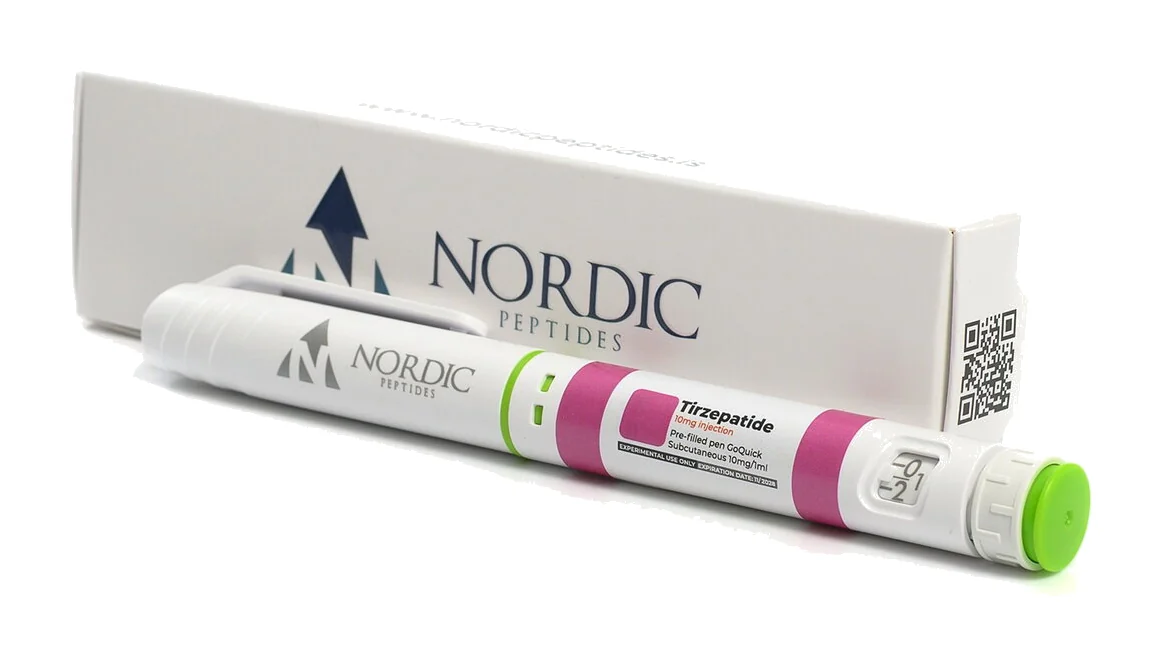
Tirzepatide (5 mg and 10 mg) pens from Nordic Peptides, shipped as supplied by the manufacturer, batch documentation on request. Research use only — not for human or veterinary use, no exceptions.
References.
- Jastreboff AM, Aronne LJ, Ahmad NN, et al. Tirzepatide Once Weekly for the Treatment of Obesity (SURMOUNT-1). N Engl J Med. 2022;387(3):205-216 (PubMed record, PMID 35658024).
- Garvey WT, Frias JP, Jastreboff AM, et al. Tirzepatide once weekly for the treatment of obesity in people with type 2 diabetes (SURMOUNT-2): a double-blind, randomised, multicentre, placebo-controlled, phase 3 trial. Lancet. 2023;402(10402):613-626 (PubMed record, PMID 37385275).