Epithalon and the telomere claim: what the Khavinson papers actually report
Telomerase reactivation in a dish, extra passages past the Hayflick limit, longer-lived flies and mice — and no modern human trial. The published Epithalon record, figure by figure.
26 September 2026 · 4 min read
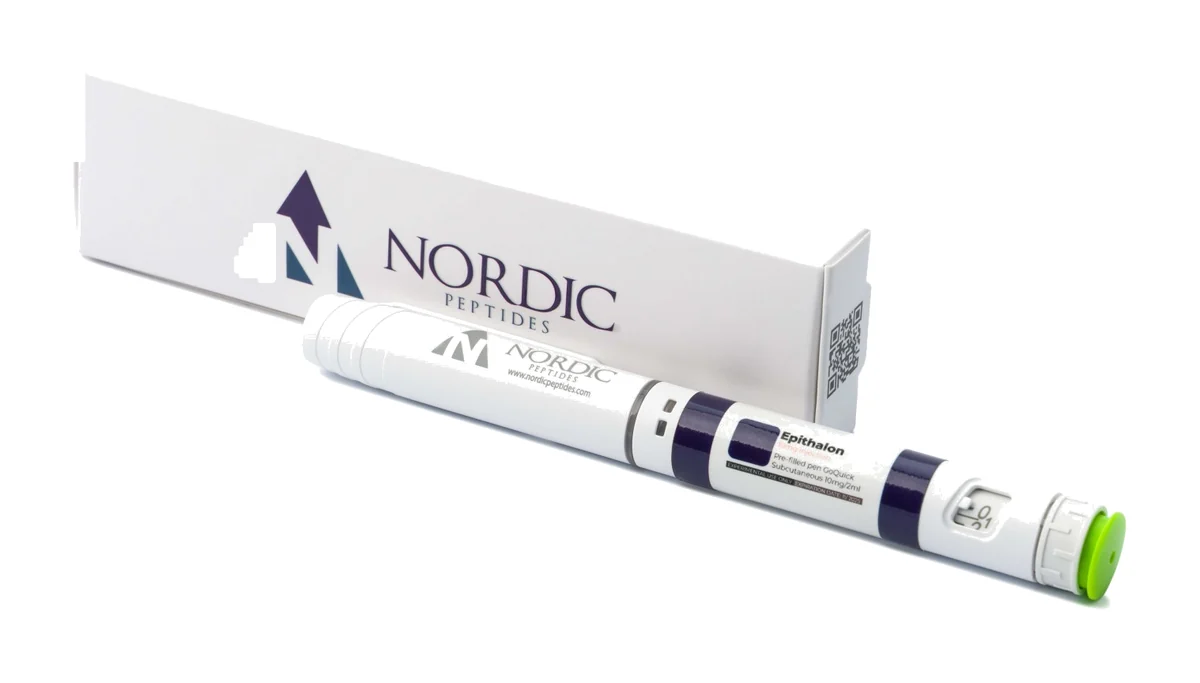 Epithalon - 20mg
Epithalon is the synthetic tetrapeptide Ala-Glu-Asp-Gly, developed by Vladimir Khavinson’s group at the St Petersburg Institute of Bioregulation and Gerontology as a defined analogue of Epithalamin, the pineal-gland extract the same institute had worked with since the 1970s. (The literature spells it Epitalon and Epithalon interchangeably; the molecule is the same four amino acids.)
It is sold online as a longevity compound on the strength of one sentence: it reactivates telomerase and lengthens telomeres. That sentence comes from real papers. What follows is what those papers actually contain — and where they stop.
The telomere experiments were done in a dish
The founding result is a cell-culture study. Khavinson’s group added the peptide to a culture of telomerase-negative human fetal fibroblasts and reported three things: expression of the telomerase catalytic subunit, measurable enzymatic activity of telomerase, and elongation of telomeres — attributed by the authors to reactivation of the telomerase gene in somatic cells.
The follow-up asked what that elongation buys the cells. Primary pulmonary fibroblasts from a 24-week fetus lost their proliferative potential at the 34th passage in the control culture, with telomeres appreciably shorter than at early passages. In the peptide-treated culture, telomeres elongated to a size comparable to early passages, and the cells made 10 extra divisions — 44 passages against the control’s 34 — and were still dividing when the experiment ended. The authors’ term for this is “overcoming the Hayflick limit.”
Both findings are in vitro. Human fetal fibroblasts in culture are the standard model for replicative senescence, and they are also about as far from a living adult organism as a model gets: no immune system, no pharmacokinetics, no tissue context. Nothing in either paper says what happens in a person.
The animal work: flies, then mice
Before the cell papers, the group tested the peptide on Drosophila melanogaster, wild strain Canton-S. The substance was added to the culture medium at the developmental stage only — from egg to larva — and the adult flies lived 11–16% longer than controls. The reported effective concentrations were extraordinarily low, and the authors note they were 16,000 to 80,000,000 times lower than the effective concentrations of melatonin in comparable setups. The lifespan increase did not depend on the dose within the tested range.
The mouse study is the most complete animal dataset on this compound. From the age of 3 months until natural death, 54 female outbred Swiss-derived SHR mice received 1.0 microgram per mouse subcutaneously on 5 consecutive days every month; 54 controls received saline on the same schedule. The results, as printed:
- No effect on food consumption, body weight, or mean life span.
- A 13.3% longer life span in the last 10% of survivors (P<0.01) and a 12.3% longer maximum life span than controls.
- A 17.1% lower frequency of chromosome aberrations in bone marrow cells (P<0.05), alongside slower age-related shutdown of estrous function.
- No effect on total spontaneous tumor incidence — but leukemia development was inhibited 6.0-fold relative to controls.
Note the shape of that result: the average mouse lived no longer; the longest-lived mice lived longer. Mean life span unchanged with maximum life span extended is a legitimate pattern, but it is a narrower claim than “extends lifespan,” and it comes from one sex of one outbred strain, dosed lifelong from early adulthood.
The human evidence is borrowed from its predecessor
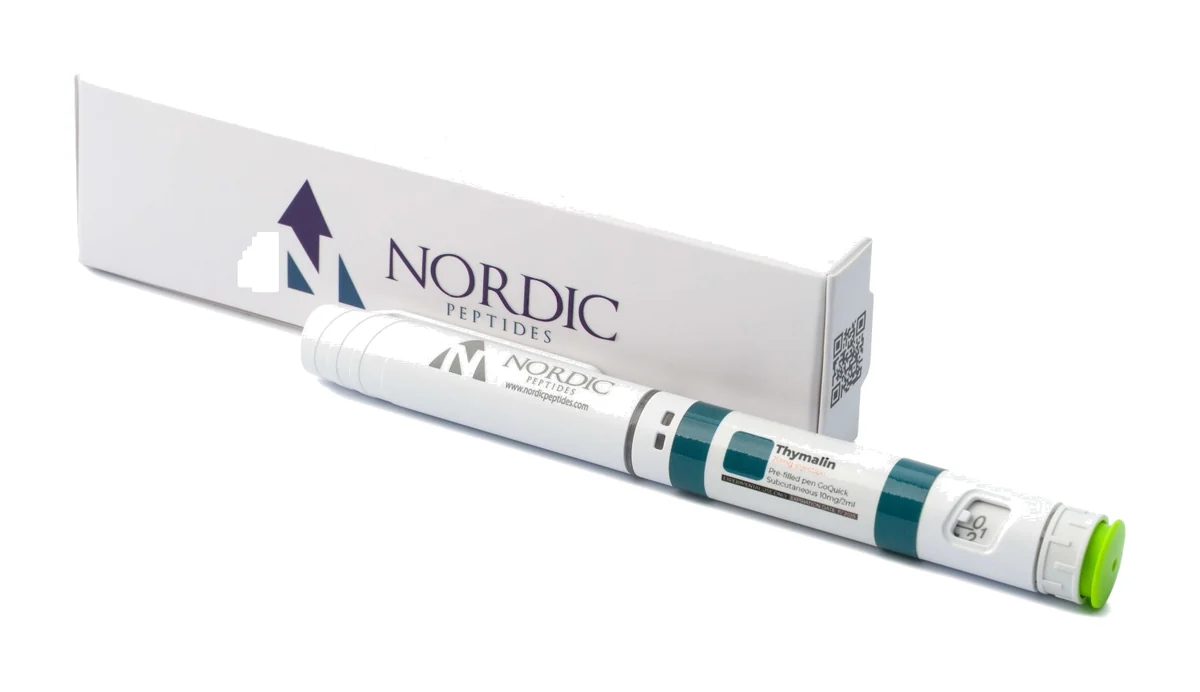
There is no modern randomised controlled trial of Epithalon in humans. What exists is the long-follow-up work the Khavinson group reports on Thymalin, Epithalamin, or both combined — 266 elderly patients followed for six to eight years, with reported normalisation of immune markers and reduced mortality in the treated groups. That study used the pineal extract Epithalamin, not the synthetic tetrapeptide, and it carries the methodological problems of the era: controlled but not blinded to contemporary standards, published in Russian-language gerontology journals, and never independently replicated outside the institute.
We have covered that dataset and its problems in detail in the Thymalin article. The honest summary transfers directly: a large body of work exists, it has never been replicated to modern standards, and quoting its mortality figures beside a vial of the synthetic peptide skips two steps — extract to defined molecule, and unblinded single-centre study to replicated finding.
Epithalon vs Thymalin: same school, different claims
The contrast is worth making explicit, because the two compounds share an origin story and attract the same customers. Thymalin’s published case rests on the long human follow-up — the weakest link being trial methodology. Epithalon’s published case rests on mechanism and animal longevity — cell-culture telomerase reactivation, extra passages, longer-lived flies and longer-lived oldest-decile mice — with no human efficacy dataset of its own at all. Same institute, same era, same replication problem; different evidence shapes. Neither is an established longevity intervention in people.
What the data do not show
- No human trial of Epithalon to modern randomised, blinded standards — no human dose, no human safety profile, no human effect size.
- The telomerase findings are from fetal fibroblast cultures, not from any living organism.
- The Drosophila exposure happened at the developmental stage only; nothing was dosed to adults.
- The mouse result is confined to females of one outbred strain, and mean life span did not move — only the tail of the survival curve did.
- Nearly all of it comes from one affiliated research cluster in St Petersburg, with no independent replication.
What we supply
Epithalon 20 mg, Nordic Peptides, shipped as supplied by the manufacturer, batch documentation on request. Presentation and storage instructions are the manufacturer’s own, on the product page.
Research use only. Not for human or veterinary use — and nothing here is medical advice.
References.
- Khavinson VKh, Bondarev IE, Butyugov AA. Epithalon peptide induces telomerase activity and telomere elongation in human somatic cells. Bull Exp Biol Med. 2003;135(6):590-592 (PubMed record, PMID 12937682).
- Khavinson VKh, Bondarev IE, Butyugov AA, Smirnova TD. Peptide promotes overcoming of the division limit in human somatic cell. Bull Exp Biol Med. 2004;137(5):503-506 (PubMed record, PMID 15455129).
- Khavinson VK, Izmaylov DM, Obukhova LK, Malinin VV. Effect of epitalon on the lifespan increase in Drosophila melanogaster. Mech Ageing Dev. 2000;120(1-3):141-149 (PubMed record, PMID 11087911).
- Anisimov VN, Khavinson VKh, et al. Effect of Epitalon on biomarkers of aging, life span and spontaneous tumor incidence in female Swiss-derived SHR mice. Biogerontology. 2003;4(4):193-202 (PubMed record, PMID 14501183).
- Khavinson VKh, Kuznik BI, Ryzhak GA. Peptide bioregulators: the new class of geroprotectors. Message 2. Clinical studies results. Adv Gerontol. 2013;26(1):20-37 (PubMed record, PMID 24003726).