Curcumin and joint pain: what the pooled trials actually measured
Twenty-nine randomised trials with 2,396 participants, and the authors themselves call the evidence low quality and the trial count small. The umbrella review of 11 meta-analyses finds significant effects on pain and function. The biomarker data are narrower than the pain data: CRP and TNF-alpha fall, ESR, IL-1beta, IL-6 and PGE2 do not.
16 October 2026 · 5 min read
 Curcumin - 200mg/3ml
Curcumin is the compound turmeric is coloured by, and it is the most consistently reviewed plant polyphenol in the joint-pain literature. That consistency is real, and it is also the thing to be careful with, because consistency across meta-analyses mostly means that the same small trials keep getting re-analysed. This page reads the pooled numbers as the papers that printed them report them, and it reads the biomarker data separately from the pain data, because the two do not move together.
What the big meta-analysis counted
A 2022 systematic review in Frontiers in Immunology pooled 29 randomised controlled trials involving 2,396 participants across five arthritis types: ankylosing spondylitis, rheumatoid arthritis, osteoarthritis, juvenile idiopathic arthritis and gout/hyperuricemia. Amounts in those trials ranged from 120 mg to 1,500 mg over 4 to 36 weeks. The pooled direction was favourable on inflammation severity and pain.
The same abstract is unusually honest about the ceiling on that result, and it is worth quoting the shape of the caveat rather than paraphrasing it: safety was consistent across the studies, but “due to the low quality and small quantity of RCTs, the conclusions need to be interpreted carefully.” A meta-analysis of 29 trials is not the same as 29 good trials, and the authors of the largest pool on this page say so themselves.
A second osteoarthritis-specific pool, in Bioscience Reports 2021, is smaller: 15 randomised trials with 1,621 participants. Against placebo it found reductions in visual analogue scale pain and in the pain, function and stiffness components of WOMAC; against NSAIDs it found similar effects on pain, function and stiffness with fewer adverse events; and added to NSAIDs it did not increase adverse events. Its own recommendation is that OA patients use it for more than 12 weeks. That is the review authors’ clinical recommendation, not a measured outcome of their analysis.
The numbers a reader can check
The 2016 Journal of Medicinal Food meta-analysis is the one that prints effect sizes in units you can picture. Across three studies reporting pain on a visual analogue scale, turmeric or curcumin moved the score by a mean difference of −2.04 points (95% CI −2.85 to −1.24, P < .00001) against placebo. Across four studies, WOMAC moved by −15.36 (95% CI −26.9 to −3.77, P = .009). Against conventional pain medicine there was no significant difference in visual analogue score. The authors state the evidence supports turmeric extract at about 1,000 mg per day of curcumin, then immediately add that the trial count, sample size and methodological quality were not sufficient for definitive conclusions.
The 2024 Bayesian network meta-analysis works in the same direction with more studies: 23 trials from seven countries, 2,175 knee OA patients, six interventions. Against placebo, curcumin reduced visual analogue pain by MD = −1.63 (95% CI −2.91 to −0.45) and total WOMAC by MD = −18.85 (95% CI −29.53 to −8.76). Rescue medication use dropped to OR 0.17 (95% CI 0.08 to 0.36). Against NSAIDs, adverse reactions were lower at OR 0.51 (95% CI 0.25 to 0.94).
The 2024 umbrella review pools 11 meta-analyses rather than trials, and all of its pooled outcomes — visual analogue score, WOMAC total, WOMAC function, WOMAC pain, WOMAC stiffness — came out significantly better with curcuminoid supplementation. Its authors read that as strong support for relieving pain and improving mobility. It is worth naming what an umbrella review of meta-analyses is: the same underlying trials, counted again.
Where the biomarker story stops
This is the part most marketing copy leaves out. The 2025 meta-analysis restricted to serum inflammatory biomarkers pooled 21 studies with 1,705 knee OA patients, individual sample sizes running from 24 to 160. Two markers moved: C-reactive protein at SMD −0.906 (95% CI −1.543 to −0.269, P = 0.005) and TNF-alpha at SMD −0.921 (95% CI −1.817 to −0.026, P = 0.044). Four did not: ESR, IL-1beta, IL-6 and prostaglandin E2 were not significantly different from control. The TNF-alpha result was also the less consistent of the two under sensitivity testing — the authors describe CRP as the robust one and note that TNF-alpha was not as consistent.
So the honest reading is: curcumin moves two of six measured inflammatory markers, and the two that moved are not the same two that critics usually expect to move if the mechanism were simply “anti-inflammatory” across the board.
The head-to-head that everyone cites
The 2019 randomised open-label study comparing curcumin with diclofenac in knee osteoarthritis randomised 139 patients to a 500 mg enhanced-absorption curcumin capsule three times daily or a diclofenac 50 mg tablet twice daily over 28 days. At days 14 and 28 pain severity and KOOS scores improved similarly in both arms, with no statistically significant difference. Adverse effects were reported in 13% of the curcumin group against 38% in the diclofenac group (P < 0.01), and 28% of the diclofenac group needed H2 blockers against none in the curcumin group (P < 0.01).
Two features of that trial matter for how much weight it carries. It was open-label, so patients and assessors knew which arm they were in. And it was 28 days, which is shorter than the OA meta-analyses that keep finding effects at 12 weeks and beyond.
The bioavailability problem underneath all of it
The 2007 Molecular Pharmaceutics review on curcumin is the one that explains why formulation studies exist at all. Curcumin is safe in phase I trials even at 12 g per day, but its bioavailability is poor, and the stated causes are poor absorption, rapid metabolism and rapid systemic elimination. The whole field of enhanced-absorption formulations — piperine adjuvants, liposomes, nanoparticles, phospholipid complexes — is an attempt to move that number.
That also explains an oddity in the trial literature: the head-to-head study above used a specific enhanced-absorption formulation, while pooled OA analyses mix formulations. When a meta-analysis reports an effect across a hundred milligram here and 1,500 milligrams there, it is partly pooling different things, and no abstract on this page quantifies how much of the effect belongs to the formulation.
What the data do not show
They do not show curcumin treating or curing arthritis. No trial here studied disease progression, joint replacement, or any structural endpoint. The outcomes are pain scores, function questionnaires, and two blood markers.
They do not show a long-term effect. The 2018 supplement review that screened 20 supplements across 69 studies found seven with large and clinically important short-term effects on pain, curcumin among them, and found no supplement with clinically important effects on pain at long-term follow-up. Its overall quality-of-evidence grade ranged from very low to high, with the overall analysis judged very low.
They do not show that more is better, and they do not show what happens without it. The longest pooled duration on this page is 36 weeks in one meta-analysis’s range of trial lengths, and no abstract here reports a withdrawal or dechallenge design.
Where this sits on the shelf
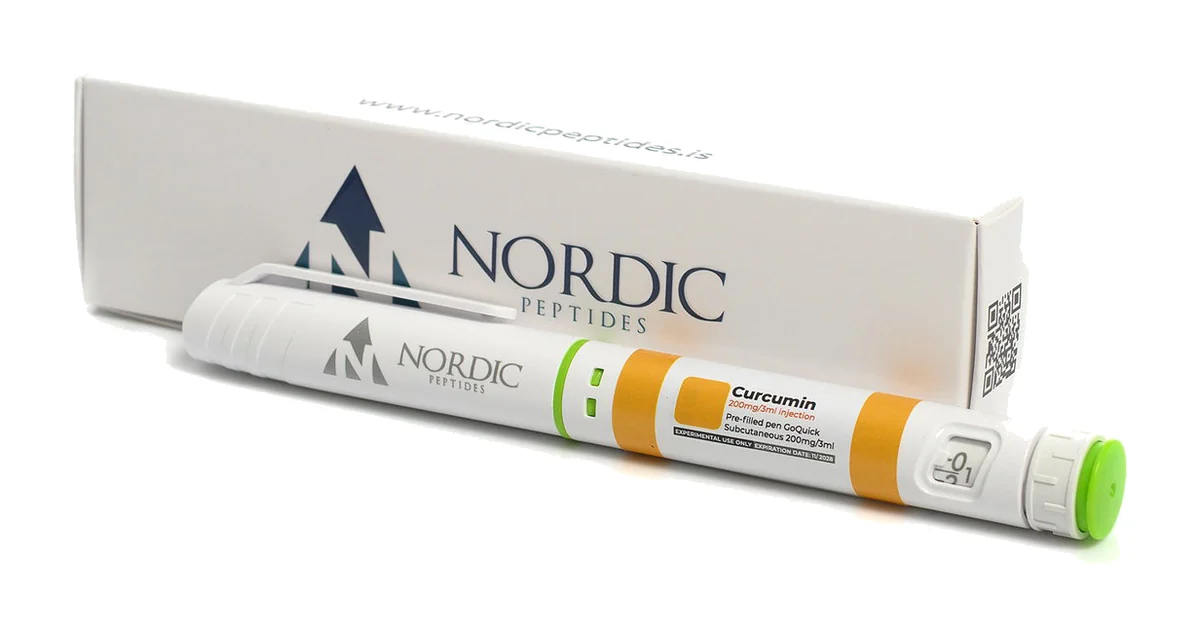
The compound as supplied by the manufacturer: Curcumin
What we supply
The curcumin preparation above, as supplied by the manufacturer, tracked, from inside the EU.
Research use only. This page summarises published studies for research reference. It is not medical advice, not a protocol, and not a suggestion for human use. Nothing we supply is for human or veterinary use.
References.
- Zeng L, et al. Efficacy and Safety of Curcumin and Curcuma longa Extract in the Treatment of Arthritis: A Systematic Review and Meta-Analysis of Randomized Controlled Trial. Front Immunol 2022;13:891822.
- Zeng L, et al. The efficacy and safety of Curcuma longa extract and curcumin supplements on osteoarthritis: a systematic review and meta-analysis. Biosci Rep 2021;41(6).
- Daily JW, Yang M, Park S. Efficacy of Turmeric Extracts and Curcumin for Alleviating the Symptoms of Joint Arthritis: A Systematic Review and Meta-Analysis of Randomized Clinical Trials. J Med Food 2016;19(8):717-729.
- Bideshki MV, et al. The efficacy of curcumin in relieving osteoarthritis: A meta-analysis of meta-analyses. Phytother Res 2024;38(6):2875-2891.
- Zhao J, et al. Efficacy and safety of curcumin therapy for knee osteoarthritis: A Bayesian network meta-analysis. J Ethnopharmacol 2024;321:117493.
- Hsueh HC, et al. Effects of curcumin on serum inflammatory biomarkers in patients with knee osteoarthritis: a systematic review and meta-analysis of randomized controlled trials. BMC Complement Med Ther 2025;25(1):237.
- Shep D, et al. Safety and efficacy of curcumin versus diclofenac in knee osteoarthritis: a randomized open-label parallel-arm study. Trials 2019;20(1):214.
- Liu X, et al. Dietary supplements for treating osteoarthritis: a systematic review and meta-analysis. Br J Sports Med 2018;52(3):167-175.
- Anand P, Kunnumakkara AB, Aggarwal BB. Bioavailability of curcumin: problems and promises. Mol Pharm 2007;4(6):807-818.
10% off every product in your first order
Join the list for your welcome code plus early access to new research arrivals. No spam — unsubscribe anytime.