Drostanolone: the human record is a doping lab, not a trial
Eight indexed papers on drostanolone, and not one of them is a controlled human efficacy trial. Six describe how the drug and its metabolites are found in urine and how long they stay there; one is hamster self-administration; one is the crystal chemistry of the propionate. The 1969 entry is a one-page bulletin notice with no abstract and no numbers.
21 October 2026 · 6 min read
 Drostanolone Propionate
Drostanolone is one of the most frequently detected anabolic steroids in anti-doping laboratories. That sentence, taken from one of the abstracts cited on this page, describes the state of its human literature accurately: the reason drostanolone is studied in people is that laboratories look for it in urine.
This page reports what eight indexed papers actually measured.
What the urine papers measured
The 2016 paper in Steroids set the pattern. Drostanolone was administered to one healthy male volunteer and the urine was analysed by liquid chromatography quadrupole time-of-flight mass spectrometry in full-scan and targeted modes. Eleven metabolites were confirmed: five new sulfates, five glucuronide conjugates and one free metabolite. Because the phase II sulfates did not fragment in a way that illustrated the steroid ring, gas chromatography was used for the structural work.
The detection window is the outcome the authors cared about. Two sulfate and glucuronide species they propose as biomarkers were detectable for up to 24 days after an intramuscular injection when the sample was prepared by liquid-liquid extraction, and up to 7 days when urine was injected directly without preparation. Both were then found in two routine drostanolone-positive urine samples, which is the point of the paper: turning a laboratory finding into a marker that survives routine screening.
The 2020 Drug Testing and Analysis paper pushes on the same variable from the other direction. Two excretion studies each for drostanolone and for metenolone, three different sample-preparation routes. For drostanolone the longest-lived non-hydrolysed sulfate reached up to 24 days; the glucuronide marker that laboratories already monitor, after enzymatic hydrolysis, stayed superior at up to 29 days. For methenolone the new sulfated metabolite gave the longest window yet, up to 17 days — nearly double the markers in current use — and in a second excretion study extended the detection window by 25%.
Read those three numbers together and the shape of the field is clear: researchers are optimising how long a compound can be found after someone stops taking it. That is a measurement of persistence, and it is not a measurement of what the compound does.
What the metabolism papers measured
The 1992 paper in the Journal of Steroid Biochemistry characterised the urinary metabolites of drostanolone and of its close relative mesterolone by GC-MS, after enzymatic hydrolysis and derivatisation. The major urinary metabolite of each was identified: 1α-methyl- androsterone for mesterolone, 2α-methyl-androsterone for drostanolone. Parent compounds and intermediate 3α,17β-dihydroxysteroids were also detected, and all metabolites were found conjugated to glucuronic acid.
The 2009 paper moved the same chemistry out of the body and into the dish. Cryopreserved human hepatocytes were incubated with drostanolone and with 17-methyldrostanolone, the latter synthesised from drostanolone and identified in commercial products. The common 3α-reduced (major) and 3β-reduced metabolites were identified by GC-MS, with stereochemistry confirmed by incubation with 3α-hydroxysteroid dehydrogenase. Structures were proposed for C-12 and C-16 hydroxylated metabolites, and for C-2 hydroxylated metabolites after chemical synthesis of 17-methylated model compounds. The authors note that all metabolites extracted from the hepatocyte medium were present in urines collected after administration to a human volunteer, in different relative amounts.
And in 2020 a group used two fungal cell cultures — Beauveria bassiana and Macrophomina phaseolina — to biotransform drostanolone heptanoate and reported seven new transformed products, five from the first culture and two from the second, with hydroxylation mapped onto C-5, C-7, C-11, C-14, C-15 and C-20.
Every one of those papers is chemistry. The word “human” in them refers to human tissue or human urine as the sample, not to a person who received the drug and was measured for an effect.
The one behavioural paper
The 2005 paper in Behavioral Neuroscience is the only record here with an animal experimental design and a behavioural endpoint. Male hamsters, n = 8 per group, were offered intracerebroventricular self-administration of four anabolic steroids at 0.1, 1.0 and 2.0 µg/µl each for 8 days. Injectable steroids produced the highest operant responding: for nandrolone, active-poke responses averaged 22.3 ± 4.6 per 4 hours against 10.7 ± 2.0 per 4 hours for inactive pokes, and responding for drostanolone was similar. Animals self-administering the orally active oxymetholone or stanozolol did not prefer the active nose-poke. The authors conclude that injectable androgens are more reinforcing than oral steroids.
That is a reinforcement finding in eight rodents per group. It is not a muscle finding, a strength finding, or a recovery finding.
The chemistry of the powder, and the 1969 notice
The 2020 Molecules paper explains why a supplier’s certificate of analysis for the propionate powder looks the way it does. Crystal structures of two polymorphs of drostanolone propionate were determined by single-crystal X-ray diffraction, both monoclinic — one in the P2₁ space group with Z = 2 and one in the I2 space group with Z = 4. A third polymorph solved by powder diffraction and refined by the Rietveld method was orthorhombic, P2₁2₁2₁, Z = 4. Lattice energies were computed with the Coulomb-London-Pauli potential and tight-binding density functional theory, and intermolecular interactions were analysed with an SAPT0 energy decomposition and Hirshfeld surfaces. The ring-geometry conclusion is that the A, B and C rings are chair conformations while ring D adopts a distorted envelope in all three structures.
That is useful to a formulator and it says nothing about a person.
The oldest citation is a 1969 one-page notice in Drug Therapeutics Bulletin, “Drostanolone and norethisterone in disseminated breast cancer”, page 10 of issue 3. It carries no abstract in PubMed, no author list, no sample size and no result. It is listed here for completeness and nothing is quoted from it. Note that its indication is not any of the indications named on the product label.
The label text and the indexed record
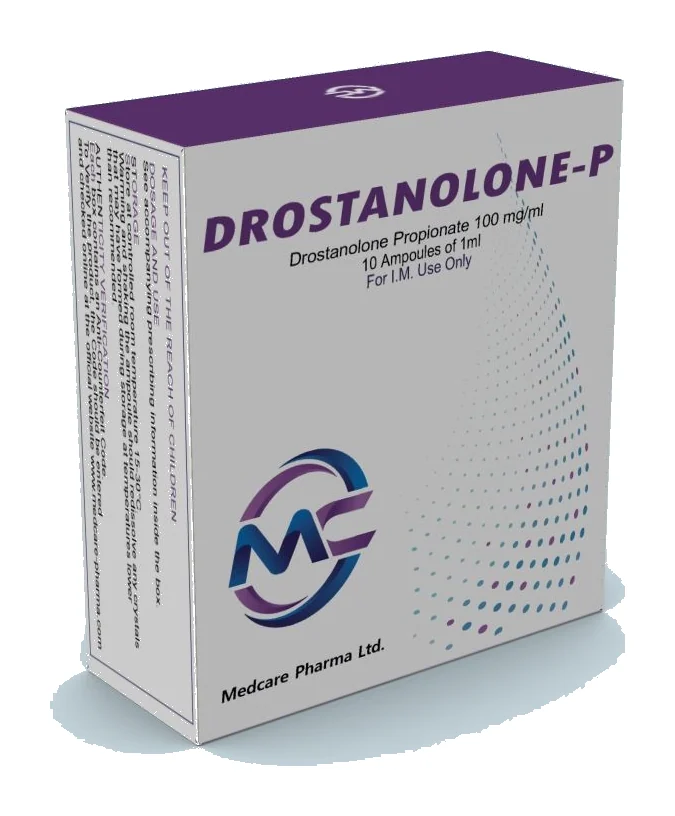
The preparation supplied on this site is described by its manufacturer as an oil-based solution of drostanolone propionate for intramuscular injection, used to promote weight gain following extensive surgery, chronic infection or severe trauma, in other cases resulting in inadequate weight gain or maintenance, to decrease muscle loss caused by corticosteroid treatment, and to reduce bone pain associated with osteoporosis.
Those are the indications printed on the label. This page has now checked what the indexed literature measured against them: eight records, and none of them is a controlled human efficacy trial in any indication. No post-surgical weight gain, no corticosteroid-associated muscle loss, no bone pain, no patient population of any kind. The oldest item in the set is a one-page notice about a different disease entirely.
Reading a label is not the same as reading the evidence behind it. Where the two disagree, the evidence is what this page reports.
What the data do not show
They do not show what drostanolone does to a person who takes it. Not one of the eight records cited here is a controlled human efficacy trial, and none reports a dose, a duration of use, or an outcome measured in a human subject.
They do not show a muscle, strength, fat or recovery outcome. There is no body-composition measurement, no strength test and no imaging anywhere in this set.
They do not show a pharmacokinetic curve. What they show is the reverse: metabolite identity, metabolite quantity, and how many days after the last injection a laboratory can still find the drug or its signature metabolites.
They do not show a safety profile. A list of urinary metabolites is not a safety dataset.
Where this sits on the shelf
The compound as supplied by the manufacturer: Drostanolone Propionate
What we supply
The drostanolone preparation above, as supplied by the manufacturer, tracked, from inside the EU.
Research use only. This page summarises published studies for research reference. It is not medical advice, not a protocol, and not a suggestion for human use. Nothing we supply is for human or veterinary use.
References.
- Liu Y, Lu J, Yang S, et al. New drostanolone metabolites in human urine by liquid chromatography time-of-flight tandem mass spectrometry and their application for doping control. Steroids 2016;108:61-7.
- Albertsdottir AD, Van Gansbeke W, Coppieters G, et al. Searching for new long-term urinary metabolites of metenolone and drostanolone using gas chromatography-mass spectrometry with a focus on non-hydrolysed sulfates. Drug Test Anal 2020;12(8):1041-1053.
- de Boer D, de Jong EG, Maes RA. The methyl-5 alpha-dihydrotestosterones mesterolone and drostanolone; gas chromatographic/mass spectrometric characterization of the urinary metabolites. J Steroid Biochem Mol Biol 1992;42(3-4):411-9.
- Gauthier J, Goudreault D, Poirier D, et al. Identification of drostanolone and 17-methyldrostanolone metabolites produced by cryopreserved human hepatocytes. Steroids 2009;74(3):306-14.
- Ballard CL, Wood RI. Intracerebroventricular self-administration of commonly abused anabolic-androgenic steroids in male hamsters (Mesocricetus auratus): nandrolone, drostanolone, oxymetholone, and stanozolol. Behav Neurosci 2005;119(3):752-8.
- Borodi G, Turza A, Bende A. Exploring the Polymorphism of Drostanolone Propionate. Molecules 2020;25(6):1436.
- Hussain Z, Atia-Tul-Wahab, Hussain N, et al. Seven new metabolites of drostanolone heptanoate by using Beauveria bassiana, and Macrophomina phaseolina cell suspension cultures. RSC Adv 2019;10(1):451-460.
- Drostanolone and norethisterone in disseminated breast cancer. Drug Ther Bull 1969;7(3):10-1. A one-page bulletin notice; no abstract is indexed in PubMed and no figure is quoted from it here.
10% off every product in your first order
Join the list for your welcome code plus early access to new research arrivals. No spam — unsubscribe anytime.