Oxymetholone: 3 kg of weight gain against 1 kg on placebo, and a liver enzyme warning attached to it
The phase III trial in HIV wasting randomised 89 people and found weight gain of 3.5 kg on 100 mg daily against 1.0 kg on placebo over 16 weeks, with 25 to 43 percent of treated patients showing liver enzyme rises above five times baseline. This page reads that trial, the dialysis trial, and the Cochrane review that says the evidence is insufficient.
19 October 2026 · 5 min read
 Oxymetholone
 is a 17-alpha-alkylated oral androgen, and it has the largest human trial record of the muscle-building steroids on this site — not because it was studied for muscle building, but because for about two decades it was a treatment for wasting. Those trials are worth reading carefully, because they describe a compound that does something measurable and pays for it in liver enzymes.
The trial that is cited everywhere
Two papers from 2003 report the same phase III programme. The randomised part assigned 89 HIV-positive eugonadal women and men with wasting to oxymetholone at 50 mg twice daily, 50 mg three times daily, or placebo for 16 weeks, followed by open-label treatment.
The weight result is clean. Oxymetholone produced significant weight gain of 3.0 ± 0.5 kg in the three-times-daily group and 3.5 ± 0.7 kg in the twice-daily group, each P < 0.05 against placebo, while the placebo group gained 1.0 ± 0.7 kg. Body cell mass rose 3.8 ± 0.4 kg in the twice-daily arm (P < 0.0001) and 2.1 ± 0.6 kg in the three-times-daily arm (P < 0.005), corresponding to 12.4% and 7.4% of baseline body cell mass. Patients reported improvements in appetite and food intake, increased wellbeing and reduced weakness.
The two regimens produced comparable benefit, and the authors concluded that the 100 mg per day regimen was equally effective as the 150 mg one while carrying less — but still significant — liver toxicity.
The number that should travel with it
The liver signal is in the same abstracts as the weight gain, and it is not subtle. In the HIV Clin Trials report, 43% of the three-times-daily group, 25% of the twice-daily group and 8% of the placebo group had a greater than five-fold baseline increase in ALT, AST or gamma GT. The AIDS report puts the same finding slightly differently, at 35% of the three-times-daily group, 27% of the twice-daily group and none on placebo for alanine aminotransferase alone during the double-blind phase. The paper’s own summary is that the most important adverse event was liver-associated toxicity.
Read next to the weight numbers, the message is simple: the drug did its main job and it had the toxicity that 17-alpha-alkylated oral androgens are known for.
A second randomised trial, in dialysis
The 2009 randomised, controlled, double-blind study in maintenance haemodialysis patients assigned 44 people to oxymetholone 50 mg twice daily or placebo for 24 weeks. After treatment, the HOMA index and body fat mass fell more in the treatment group (10.8 ± 16.4 against 3.1 ± 4.5, p < 0.05; and 1.73 ± 2.77 against 0.40 ± 1.12 kg, p < 0.05), and the change in fat-free mass was higher than control (3.24 ± 1.74 against 0.65 ± 1.21 kg, p < 0.05). Two patients in the treatment group had raised serum liver enzymes.
It is a small trial in a specific population, and it is the only randomised evidence on metabolic endpoints.
What the systematic reviews conclude
The 2014 Cochrane review of androgens for anaemia of chronic kidney disease in adults is the right anchor, because it is the one that looked for evidence and graded it. It included eight studies with 181 participants in total, rated quality moderate in six, low in one and high in one.
The oxymetholone part of it rests on a single study with 24 participants. That study reported increases in haemoglobin (MD 1.90 g/dL, 95% CI 1.66 to 2.14) and haematocrit (MD 27.10%, 26.49 to 27.71) — and, in the same breath, an increase in ALT (MD 54.50 U/L, 43.94 to 65.06) and AST (MD 47.33 U/L, 37.69 to 56.97), and a fall in HDL (MD −15.66 mg/dL, 24.84 to 6.48). Oxymetholone did not reduce blood urea nitrogen, creatinine, cholesterol or triglycerides. The review’s authors’ conclusion is unambiguous: insufficient evidence to confirm that androgens are beneficial for anaemia in adults with chronic kidney disease.
For the haematology crowd the same conclusion arrives from another direction. The 2014 review of anaemia in myelofibrosis states that none of the available treatments, including androgens, has been tested in large randomised controlled trials.
The other indication, and why it faded
In 1992 a prospective randomised aplastic anaemia trial compared antithymocyte globulin with lower-dose versus higher-dose methylprednisolone, both arms including oxymetholone. Among 64 evaluable patients, 12 of 33 (36%) on the lower dose responded versus 15 of 31 (48%) on the higher dose (P = .33), and actuarial four-year survival was 43% against 47% (P = .99). The authors could show no significant difference in toxicity, response rate or survival — so the trial is evidence about the steroid, not about oxymetholone.
The critical illness story is a good example of a plausible idea that has not landed. The 2001 chapter lays out the physiology — serum testosterone falls to pre-pubertal levels through reduced gonadotropin secretion and reduced Leydig cell response, while oestrogen rises through increased peripheral aromatisation — and sets out two opposing lines of evidence: one arguing for administering anabolic steroids to improve the catabolic state, another suggesting in animal models that testosterone may suppress the immune system and myocardial function.
What the data do not show
They do not show oxymetholone building muscle in healthy people. Every trial on this page studied wasting, anaemia, dialysis or aplastic anaemia. No abstract cited here reports a strength, power or lean-mass outcome in a healthy or training population.
They do not show a clean liver profile. Between a quarter and a third of treated patients in the phase III trial exceeded five times baseline in liver enzymes.
They do not show a benefit for anaemia of kidney disease. The Cochrane review’s verdict is insufficient evidence, and the entire oxymetholone signal in it comes from 24 participants.
They do not show a mortality or outcomes trial in critical illness. The catabolic-state hypothesis remains a hypothesis in that literature.
Where this sits on the shelf
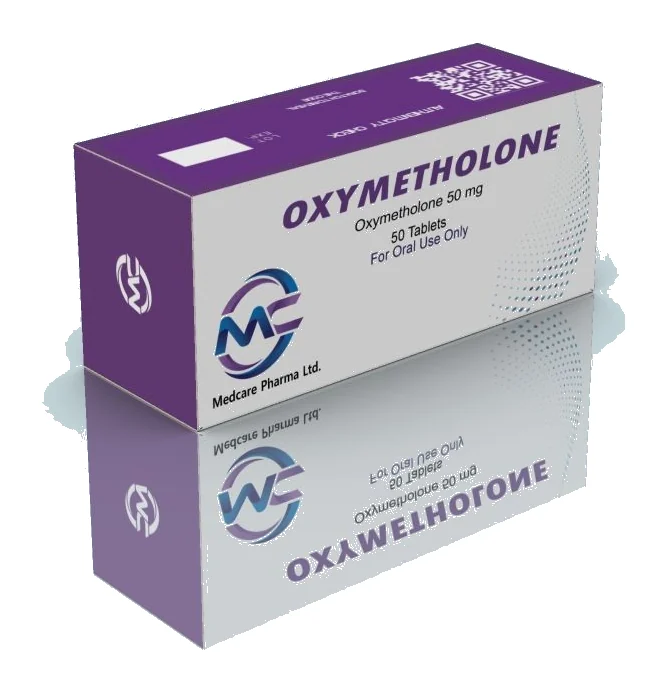
The compound as supplied by the manufacturer: Oxymetholone
What we supply
The oxymetholone preparation above, as supplied by the manufacturer, tracked, from inside the EU.
Research use only. This page summarises published studies for research reference. It is not medical advice, not a protocol, and not a suggestion for human use. Nothing we supply is for human or veterinary use.
References.
- Hengge UR, et al. Oxymetholone for the treatment of HIV-wasting: a double-blind, randomized, placebo-controlled phase III trial in eugonadal men and women. HIV Clin Trials 2003;4(3):150-163.
- Hengge UR, et al. Double-blind, randomized, placebo-controlled phase III trial of oxymetholone for the treatment of HIV wasting. AIDS 2003;17(5):699-710.
- Aramwit P, et al. Oxymetholone ameliorates insulin sensitivity in maintenance hemodialysis patients: a randomized controlled trial. Clin Nephrol 2009;71(4):413-422.
- Yang Q, et al. Androgens for the anaemia of chronic kidney disease in adults. Cochrane Database Syst Rev 2014;(10):CD006881.
- Doney K, et al. Immunosuppressive therapy of aplastic anemia: results of a prospective, randomized trial of antithymocyte globulin, methylprednisolone, and oxymetholone. Blood 1992;79(10):2566-2571.
- Spratt DI, et al. Altered gonadal steroidogenesis in critical illness: is treatment with anabolic steroids indicated? Best Pract Res Clin Endocrinol Metab 2001;15(4):479-494.
- Birgegard G. Does anything work for anaemia in myelofibrosis? Best Pract Res Clin Haematol 2014;27(2):175-185.
10% off every product in your first order
Join the list for your welcome code plus early access to new research arrivals. No spam — unsubscribe anytime.