Resveratrol and the trials: small effects in people, large effects in rats
The umbrella of 19 meta-analyses covering 81 randomised trials puts the BMI effect at ES -0.119 and the body weight effect at nothing. In rats, the pooled infarct-volume effect is SMD -2.88. This page puts the human numbers and the animal numbers side by side, and then the bioavailability meta-analysis that explains the gap.
18 October 2026 · 5 min read
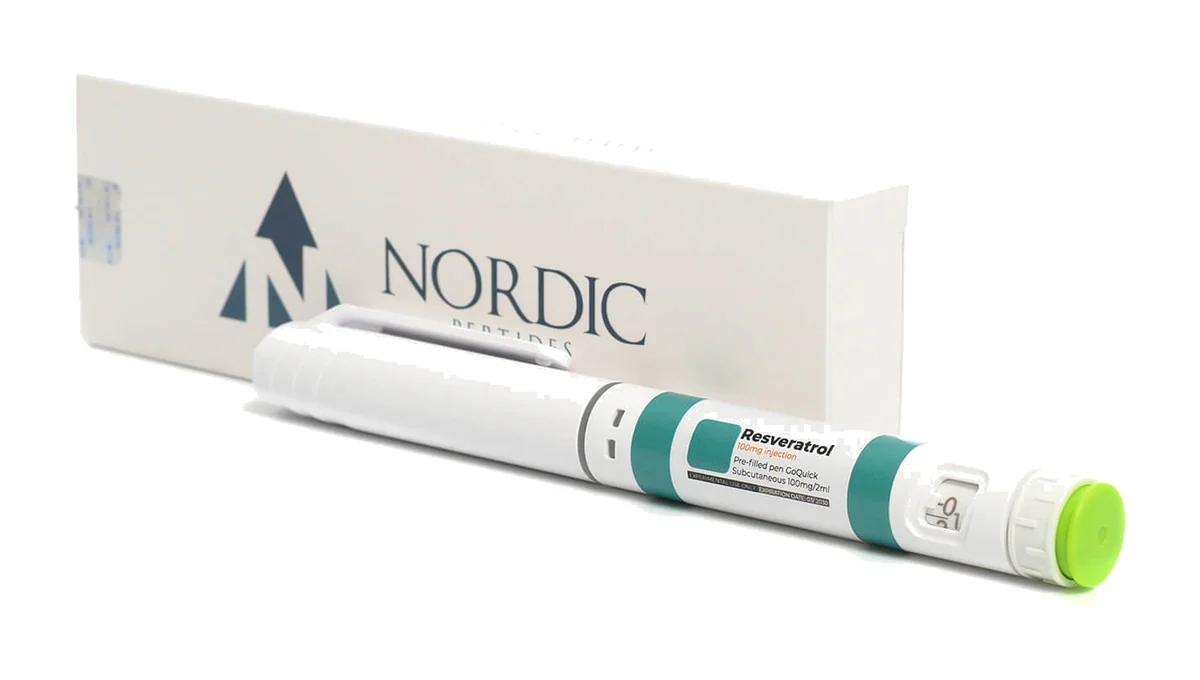 Resveratrol - 100mg/2ml
Resveratrol is the polyphenol in red grapes that made it famous, and it is the clearest example in nutrition literature of a compound whose animal results are spectacular and whose human results are small. That is not a rhetorical framing. The numbers below are taken from pooled analyses on both sides, and they are not the same size by roughly two orders of magnitude.
What the human pooling found
The 2024 umbrella meta-analysis is the widest human summary on anthropometry and inflammation: 19 meta-analyses covering 81 unique randomised trials with 4,088 participants. Resveratrol supplementation reduced BMI by ES −0.119 (95% CI −0.192 to −0.047), waist circumference by ES −0.405 (95% CI −0.664 to −0.147), C-reactive protein by ES −0.390 (95% CI −0.474 to −0.306) and TNF-alpha by ES −0.455 (95% CI −0.592 to −0.318). Body weight and interleukin-6 were not significantly affected. The weight effect appeared only in trials running at least 12 weeks (ES −0.160) and in trials using at least 500 mg per day (ES −0.130).
An ES of −0.119 on BMI is the number to hold on to. That is what a real but small effect looks like in pooled trial data.
The 2021 obesity-specific review is blunter. Nineteen studies, of which the authors say only three demonstrated any positive effect at all: no significant effect on weight (SMD 0.03, 95% CI −0.44 to 0.49, I² = 82%) or BMI (SMD 0.01, 95% CI −0.39 to 0.41, I² = 72%), with a small effect on waist circumference (SMD −1.04, 95% CI −1.86 to −0.27, I² = 87%). The conclusion line is: supplementation with resveratrol does not have an anti-obesity effect.
The lipid umbrella agrees, and adds the sentence most summaries leave out. Resveratrol reduced triglycerides (SMD −0.14) and total cholesterol (SMD −0.20) but not HDL (SMD 0.00) or LDL (SMD −0.16, 95% CI −0.40 to 0.07). The authors’ own judgement: these significant decreases are not clinically important, so resveratrol can only be considered an adjunctive approach in managing dyslipidaemia.
The glycaemic literature is the mirror image — real but modest. A systematic review of 32 studies found glucose down 5.24 mg/dL and insulin down 1.23 mIU/L, with HbA1c and HOMA-IR unchanged. Sub-analysis by amount put the glucose effect at 500–1,000 mg per day and the insulin effect both below 500 and above 1,000 mg per day, which is the shape of a heterogeneous literature rather than a clean dose-response.
The single best human trial on this page
The 2022 randomised double-blind placebo-controlled parallel-group trial randomised 110 people with type 2 diabetes on oral hypoglycaemics to resveratrol 200 mg daily or cellulose for 24 weeks; 94 completed, 45 on resveratrol and 46 on placebo. At 24 weeks resveratrol significantly reduced plasma glucose (−0.50, 95% CI −0.94 to −0.06), insulin (−1.31, −2.24 to −0.38), HOMA-IR (−0.83, −1.37 to −0.29), malondialdehyde (−0.36, −0.61 to −0.11), high-sensitivity CRP (−0.35, −0.70 to −0.01), TNF-alpha (−1.25, −1.90 to −0.61) and IL-6 (−1.99, −3.29 to −0.69). No side effects were reported during the trial.
That is a well-constructed trial with a coherent direction across metabolic, oxidative and inflammatory markers. It is also one trial with 94 completers, and a single 200 mg daily amount for half a year.
What the animal pooling found
The 2022 cerebral ischaemia/reperfusion meta-analysis pooled 41 rat studies. Resveratrol reduced cerebral infarct volume across 29 studies at SMD −2.88 (95% CI −3.23 to −2.53, p < 0.00001) and improved neurological function at SMD −1.96 across 15 studies. The paper itself notes that only a few of the included studies had relatively low methodological quality and that publication bias cannot be ignored.
The myocardial meta-analysis is smaller but similarly framed as pre-clinical: 10 in vivo and 7 ex vivo studies with 261 animals in total, 130 on resveratrol. Infarct size fell by a weighted mean difference of −13.42 (95% CI −16.63 to −10.21) in vivo. The authors are explicit about what is missing: studies with large animals or randomised controlled trials would add more evidence and provide the rationale for clinical use.
An SMD of −2.88 in rats against an ES of −0.119 on BMI in humans is the whole story of this compound in one line.
Why the gap exists
The 2025 bioavailability meta-analysis examined 84 oral administrations across nine resveratrol amounts from 25 to 5,000 mg in clinical trials. The mean maximum plasma concentration across all of them was 31.07 ng/mL — and the mean Cmax in the group taking 100 to 500 mg was 33.59 ng/mL. In other words, going from the smallest studied amount to the largest did not produce meaningfully more resveratrol in the blood. The meta-analysis also attributes conclusions to methodological inconsistencies across studies and substantial heterogeneity, and it treats the 100–500 mg band as the appropriate choice on the basis of that flat curve plus a low side-effect risk.
The honest reading: raising the amount does not raise the exposure, so the flat dose-response in the human trials is not evidence that a higher amount failed to work. It is evidence that more resveratrol never arrived.
The endpoints where nothing moved
Two syntheses are worth quoting for the endpoints that stayed flat. The postmenopausal meta-analysis pooled 10 randomised trials with 928 participants: pain scores improved (WMD −2.841), as did pain on visual analogue scale (−7.585) and a bone turnover marker (CTX −0.137), but there were no significant effects on cognition and memory, mood, metabolic parameters, blood pressure, sleep disturbance, menopausal symptoms, quality of life, or the bone markers ALP and osteocalcin.
The endothelial meta-analysis pooled 21 arms from 17 studies: flow-mediated dilation moved +1.43% (95% CI 0.98 to 1.88) and ICAM-1 fell 7.09 ng/mL, while VCAM-1, fibrinogen and PAI-1 did not change significantly.
What the data do not show
They do not show a body weight effect. The obesity-specific meta-analysis found none, and the umbrella found none overall.
They do not show a clinically important lipid change, by the authors’ own statement.
They do not show that anything found in rats happened in people. The animal effect sizes are an order of magnitude larger, in the opposite direction of translation, and the animal papers say the large-animal and randomised work is still missing.
They do not show that more resveratrol helps. The bioavailability pooling says the exposure curve is flat between 25 and 5,000 mg.
Resveratrol turns up on the NAD, NMN and nicotinamide page only as one ingredient inside a blend. It has a page of its own here, and the two do not share a human record: the pooling above is resveratrol, and the metabolite work over there is not.
Where this sits on the shelf
The compound as supplied by the manufacturer: Resveratrol
What we supply
The resveratrol preparation above, as supplied by the manufacturer, tracked, from inside the EU.
Research use only. This page summarises published studies for research reference. It is not medical advice, not a protocol, and not a suggestion for human use. Nothing we supply is for human or veterinary use.
References.
- Molani-Gol R, et al. Effects of resveratrol on the anthropometric indices and inflammatory markers: an umbrella meta-analysis. Eur J Nutr 2024;63(4):1023-1040.
- Li Z, et al. Efficacy of resveratrol supplementation on lipid profile parameters: An umbrella of meta-analysis. Prostaglandins Other Lipid Mediat 2024;175:106903.
- Delpino FM, et al. What is the effect of resveratrol on obesity? A systematic review and meta-analysis. Clin Nutr ESPEN 2021;41:59-67.
- Garcia-Martinez BI, et al. Hypoglycemic Effect of Resveratrol: A Systematic Review and Meta-Analysis. Antioxidants (Basel) 2021;10(1).
- Mahjabeen W, et al. Role of resveratrol supplementation in regulation of glucose hemostasis, inflammation and oxidative stress in patients with diabetes mellitus type 2: A randomized, placebo-controlled trial. Complement Ther Med 2022;66:102819.
- Szymkowiak I, et al. Resveratrol Bioavailability After Oral Administration: A Meta-Analysis of Clinical Trial Data. Phytother Res 2025;39(1):453-464.
- Xue R, et al. A meta-analysis of resveratrol protects against cerebral ischemia/reperfusion injury: Evidence from rats studies. Front Pharmacol 2022;13:988836.
- Mao ZJ, et al. A Meta-Analysis of Resveratrol Protects against Myocardial Ischemia/Reperfusion Injury: Evidence from Small Animal Studies. Oxid Med Cell Longev 2019;2019:5793867.
- Wu W, et al. Effects of resveratrol on postmenopausal women: a systematic review and meta-analysis. Front Pharmacol 2025;16:1588284.
- Mohammadipoor N, et al. Resveratrol supplementation efficiently improves endothelial health: A systematic review and meta-analysis of randomized controlled trials. Phytother Res 2022;36(9):3529-3539.
10% off every product in your first order
Join the list for your welcome code plus early access to new research arrivals. No spam — unsubscribe anytime.