Methandienone: what three trials measured
Three double-blind crossover trials — 1975, 1976 and a 1981 repeat — gave 100 mg/day of methandienone to 11 athletic men and to 7 weightlifters, for six weeks each. Both 100 mg trials found weight gain — 3.3 kg and 2.3 kg — but the repeat trial measured total body nitrogen and concluded the gain was not normal muscle. This page reports the numbers and the authors' own interpretation.
20 October 2026 · 4 min read
 Methandienone
Almost every claim about “Dianabol” traces back to three trials run between 1975 and 1981 by two groups. They are small, they are old, and they are unusually honest about what they found. The most quoted line in the anabolic-steroid literature — that the weight is water, not muscle — is not folklore; it is the conclusion the trial authors reached themselves, by measuring body nitrogen.
The 1976 trial: 11 men, 100 mg a day
Hervey and colleagues in The Lancet gave methandienone to 11 athletic men during a course of weight training, in a double-blind crossover design, at 100 mg/day for 6 weeks, against a placebo period. Body weight and composition, muscular strength and performance, and endocrine indices were measured.
Against the placebo period, subjects on methandienone gained weight (mean 3.3 ± 0.6 kg) and accumulated a disproportionately large amount of potassium (420 ± 68 mmol). The weight gain was confined to the lean part of the body and the muscles increased in size. Strength and performance improved over each training period, but not significantly differently on drug and placebo.
The endocrine side of the same experiment points the other way. On the drug, plasma cortisol concentration and urinary cortisol excretion increased, and plasma testosterone decreased.
Then the sentence that ended the debate in the authors’ own words: although the weight and body-composition changes may demonstrate an anabolic action, they may alternatively have been caused by an increase in intracellular fluid, and the question of anabolic action therefore remains open.
The 1981 repeat, which actually measured the thing in dispute
Five years later the same group answered its own question. The trial was repeated in seven male weightlifters in regular training, this time with total body nitrogen measurement, on the same 100 mg/day methandienone given alternately with placebo, six-week treatment periods separated by a six-week interval.
Weight, potassium, nitrogen, muscle size, and leg performance and strength increased significantly during training on the drug, but not during the placebo period. So the effect was real, and it was real against a placebo period — this was not a case of training alone.
But the composition numbers refused to support the muscle story. Body potassium rose 436 ± 41 mmol and nitrogen 255 ± 69 g, and the authors’ conclusion is explicit: those increases were too large in proportion to the weight gain of 2.3 ± 0.4 kg to be attributed to gain of normal muscle or other lean tissue, and they imply gain of a nitrogen-rich, phosphate-poor substance. Their final line is the one that has been quoted for fifty years: although this action might be described as anabolic, the weight gain produced is not normal muscle.
The 1975 trial: lower dose, higher dropout
The British group ran a parallel set of experiments. Thirteen experienced male weightlifters on high-protein diets and regular exercise took part in a double-blind crossover trial of methandienone 10 or 25 mg/day.
Their improvements were significantly greater on methandienone than on placebo. Their body weights rose, though this seemed to be associated with water retention. Systolic blood pressure rose significantly. The authors report that methandienone caused many side effects and three men had to withdraw because of them, with all side effects disappearing after the drug was stopped.
That is the tradeoff in one paragraph: measurable performance improvement at 10–25 mg/day, significant blood pressure rise, and three of the thirteen men withdrawing for adverse effects.
Where the drug stands analytically
The 2021 metabolism work from the Berlin group gives the modern analytical context. Metandienone and methyltestosterone are orally active anabolic-androgenic steroids with a 17alpha-methyl structure, prohibited in sports and frequently detected in anti-doping analysis. Following the earlier detection of long-term metabolites in the chlorinated analogue dehydrochloromethyltestosterone, the authors investigated similar metabolites in metandienone and methyltestosterone, synthesising reference compounds and identifying two diastereomeric substances after methyltestosterone administration; in post-administration urines of metandienone only the 5beta-metabolite was detected, and 3alpha,5beta-tetrahydro-epi-methyltestosterone appeared in the urines of both.
Note what that paper is: it is about finding metabolites in urine, not about what the drug does to a person.
What the data do not show
They do not show methandienone producing muscle. Two of the three trials say the weight gain is not normal muscle; the third attributes the rise to water retention.
They do not show a significant performance advantage over placebo in the 100 mg/day trials. The 100 mg/day work found strength and performance improved over each training period but not significantly differently on drug and placebo. The significant performance result comes from the 10–25 mg/day trial, which also produced the blood pressure rise and the withdrawals.
They do not show safety. Cortisol rose, testosterone fell, blood pressure rose, three of thirteen withdrew, and one in three had a liver enzyme rise in the oxymetholone trials on this site — a different compound, but the same structural class.
They do not show a modern dose, a modern population, or a modern outcome. The longest single period on this page is six weeks of treatment, in seven men, in 1981.
Where this sits on the shelf
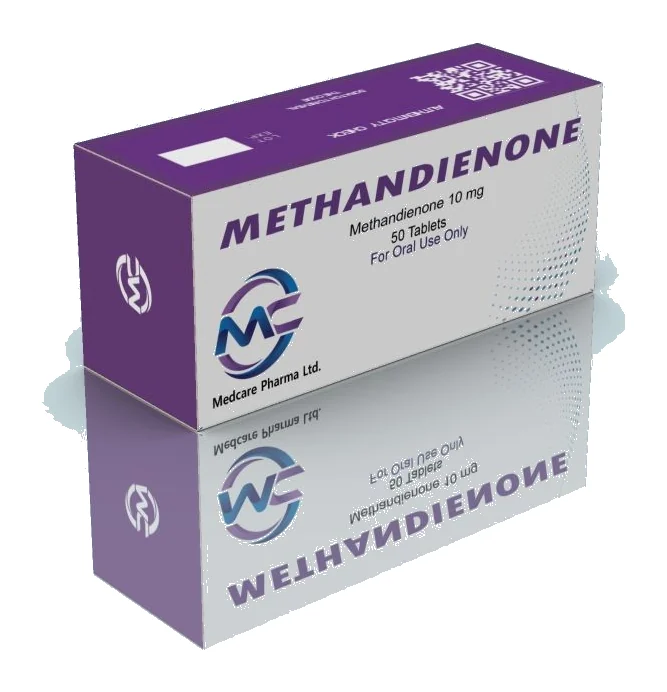
The compound as supplied by the manufacturer: Methandienone
What we supply
The methandienone preparation above, as supplied by the manufacturer, tracked, from inside the EU.
Research use only. This page summarises published studies for research reference. It is not medical advice, not a protocol, and not a suggestion for human use. Nothing we supply is for human or veterinary use.
References.
- Hervey GR, et al. "Anabolic" effects of methandienone in men undergoing athletic training. Lancet 1976;2(7988):699-702.
- Hervey GR, et al. Effects of methandienone on the performance and body composition of men undergoing athletic training. Clin Sci (Lond) 1981;60(4):457-461.
- Freed DL, et al. Anabolic steroids in athletics: crossover double-blind trial on weightlifters. Br Med J 1975;2(5969):471-473.
- Loke S, et al. New Insights into the Metabolism of Methyltestosterone and Metandienone: Detection of Novel A-Ring Reduced Metabolites. Molecules 2021;26(5):1354.
10% off every product in your first order
Join the list for your welcome code plus early access to new research arrivals. No spam — unsubscribe anytime.