Ecdysterone: what the human trials actually found
A 2019 ten-week trial in 46 men reported larger muscle-mass and bench-press gains on ecdysterone. A 2023 matched study found no effect on mass or strength, only lower cortisol. A 2025 study found the capsules held under 1% of the labelled dose. All three papers, and what they add up to.
2 October 2026 · 4 min read
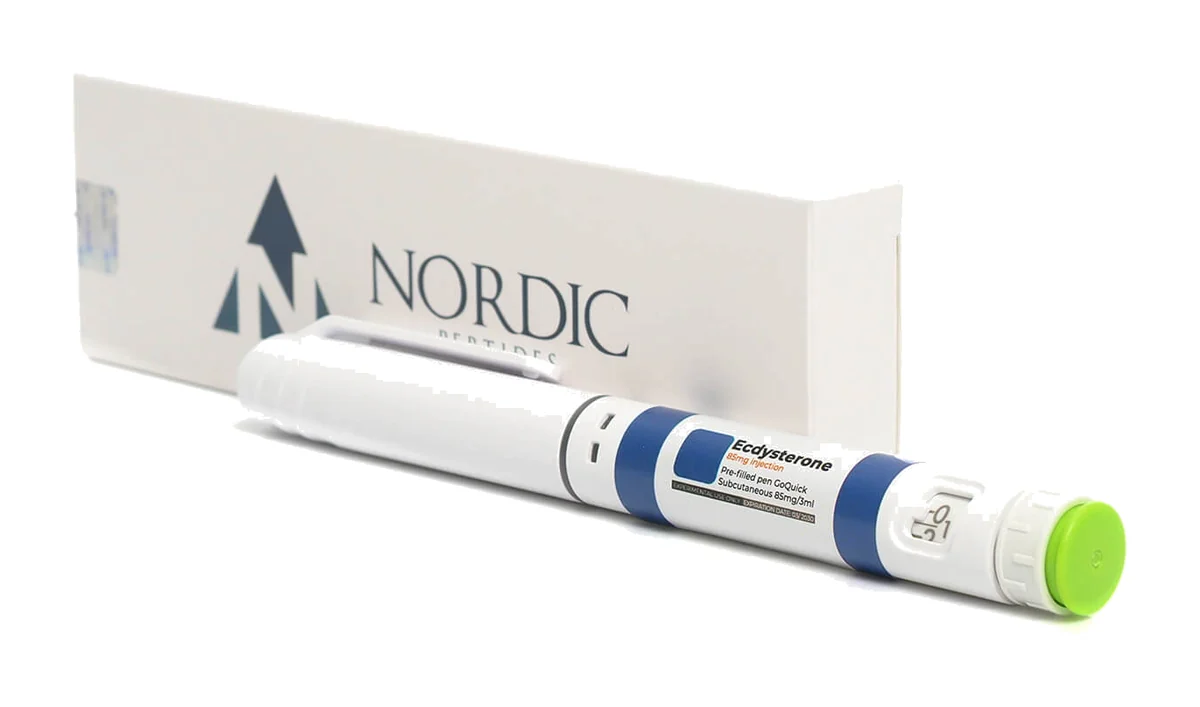 Ecdysterone - 50mg/3ml
Ecdysterone sells on the back of a claim that is stronger than its evidence: that it is an anabolic steroid that is not on the prohibited list. The human record is three studies, and they do not agree with each other. Two of them failed to reproduce the first. The third failed for a reason that has nothing to do with the molecule: the capsules were not what the label said.
This page goes through all three in order, because the sequence is the story.
The 2019 trial that started the reputation
Isenmann and colleagues ran the study that still gets cited: a ten-week strength-training intervention in 46 young men, split across several ecdysterone-containing supplement doses, with blood and urine sampled throughout, a full screen for prohibited substances on the participants, and the supplement itself tested for anabolic steroid contamination before it was handed out. The reported findings were larger muscle-mass increases in the dosed groups, and more pronounced increases in one-repetition bench-press performance. Hypertrophic effects showed up in C2C12 myotubes in vitro, and no rise in liver or kidney toxicity biomarkers.
It is careful work, and the authors are unusually careful with it. Their own conclusion is that the results argue for ecdysterone’s addition to the prohibited list in class S1.2, other anabolic agents. That framing has not aged well for the marketing side of the compound, but it is what the paper says.
The 2023 study where the effect stopped at the cortisol
Twenty men aged 20.1 years, matched and randomised, double-blind on 30 mg per day of 20-hydroxyecdysone extracted from asparagus, over twelve weeks in total, the last six of them a detraining block. The result reads in two halves, and only one of them is interesting to anyone selling the compound.
During the training block itself: 20-hydroxyecdysone significantly reduced cortisol, and showed no effect on muscle mass, strength, or anabolic hormones. During the detraining block it did something: a smaller percentage drop in bench-press strength relative to fat-free mass, smaller losses in thigh and chest circumference, and lower cortisol again. So the honest reading is that the benefit, if there is one, is about losing less when you stop training. That is a different claim from building more while you train, and it is the claim the market rarely repeats.
The 2025 study where the capsules were the problem
The most recent trial is the one worth knowing about, because it attacks the assumption underneath the other two. Twenty-eight resistance-trained men, randomised, twelve weeks of free-weight training three times a week, half on a commercial 20-hydroxyecdysone and diosgenin product at the label dose, half on placebo. Twenty-four finished.
Squat and bench press one-repetition maximum improved significantly across both arms. So did fat-free mass, muscle mass, fat mass and ultrasound-measured muscle thickness. The authors’ reading is precise: a time effect with no group effect. Training did the work.
Then they opened the capsules. Liquid chromatography with tandem mass spectrometry found less than 1% of the claimed 20-hydroxyecdysone and 10.4% of the claimed diosgenin. In the cell work, no biological activity was detectable at all. Their recommendation is the transferable part: verify actual content, and confirm it in vitro, before treating any phytosteroid result as evidence about phytosteroids.
A fourth paper, for context on why this compound is awkward to test
Anti-doping bodies added ecdysterone to their monitoring programme in 2020, and the reason is pharmacokinetic rather than clinical. A 2023 metabolism study dosed volunteers with 50 mg and identified more than twenty previously undescribed urinary metabolites, alongside large interindividual variation in how much was excreted. A compound whose metabolites are still being mapped is a compound whose long-term record is not settled, in either direction.
What the data do not show
They do not show a replicated effect. The positive muscle-mass and bench-press findings exist in one 2019 study. The 2023 study found nothing on mass or strength during training and something during detraining, in a different design and a smaller group. The 2025 study found nothing, but its capsules contained almost none of the named compound, so its null result is evidence about that product and not about ecdysterone. No trial ran past twelve weeks, none included women or older adults, and none studied anyone with a condition. Nobody has demonstrated that correctly dosed material does for a trained person what the first paper claimed for an unclear dose of an unspecified supplement.
For orientation, the rest of the muscle and performance shelf on this site is built from compounds with a cleaner separation between what was measured and what was sold, covered in the myostatin inhibitor research summary.
What we supply
Ecdysterone as supplied by the manufacturer, factory filled, tracked, from inside the EU. We do not restate a label claim we have not measured, and we do not sell the three studies above as though they were one. Where a batch carries laboratory documentation it is listed on the product page.
Research use only. This page summarises published human trials for research reference. It is not medical advice, not a protocol, and not a suggestion for human use. Nothing we supply is for human or veterinary use.
References.
- Isenmann E, et al. Ecdysteroids as non-conventional anabolic agent: performance enhancement by ecdysterone supplementation in humans. Arch Toxicol 2019;93(7):1807-1816 (PMID 31123801).
- Denben B, et al. Beneficial Effects of Asparagus officinalis Extract Supplementation on Muscle Mass and Strength following Resistance Training and Detraining in Healthy Males. Sports (Basel) 2023;11(9):175 (PMID 37755852).
- Dissemond J, et al. How reliable is the labeling of a commercial phytosteroid product? A 12-week randomized double-blind training study. J Int Soc Sports Nutr 2025;22(1):2540408 (PMID 40781783).
- Piper T, et al. Investigations into the human metabolism of ecdysterone. Drug Test Anal 2023;15(11-12):1503-1520 (PMID 37778393).
Get 10% off your first order
Join the list for your welcome code plus early access to new research arrivals. No spam — unsubscribe anytime.