Elamipretide (SS-31): the trials, including the failure
A small crossover trial saw a signal. The 218-patient phase 3 missed both primary endpoints. A post hoc analysis points at one genotype.
30 September 2026 · 5 min read
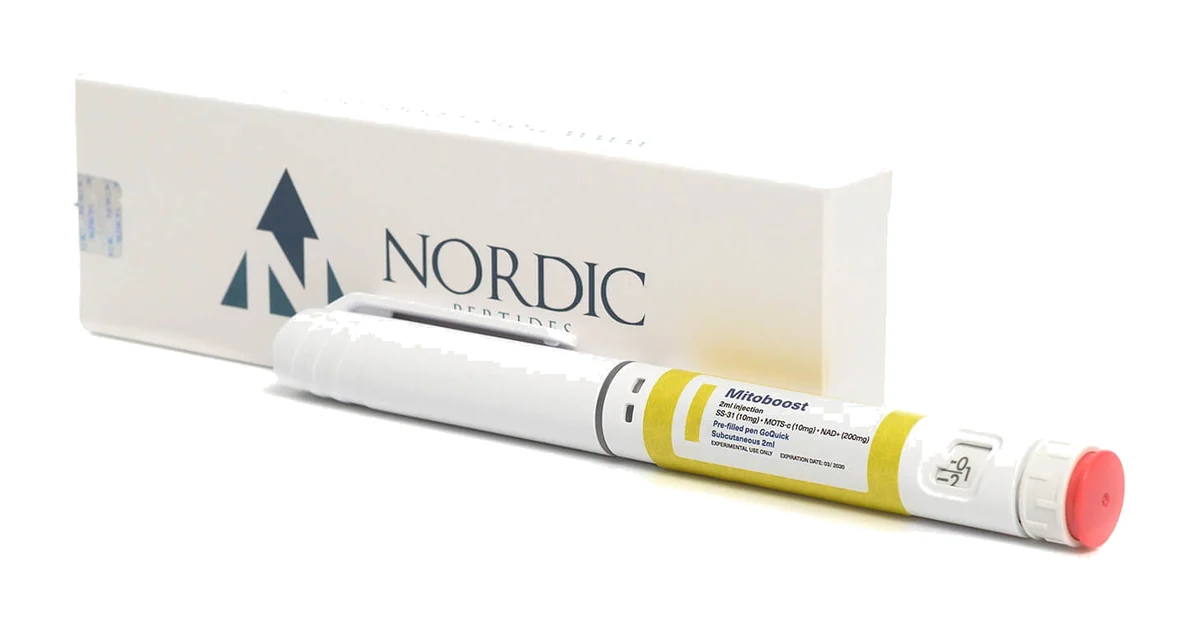 MitoBoost (SS-31 - 10mg + MOTS-c - 10mg + NAD+ - 200mg) - 220mg/2ml
One blend in the catalog carries an ingredient with a genuine phase 3 record. MitoBoost lists SS-31 alongside MOTS-c and NAD+, and SS-31 is the laboratory name for elamipretide, a tetrapeptide developed specifically to reach mitochondria. The MOTS-c half of that blend has its own page, mostly about mice: the peptide your mitochondria write themselves. This page is about the other half, and it is a different kind of story, because the elamipretide record contains something rare in this catalog: a large trial that said no.
What the molecule is supposed to do
Elamipretide is a small synthetic tetrapeptide, also published as SS-31, MTP-131 and Bendavia. A 2025 review of its structure and mechanism describes the part everyone agrees on: the peptide concentrates in mitochondria and binds cardiolipin, a lipid found almost exclusively in the inner mitochondrial membrane. Cardiolipin holds the respiratory complexes in shape, so stabilizing it should stabilize the cristae folds, lower oxidative stress and support ATP production. Preclinical work reported protective effects in models of heart failure, neurodegeneration, ischemia-reperfusion injury and muscle wasting.
That paragraph is mechanism, not outcome. Mitochondria-targeted chemistry has looked convincing in animals many times before. The question is what happened in people, and there the record is three trials deep.
MMPOWER-2: thirty patients, a signal that missed significance
The first human test that matters was MMPOWER-2, a randomized, double-blind, placebo-controlled crossover trial in 30 adults with genetically confirmed primary mitochondrial myopathy. Each participant received elamipretide under the skin once daily for 4 weeks and placebo for 4 weeks, in random order, separated by a 4-week washout. The primary endpoint was distance walked in 6 minutes.
On the primary endpoint, the drug arm walked 398.3 meters against 378.5 on placebo, a difference of 19.8 meters with a 95% confidence interval from minus 2.8 to plus 42.5 and a p-value of 0.0833. That is not statistically significant, and the authors say so plainly. Nineteen meters would matter to a patient who struggles to cross a street; the trial was too small to tell whether those meters belonged to the drug.
The secondary endpoints told a friendlier story. Total fatigue scores and fatigue-during-activities scores on the myopathy symptom assessment both favored elamipretide, with p-values of 0.0006 and 0.0018. Fatigue on the Neuro-QoL short form improved (p = 0.0115), as did the patient global assessment (p = 0.0421). But the physician global assessment did not reach significance (p = 0.0636), the timed up-and-go test did not move (p = 0.8423), and wrist and hip accelerometry showed nothing (p = 0.9345 and 0.7326). Injection-site reactions affected 80% of treated participants, mostly mild. No serious adverse events and no deaths were reported.
Read honestly, MMPOWER-2 is a split result: patients said they felt less tired, the stopwatch refused to confirm it. It was enough of an efficacy signal to justify a phase 3, which is exactly what it did.
MMPOWER-3: 218 patients, both primary endpoints missed
MMPOWER-3 was the pivotal phase 3: 218 participants randomized one-to-one to elamipretide or placebo, given under the skin once daily, for 24 weeks. Mean age 45.6 years, 64% women, 94% White. Three quarters carried mitochondrial DNA alterations, the rest nuclear DNA defects. At baseline the group walked a mean of 336.7 meters in 6 minutes with a fatigue score of 10.6.
The study did not meet either primary endpoint. The least-squares mean difference on the 6-minute walk from baseline to week 24 was minus 3.2 meters, with a 95% confidence interval from minus 18.7 to plus 12.3. Fatigue did not separate either. Treatment was well tolerated, as in the smaller trial. The evidence classification attached to the paper is the one other sponsors dread: Class I evidence that elamipretide does not improve walking distance or fatigue at 24 weeks compared with placebo in primary mitochondrial myopathy.
This is the paragraph most catalog pages would leave out. It stays in, because it is the largest human dataset on this molecule and it points the wrong way.
The post hoc: one genotype where the numbers move
After a failed phase 3, the standard move is to ask whether the drug worked in somebody. A prespecified subgroup with nuclear DNA variants had already shown a walk-test improvement while the mitochondrial DNA majority showed none, and a 2024 post hoc analysis dug into that split.
Most of the nuclear DNA cohort carried variants in genes that maintain mitochondrial DNA itself, chiefly POLG and TWNK. In that replisome subgroup, the elamipretide arm gained 25.2 meters against 2.0 on placebo, with a p-value of 0.06, trending toward but not reaching significance. In the smaller subset with chronic progressive external ophthalmoplegia, the gain was 37.3 meters against a loss of 8.0 on placebo (p = 0.0024). Higher plasma drug levels correlated weakly with larger walk improvements. The authors present this as the foundation for NuPOWER, a follow-up phase 3 restricted to mitochondrial DNA maintenance disorders.
Post hoc findings are hypothesis generators, not conclusions. This one has a plausible mechanism behind it and a confirmatory trial designed around it, which is the most any failed-trial subgroup can offer. Until NuPOWER reads out, the genotype story is a lead, not a result.
What the data do not show
No trial has tested the finished blend. Every number on this page comes from elamipretide alone, given under the skin once daily to patients with diagnosed mitochondrial disease, and the largest of those trials failed. Nothing here concerns healthy users, nothing concerns oral intake, nothing concerns combinations with MOTS-c or NAD+, and the one positive signal lives in a genetic subgroup most readers will never be tested for. The antioxidant pens page covers the related glutathione record for readers comparing mitochondrial-adjacent options: the antioxidant pens, ingredient by ingredient.
What we supply
MitoBoost, a factory-filled pen listing SS-31 with MOTS-c and NAD+ in its catalog name, shipped as supplied by the manufacturer, tracked, from inside the EU. Readers who want the MOTS-c molecule on its own will find it at MOTS-c. Batch documentation for every product that carries any is explained in how to read a COA.
Research use only. Not for human or veterinary use, and nothing on this page is medical advice.
References.
- Tung C, Varzideh F, Farroni E, et al. Elamipretide: a review of its structure, mechanism of action, and therapeutic potential. Int J Mol Sci 2025;26(2): (PMID 39940712).
- Karaa A, Haas R, Goldstein A, et al. A randomized crossover trial of elamipretide in adults with primary mitochondrial myopathy. J Cachexia Sarcopenia Muscle 2020;11(4) (PMID 32096613).
- Karaa A, Bertini E, Carelli V, et al. Efficacy and safety of elamipretide in individuals with primary mitochondrial myopathy: the MMPOWER-3 randomized clinical trial. Neurology 2023;101(3):e238–e252 (PMID 37268435).
- Karaa A, Bertini E, Carelli V, et al. Genotype-specific effects of elamipretide in patients with primary mitochondrial myopathy: a post hoc analysis of the MMPOWER-3 trial. Orphanet J Rare Dis 2024;19: (PMID 39574155).