GLP-1 weight loss and muscle: what the body-composition trials actually measured
STEP 1 took off 14.9% of body weight in 68 weeks. A SURMOUNT-1 DXA substudy then measured what that kind of loss is made of: roughly 75% fat and 25% lean. The protein and training literature adds the rest of the picture.
1 October 2026 · 4 min read
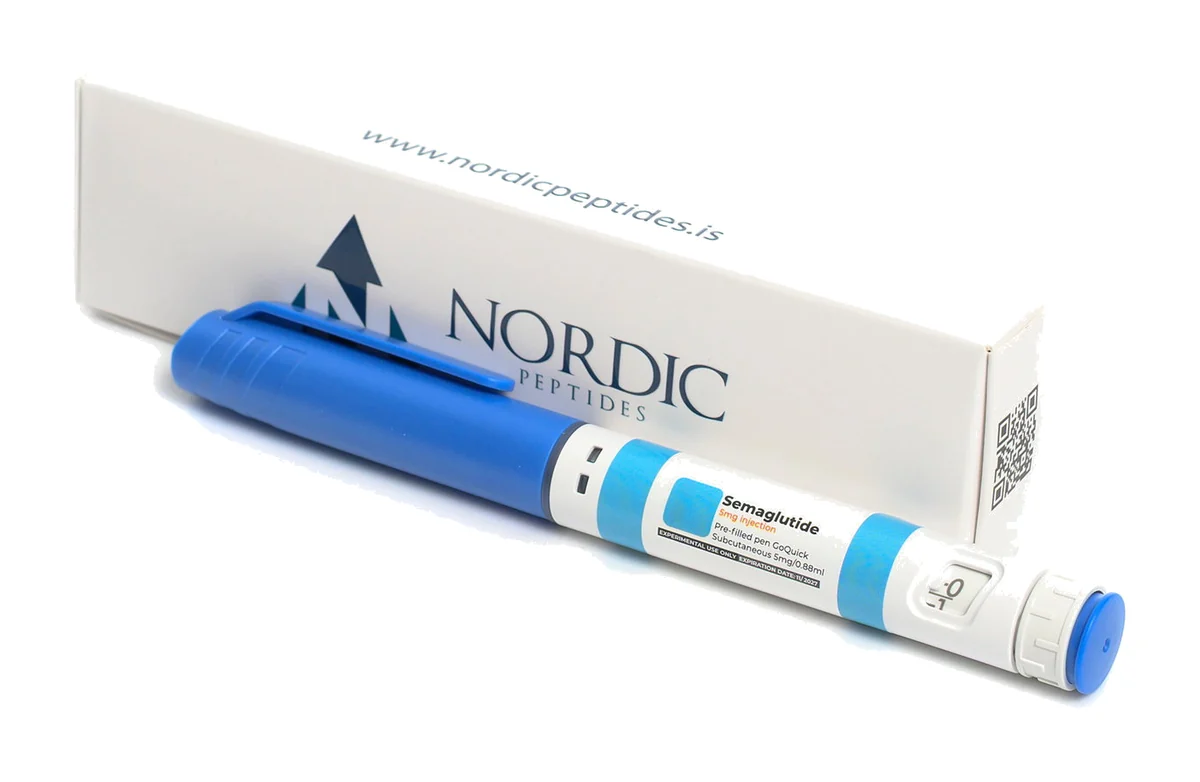 Semaglutide - 5mg
Lose 15% of your body weight and some of it will be lean tissue. That was true long before GLP-1 drugs existed, and it is still true on them. The useful question is not whether lean mass moves. It is how much of the loss it accounts for, and what the older literature says about shrinking that share. Two trial programmes and two reviews answer those questions in order. The preparations on this page are Semaglutide and Tirzepatide. What follows is the published record, nothing else.
STEP 1 set the scale of the loss
STEP 1 randomised 1,961 adults with overweight or obesity, without diabetes, to once-weekly semaglutide or placebo alongside lifestyle intervention for 68 weeks, and published in the New England Journal of Medicine in 2021.
Mean weight change was −14.9% on the drug against −2.4% on placebo, or −15.3 kg against −2.6 kg. The threshold figures show how broad the response was: 86.4% of the semaglutide group lost at least 5% of body weight, 69.1% lost at least 10%, and 50.5% lost at least 15%. Placebo sat at 31.5%, 12.0% and 4.9%.
A loss that large forces the composition question. STEP 1 itself did not answer it with scans. The tirzepatide programme later did.
SURMOUNT-1 measured the mix: about three parts fat, one part lean
Look and colleagues ran a dual-energy X-ray absorptiometry substudy inside SURMOUNT-1. Of the 2,539 trial participants, 160 had DXA scans at baseline and at week 72: 124 on pooled tirzepatide doses and 36 on placebo. The group was 73% female with a mean weight of 102.5 kg and a mean body mass index of 38.0.
From baseline to week 72, the tirzepatide group lost 21.3% of body weight, 33.9% of fat mass and 10.9% of lean mass. Placebo lost 5.3%, 8.2% and 2.6%. Of the weight lost, approximately 75% was fat mass and 25% was lean mass on tirzepatide, and the same split held on placebo. Subgroup cuts by sex, age and size of weight loss left the proportions roughly unchanged.
That symmetry is the finding. The drug group lost far more absolute tissue, lean included, but the ratio of fat to lean in the loss looked like ordinary diet-induced loss, not a selective muscle burn. For the full SURMOUNT record this substudy sits inside, see what the SURMOUNT programme showed.
Protein above the RDA kept fractions of a kilo of lean mass
Hudson and colleagues pooled the protein trials in 2020: 18 randomised, controlled, parallel studies and 22 comparisons of lean mass change in healthy adults, pitting protein intakes above the recommended daily allowance of 0.8 g per kg per day against intakes at the allowance.
Across all comparisons, the higher intake improved lean mass change by a weighted mean difference of 0.32 kg. In the energy-restriction subgroup of 14 comparisons, the difference was 0.36 kg toward preserved lean mass. In the resistance-training subgroup of 3 comparisons, it was 0.77 kg toward gained lean mass. With neither restriction nor training, 7 comparisons showed no difference at all.
Fractions of a kilo are small numbers. They are also the only numbers of their kind: the best available estimate of what extra protein buys during a diet, averaged across the trials that tested it.
Training cut the share of loss that came from lean tissue
Weinheimer and colleagues reviewed 52 studies of energy restriction, exercise, or both in overweight and obese adults aged 50 and over. The reporting format is worth keeping: the share of study groups in which at least 15% of the weight lost was fat-free mass.
Eighty-one percent of the restriction-only groups crossed that line. Thirty-nine percent of the combined restriction-plus-exercise groups did. Exercise in these studies was mainly aerobic training, not heavy resistance work, and the weight and lean changes in the exercise-only groups were modest. The authors read the gap as evidence that exercise helps preserve fat-free mass during moderate diet-induced loss in this age band.
What the data do not show
A single trial combining a GLP-1 drug with a set protein intake or a set training programme. Every protein and training figure above comes from diet-and-exercise literature, and none of it was measured in people taking semaglutide or tirzepatide. DXA lean mass is a scan compartment, not strength, not function, not muscle biopsies. And the 25% lean share in the DXA substudy matched placebo, which cuts two ways: no evidence of a drug-specific muscle burn, and no evidence the drug spares muscle either. Anything about amounts, menus or programmes is not in these papers.
What we supply
Semaglutide and Tirzepatide, as supplied by the manufacturer, tracked, from inside the EU. Batch documentation for every product that carries any is explained in the COA guide linked from the product page.
Research use only. Not for human or veterinary use, and nothing on this page is medical advice.
References.
- Wilding JPH, Batterham RL, Calanna S, et al. Once-Weekly Semaglutide in Adults with Overweight or Obesity (STEP 1). N Engl J Med 2021;384(11):989-1002 (PMID 33567185).
- Look M, Dunn JP, Kushner RF, et al. Body composition changes during weight reduction with tirzepatide in the SURMOUNT-1 study of adults with obesity or overweight. Diabetes Obes Metab 2025;27(5):2720-2729 (PMID 39996356).
- Hudson JL, Wang Y, Bergia RE 3rd, Campbell WW. Protein Intake Greater than the RDA Differentially Influences Whole-Body Lean Mass Responses to Purposeful Catabolic and Anabolic Stressors: A Systematic Review and Meta-analysis. Adv Nutr 2020;11(3):548-558 (PMID 31794597).
- Weinheimer EM, Sands LP, Campbell WW. A systematic review of the separate and combined effects of energy restriction and exercise on fat-free mass in middle-aged and older adults. Nutr Rev 2010;68(7):375-388 (PMID 20591106).