HCG and enclomiphene: what the fertility trials actually studied
Two compounds, four published studies, and a hard boundary: the literature describes what was measured in enrolled patients — intratesticular testosterone, sperm counts, pregnancies — not a protocol for anyone else. This article stays on the published side of that line.
28 September 2026 · 4 min read
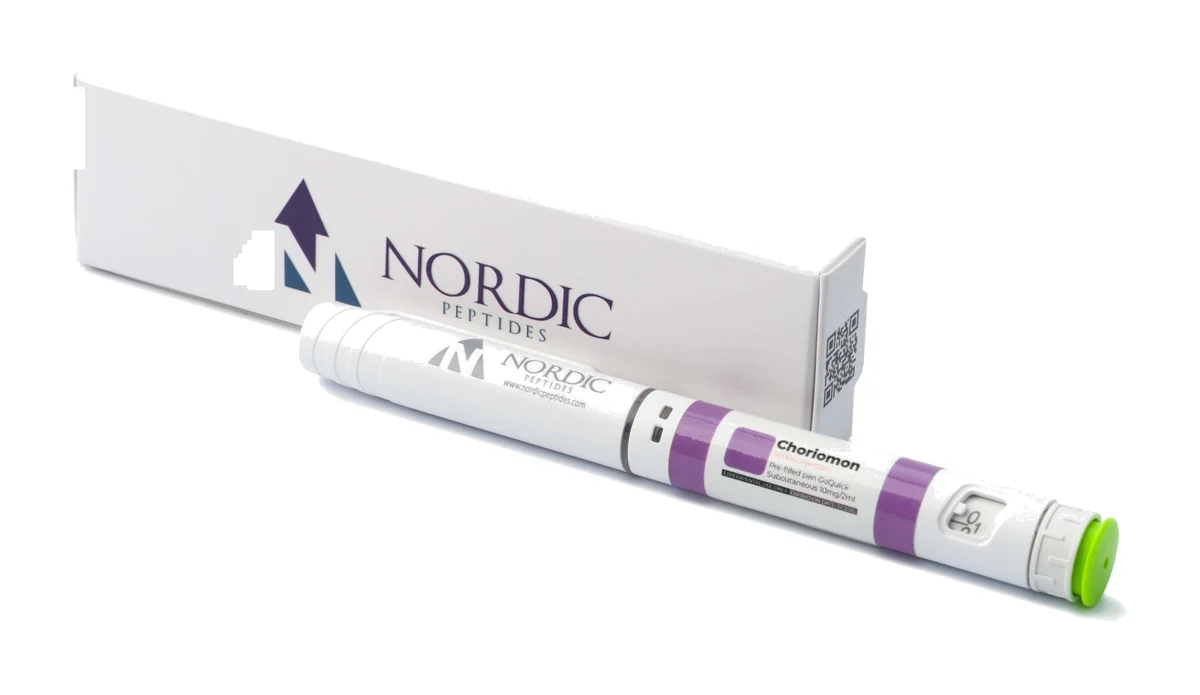 HCG Choriomon 5000 IU
“HCG” and “enclomiphene” are among the most searched terms in this catalog, and the pages ranking for them mostly describe use protocols. This one does not. It describes four published studies — who was enrolled, what was measured, what was found — and stops where the papers stop. Anything beyond that is not in the literature cited here.
Why these two belong together
Exogenous testosterone suppresses the hypothalamic–pituitary–gonadal axis: LH and FSH fall, intratesticular testosterone collapses, and spermatogenesis with it — azoospermia in about 40% of patients on replacement therapy. The two compounds on this page intervene at opposite ends of that problem. HCG acts downstream, as an LH analogue at the testis, keeping intratesticular testosterone up while the pituitary is suppressed. Enclomiphene acts upstream, as an estrogen-receptor antagonist at the hypothalamus and pituitary, restoring the body’s own LH and FSH signal. Same axis, opposite directions — which is why the trials read as complements, not competitors.
HCG: the dose-response study
Coviello et al. (JCEM 2005) is the cleanest experiment in this set. Twenty-nine men with normal reproductive physiology received 200 mg testosterone enanthate weekly — enough to suppress LH to 5% and FSH to 3% of baseline — plus saline placebo or HCG at 125, 250, or 500 IU every other day for three weeks. Intratesticular testosterone was measured directly, by percutaneous fine-needle aspiration.
The numbers: baseline serum testosterone was 1.2% of intratesticular levels (14.1 against 1174 nmol/L) — the testis normally bathes in concentrations two orders of magnitude above blood. Suppression cut intratesticular testosterone 94%, from 1234 to 72 nmol/L. HCG restored it dose-linearly (P<0.001): 125 IU left it 25% below baseline, 250 IU left it 7% below — within the normal range — and 500 IU pushed it 26% above.
The authors’ framing matters: this was designed to find the minimum dose maintaining normal intratesticular testosterone as a first step toward determining the threshold needed to maintain spermatogenesis — a threshold the paper explicitly says is still unknown. It is a pharmacology study in 29 suppressed men over three weeks, not a fertility outcome.
HCG alongside replacement: the retrospective
Hsieh et al. (J Urol 2013) is the paper most often invoked for combined use — and the weakest by design, which is stated here because the rest of the internet does not. It is a retrospective records review: 26 hypogonadal men (mean age 35.9) on replacement therapy — 19 injectable, 7 transdermal — with concomitant intramuscular HCG 500 IU every other day, mean follow-up 6.2 months.
Findings: serum testosterone 207.2 vs 1055.5 ng/dl before vs during (P<0.0001); semen parameters unchanged over more than a year of follow-up; no patient became azoospermic; 9 of 26 men contributed to a pregnancy with their partner during follow-up.
Retrospective, uncontrolled, twenty-six men, no randomization, no blinding. It is consistent with the Coviello mechanism and it is not, by itself, proof of anything. Both halves of that sentence belong in any honest citation of it.
Enclomiphene: the isomer and its two trials
Clomiphene citrate as prescribed is a mixture of two diastereoisomers, zuclomiphene and enclomiphene. Enclomiphene is the trans isomer being developed as a standalone compound for secondary male hypogonadism — low testosterone with low or inappropriately normal LH, i.e. a pituitary that can still answer if stimulated. It holds no approval.
Kaminetsky et al. (J Sex Med 2013). A proof-of-principle randomized open-label phase IIB study in 12 men with secondary hypogonadism previously on topical testosterone. After washout, morning total testosterone averaged 165; at 6 months it reached 545 with gel and 525 with enclomiphene (as printed) — similar testosterone, different physiology underneath. Only the enclomiphene group showed increased LH and FSH. Sperm counts rose in seven of seven enclomiphene men at 3 months and six of six at 6 months (75–334 × 10⁶/mL); the gel failed to raise counts above 20 × 10⁶/mL in any of five men at 3 months and in only two of five at 6. Testosterone fell back to pretreatment values one month after stopping.
Wiehle et al. (Fertil Steril 2014). The larger phase II randomized trial (NCT01270841) against 1% topical testosterone gel in men with secondary hypogonadism: enclomiphene raised morning serum testosterone, estradiol and LH comparably to gel, increased FSH and LH, and conserved sperm counts. The authors’ conclusion is the precise claim and its limit in one sentence: the compound reverses the two hallmarks of secondary hypogonadism — low total testosterone and low LH — while preserving sperm production. In enrolled patients, over the trial duration, against that comparator.
What the data do not show
No dosing protocol for anyone reading this — the trial regimens above are descriptions of what enrolled patients received under supervision, not instructions, and this article contains no schedule, titration, or duration guidance. No post-cycle recovery trial exists in this set: “PCT” as practiced online has no randomized study behind it, and none of these papers studied it. The HCG fertility evidence is one retrospective of 26 men; the enclomiphene evidence is two small trials in secondary hypogonadism, a defined diagnosis, not a general population. Long-term safety of enclomiphene is unstudied, and it is unapproved. The spermatogenesis threshold Coviello set out to find remains, twenty years on, unfound.
What we supply
HCG (Choriomon 5000) and N-clomiphene (enclomiphene) as supplied by the manufacturers, batch documentation on request. Research use only. These are compounds with real trial literature and real regulatory boundaries — the approved products exist for their labelled indications, and that route is a physician’s, not ours.
References.
- Coviello AD, Matsumoto AM, Bremner WJ, et al. Low-dose human chorionic gonadotropin maintains intratesticular testosterone in normal men with testosterone-induced gonadotropin suppression. J Clin Endocrinol Metab 2005;90(5):2595–2602 (PMID 15713727).
- Hsieh TC, Pastuszak AW, Hwang K, Lipshultz LI. Concomitant intramuscular human chorionic gonadotropin preserves spermatogenesis in men undergoing testosterone replacement therapy. J Urol 2013;189(2):647–650 (PMID 23260550).
- Wiehle RD, Fontenot GK, Wike J, et al. Enclomiphene citrate stimulates testosterone production while preventing oligospermia: a randomized phase II clinical trial comparing topical testosterone. Fertil Steril 2014;102(3):720–727 (PMID 25044085).
- Kaminetsky J, Werner M, Fontenot G, Wiehle RD. Oral enclomiphene citrate stimulates the endogenous production of testosterone and sperm counts in men with low testosterone: comparison with testosterone gel. J Sex Med 2013;10(6):1628–1635 (PMID 23530575).