Heptaminol: what the trials measured, and what none of them measured
The clinical literature on heptaminol is veins and blood pressure. A 2022 review covers a fixed combination with ginkgo and troxerutin for venous insufficiency and says of its evidence base, in the singular, that the available study showed excellent tolerability. The 1991 mechanistic paper measures orthostatic hypotension in rats, noradrenaline uptake in bovine chromaffin cells and a cardiotonic effect in isolated rat hearts. Nothing in this set measures training capacity, pre-workout intensity or body composition in a person.
22 October 2026 · 5 min read
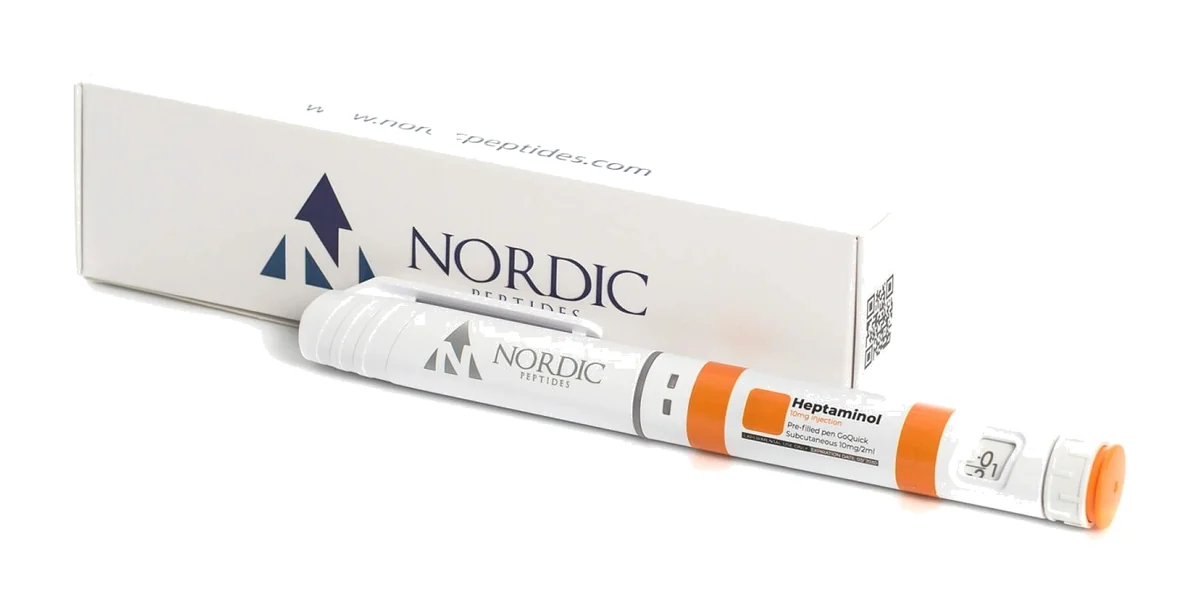 Heptaminol - 10mg/2ml
The label on this product describes heptaminol as a circulatory and performance support compound: cardiovascular drive, vascular tone, blood pressure balance, cardiac output, morning activation, pre-workout intensity, training capacity. This page reports what the published literature on heptaminol actually measured.
The clinical record is a venotonic combination
The largest and most recent clinical paper here is a 2022 review in the European Review for Medical and Pharmacological Sciences. It concerns Ginkor Fort, a fixed combination of ginkgo biloba extract, troxerutin and heptaminol chlorhydrate, described as a venotonic and vasculoprotective agent that strengthens veins, increases vessel resistance and reduces permeability, indicated for the signs and symptoms of venous insufficiency and for haemorrhoidal crisis. The stated mechanism is prevention of hypoxia-induced activation of endothelial cells, reduction of capillary tone and a haemostatic activity.
Read the evidence sentence closely, because it is the whole of it: “In the available study, the GB-T-H combined treatment showed excellent tolerability.” The paper is a review, it is about the combination rather than about heptaminol, and its own statement about clinical evidence is a tolerability observation in a single study. The authors conclude that available literature evidence and extensive clinical experience support the combination as an effective and safe option.
A 2022 Russian surgical thesis, cited here as a second data point on the same combination, frames the same choice the same way: in modern combined treatment of haemorrhoids, alongside a topical tribenoside plus lidocaine formulation, the phlebotonic ginkgo, troxerutin and heptaminol combination is presented as the pathogenetic option. It is a thesis on treatment patterns, not a trial.
The 1991 mechanistic paper is the most informative one
A review in Annales Pharmaceutiques Francaises is worth reading in full because it explains where the compound came from and what it was originally for. Heptaminol hydrochloride is described as widely used for the treatment of orthostatic hypotension. It continues to elicit controversy over its mode of action, since Loubatieres in 1951 described a powerful inotropic action on an ischaemic preparation, and twenty-five years later it was suggested that the drug acts by interfering with the release and uptake of catecholamines.
The measured findings, in order:
In the rat, heptaminol hydrochloride prevented orthostatic hypotension and increased the noradrenaline plasma concentration. In bovine chromaffin cells maintained in primary culture, it was found to be a competitive inhibitor of noradrenaline uptake, which the authors say may partially account for its antihypotensive effect. The cardiotonic effect was studied using 31P nuclear magnetic resonance spectroscopy and left ventricular pressure measurement in rat isolated hearts, and the results suggest the inotropic effect during moderate ischemia could be related to a restoration of internal pH, possibly mediated by stimulation of the Na+/H+ exchange. On satellite cells of adult skeletal muscle, which the authors describe as myogenic cells involved in muscle regeneration that differentiate into myotubes and so mimic some aspects of the in vivo process, heptaminol did not significantly alter cloning efficiency or proliferation, and increased the capacity of satellite cells to differentiate into myotubes.
That last item is the closest anything in this set comes to muscle. It is a cell culture of satellite cells on a dish, the endpoints are cloning efficiency, proliferation and differentiation capacity, and no contractile function, force or performance was measured.
The 2025 rat paper points the other way
A 2025 paper in Archives of Physiological Biochemistry reports heptaminol-induced metabolic liver and cardiac injuries in rats, with a plant extract tested alongside as a proposed protectant. The measured effects of heptaminol were an increase in body weight associated with significant increases in total cholesterol, triglycerides, total and direct bilirubin, alkaline phosphatase, creatinine kinase-MB, ACE and troponin-T; changes in ECG pattern, including ST-segment elevation; and an increased rate of TBARS with decreases in antioxidant enzyme activity. Histological examination was used to confirm the biochemical changes.
That is a toxicity study, not an efficacy study, and it belongs on the same page as the rest because a reader weighing the compound should see both directions of the record.
The doping laboratory, which is where heptaminol is most carefully measured
Two records concern heptaminol as an analytical target rather than as a medicine.
A 2019 paper in Drug Testing and Analysis carries the title “Is heptaminol a (major) metabolite of octodrine?” and has no abstract indexed in PubMed. Nothing is quoted from it here.
A 2025 paper in Clinica Chimica Acta is the substantive one. Octodrine, also known as dimethylhexylamine, is a central nervous stimulant; when ingested by humans it is rapidly metabolised to heptaminol, the main compound present in the blood. Due to their stimulant activities, octodrine and its metabolite are specified substances in section S6b, specified stimulants, of the World Anti-Doping Agency Prohibited List, prohibited in competition.
The case described is instructive as measurement rather than as advice. An athlete returned an adverse analytical finding for heptaminol, at 141 and 136 ng/mL in two urine samples after correction for specific gravity, with octodrine at 16 ng/mL — below the 50 ng/mL minimum request level in the first sample. Every supplement the athlete had taken was analysed, and one contained octodrine at 16-34 µg/g; the athlete had taken 13 g daily, corresponding to 0.2-0.4 mg of octodrine, for 20 days before the finding, a total of 4-8 mg. Pubic hair and toenail clippings were sampled two months later. A controlled study was then run in which a volunteer took a single 13 g dose of the contaminated supplement, and the volunteer’s urine was positive for both compounds at concentrations close to the athlete’s on the day of the finding. The WADA commission accepted the contamination explanation; the athlete was still banned for nine months for having consumed supplements bought over the internet.
Two of the older entries are bare titles without abstracts: a 1962 note on heptaminol and curarisation in the Comptes rendus des séances de la Société de biologie, and a 2024 case report in American Journal of Therapeutics on hair lightening following heptaminol treatment in a haemodialysis patient. Neither has an abstract in PubMed, so nothing is quoted from either.
What the data do not show
They do not show an effect on training capacity, pre-workout intensity, endurance or performance in a person. No record on this page measured any of those in a human being. The cardiotonic data are isolated rat hearts; the skeletal-muscle data are satellite cells in culture.
They do not show an effect on body composition. Nothing here measures fat mass, lean mass or body weight as an outcome in people; the body-weight figure in the record is a toxicology endpoint in rats.
They do not show heptaminol acting alone. Every clinical paper on this page studies it inside a fixed combination with ginkgo biloba and troxerutin, and the combination cannot be decomposed into its parts without a trial that does not exist.
They do not show a clean safety record. The 2025 rat study reports cardiac and hepatic marker changes and ECG changes, the 2025 doping case is an adverse analytical finding with a nine-month ban, and the haemodialysis case report describes an unexpected effect.
Where this sits on the shelf
The compound as supplied by the manufacturer: Heptaminol
What we supply
The heptaminol preparation above, as supplied by the manufacturer, tracked, from inside the EU.
Research use only. This page summarises published studies for research reference. It is not medical advice, not a protocol, and not a suggestion for human use. Nothing we supply is for human or veterinary use.
References.
- Nonikashvili Z, Jurate Gerbutaviciene R, et al. Ginkgo biloba, troxerutin and heptaminol chlorhydrate combined treatment for the management of venous insufficiency and hemorrhoidal crises. Eur Rev Med Pharmacol Sci 2022;26(14):5200-5209.
- Pourrias B. Heptaminol chlorhydrate: new data. Ann Pharm Fr 1991;49(3):127-38.
- Dib J, Bosse C, Tsivou M, et al. Is heptaminol a (major) metabolite of octodrine? Drug Test Anal 2019;11(11-12):1761-1763. No abstract is indexed in PubMed; nothing is quoted from it here.
- Alvarez JC, Etting I. Heptaminol hair testing to highlight octodrine contamination in supplements, responsible for a doping adverse analytical finding. Clin Chim Acta 2025;565:120002.
- Abbassi R, Bouzenna H, Badraoui R, et al. Heptaminol-induced metabolic liver and cardiac injuries in rats: phytochemical screening, experimental, computational modelling and pharmacological study of Phoenix dactylifera seeds. Arch Physiol Biochem 2025;131(5):859-873.
- Mahjoubi YS, Hamza I, Aouinti I, et al. Hair Lightening Following Heptaminol Treatment in a Hemodialysis Patient. Am J Ther 2024;31(5):e602-e604. No abstract is indexed in PubMed; nothing is quoted from it here.
- Sidorova AV, Yunusov BT, Groshilin VS, et al. Modern trends in combined treatment of hemorrhoids: topical form Tribenoside + Lidocaine and phlebotonic Ginkgo biloba + Troxerutin + Heptaminol. Khirurgiia (Mosk) 2022;(12) Vyp. 2:90-97.
- Chauchard P, Mazoue H. Heptaminol and curarization. C R Seances Soc Biol Fil 1962;156:1071-2. No abstract is indexed in PubMed; nothing is quoted from it here.
10% off every product in your first order
Join the list for your welcome code plus early access to new research arrivals. No spam — unsubscribe anytime.