HGH fragment 176-191: what the clinics measured
Rodent studies read glucose, insulin and body weight. No published human trial reads anything, so no blood panel can rank this fragment.
5 October 2026 · 6 min read
 HGH Fragment (hgh frag 176-191) - 5mg
The question behind “is frag weaker than the full hormone” is a measurement question, and it has a clean answer: every published study on this fragment read glucose, insulin or body weight in rats and mice, and not one of them read a growth hormone axis marker in a person. So there is no number on either side of the comparison. This article is about what was actually measured, because that is what decides what a blood panel can and cannot tell you.
What the 1978 study actually read
The foundational paper is from 1978 and it is a rat study. The authors synthesised six C-terminal fragments spanning 172-191 through 180-191 and gave them to normal rats. Four of them, 172-191, 176-191, 177-191 and 178-191, produced a short-lived rise in blood glucose and a more sustained rise in plasma insulin. The two shortest, 179-191 and 180-191, were inert in the systems tested.
At 5 nmol/kg, the peptides carrying the 178-191 sequence significantly reduced insulin sensitivity in intravenous insulin tolerance tests. The authors’ own conclusion is the one that matters for anyone shopping by sequence: the biologically active peptides need not only the minimum informational sequence but also that sequence in the correct physical configuration.
Two things to hold onto. The endpoints are glucose, insulin and insulin sensitivity; there is no IGF-1 measurement in that paper. And 176-191 is not one molecule with one profile, as the next two studies show.
What the 2001 studies read
In obese Zucker rats, an oral preparation of the lipolytic domain fragment, AOD9604, at 500 microg/kg body weight over 19 days reduced over 50% of body weight gain, 15.8 plus or minus 0.6 g against 35.6 plus or minus 0.8 g in controls, and the adipose tissue showed increased lipolytic activity. In contrast to chronic treatment with intact growth hormone, this fragment showed no adverse effect on insulin sensitivity on euglycemic clamps.
In obese and lean mice treated for 14 days with osmotic pumps, both full growth hormone and the modified C-terminal fragment reduced body weight gain and increased fat oxidation. Unlike the full hormone, the fragment did not induce hyperglycaemia, did not reduce insulin secretion, did not compete for the growth hormone receptor and did not induce cell proliferation.
Put those three papers side by side and the direction flips. The 1978 rat work says the C-terminal sequence raises glucose and blunts insulin sensitivity. The 2001 work says the modified version does neither. Same family, different construct, different endpoint, opposite sign. That is not a contradiction to explain away; it is the reason a single sentence about “the fragment” cannot be written honestly. The 1982 follow-up to the hyperglycaemic finding is Ma, Macaulay and Maggs in Biochim Biophys Acta, and PubMed indexes no abstract for it, so nothing is taken from it here beyond the fact that it exists.
The cell-line work
A 2022 paper took the 176-191 fragment as a targeting component, docked it against breast cancer receptors, loaded it with doxorubicin onto chitosan nanoparticles and then ran a viability assay on an MCF-7 breast cancer cell line. The dual-loaded particles were more antiproliferative than doxorubicin alone. That is molecular modelling and a cell line, and it is filed here only so the reader knows where the “fragment plus cancer” citations come from.
What a clinic measures, and why the number is not portable
If a laboratory is going to say anything about the growth hormone axis, the workhorse marker is IGF-I. The largest reference-interval study for it, 15 014 subjects from 0 to 94 years across 12 cohorts in the United States, Canada and Europe, is worth reading for a specific reason: the interval moves with age. It declines immediately after birth, rises until a pubertal peak at 15 years, then falls continuously through adult life. The sex effect is small but women sit lower on average across the whole span. Region and sampling setting did not move the intervals.
So a single IGF-1 number carries no meaning without age, sex and assay. Two results from two laboratories, on two assays, at two ages are not two data points but one data point and one unknown.
What a real axis trial measures, for contrast
When a secretagogue was tested on the axis in people, the readout looked completely different. A 1997 single-blind randomised placebo-controlled trial gave ten women and nine men aged 55 to 71 a GHRH analogue at 10 microg/kg nightly for 16 weeks after four weeks of placebo. Nightly administration at 2100 h induced an acute growth hormone release within 10 minutes, lasting two hours; 12-hour integrated nocturnal growth hormone rose in both sexes; IGF-I rose within two weeks, IGFBP-3 rose, and lean body mass and insulin sensitivity rose in men only. The only adverse effect was a transient rise in lipids that resolved by the end of the study.
And the neighbouring class has its nulls too. A 2014 phase 2 randomised double-blind placebo-controlled trial enrolled 117 patients after bowel resection, 114 in the analysis, with 0.03 mg/kg of a ghrelin receptor agonist twice a day for up to seven days. Median time to a tolerated meal was 25.3 hours against 32.6 hours on placebo, p = 0.15. The authors’ conclusion is that there were no significant differences between the drug and placebo in the key or secondary efficacy analyses. A structurally plausible axis effect is not a result until a randomised comparison produces one.
Why a clean panel does not clear the fragment
There is a laboratory detail here that a buyer should know. The modified fragment used in the anti-doping literature is the C-terminal sequence from amino acids 177 to 191 with an added N-terminal tyrosine, and it was recently identified in confiscated vials in the United States. A validated urine method detects it at a limit of 50 pg/mL, with recovery of 62% and six candidate metabolites, one of which, CRSVEGSCG, is far more stable than the parent compound.
A separate 2013 paper reports that the fragment does not influence the WADA human growth hormone isoform immunoassay, the blood test built to detect exogenous full-length hormone. The assay most people mean by a growth hormone blood test does not respond to this sequence at all.
Where this sits on the shelf
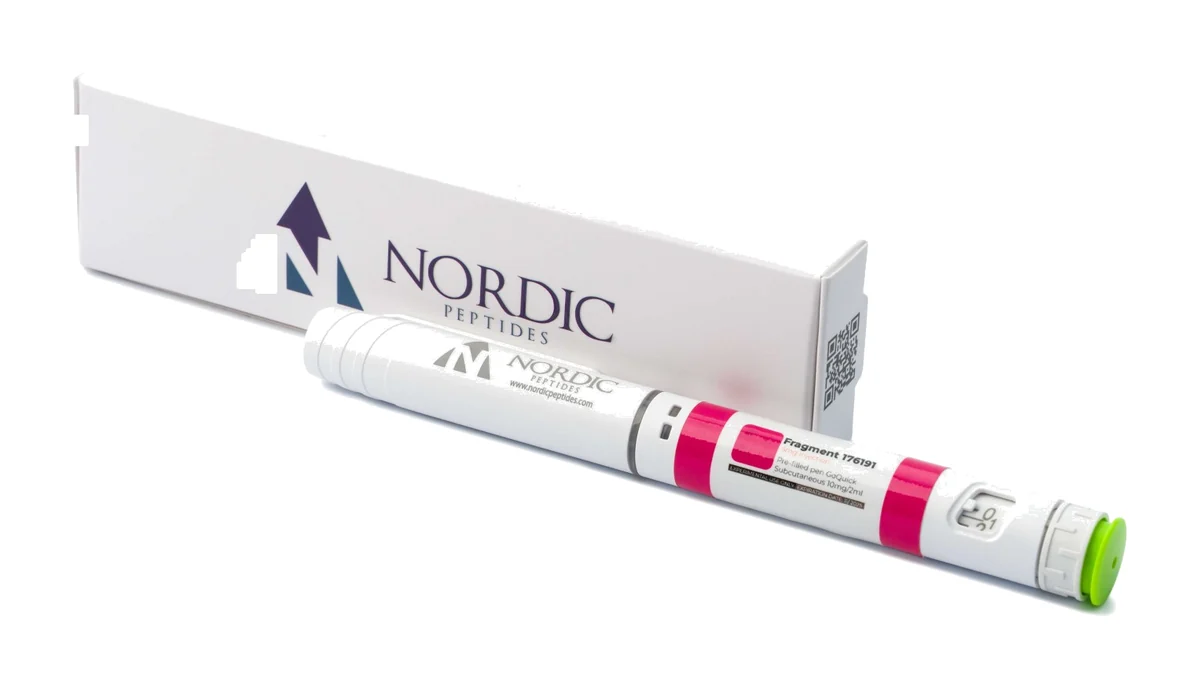
We carry the C-terminal growth hormone fragment. The longer argument, with the 1993 paper and the full mouse programme laid out, is in the missing human chapter.
What the data do not show
There is no published human study of the C-terminal growth hormone fragment. Not a trial of lean mass, not a trial of fat loss, not a trial of recovery, not a pharmacokinetic study. A PubMed phrase search on 30.09 for the full sequence name “human growth hormone fragment 176-191” returned four records in total, and not one of them reports an outcome measured in a person. The 2026 reviews that list it alongside the secretagogues both say the same thing in different words: one describes evidence tiers running from regulatory-grade randomised data down to a complete absence of human studies, the other states flatly that there is a current lack of clinical trials.
No IGF-1 number appears anywhere in the fragment literature. No head-to-head against full-length growth hormone exists on any endpoint, in any species, so the question of whether one is “weaker” has no answer to be found, and anyone who gives you one is quoting somebody else. Nothing here was measured in a healthy adult, and the nearest human data in this region of the axis include a randomised trial with p = 0.15.
What a well-run laboratory can do is measure an age- and sex-adjusted IGF-I and read it against a reference interval drawn from fifteen thousand people. What it cannot do is tell you whether a vial contained anything, and it will not be looking for this sequence.
What we supply
The growth hormone fragment preparation above, as supplied by the manufacturer, tracked, from inside the EU. Batch documentation for every product that carries any is explained in the COA guide linked from the product page.
Research use only. This page summarises published trials and evidence syntheses for research reference. It is not medical advice, not a protocol, and not a suggestion for human use. Nothing we supply is for human or veterinary use.
References.
- Ng FM, Bornstein J. Hyperglycemic action of synthetic C-terminal fragments of human growth hormone. Am J Physiol 1978;234(5):E521-6 (PMID 645904).
- Ma GY, Macaulay SL, Maggs JA, et al. The mechanism of the hyperglycaemic action of synthetic peptides related to the C-terminal sequence of human growth hormone. Biochim Biophys Acta 1982;716(3):400-9 (PMID 6810951). No abstract is indexed in PubMed; nothing is quoted from it here.
- Ng FM, Sun J, Sharma L, et al. Metabolic studies of a synthetic lipolytic domain (AOD9604) of human growth hormone. Horm Res 2000;53(6):274-8 (PMID 11146367).
- Heffernan MA, Thorburn AW, Fam B, et al. Increase of fat oxidation and weight loss in obese mice caused by chronic treatment with human growth hormone or a modified C-terminal fragment. Int J Obes 2001;25(10):1442-9 (PMID 11673763).
- Dominikowski A, Rękoś Z, Olejarz M, et al. The emerging landscape of performance-enhancing peptides modulating GH-IGF1 axis. Front Endocrinol 2026;17:1822475 (PMID 42395176).
- Bidlingmaier M, Friedrich N, Emeny RT, et al. Reference intervals for insulin-like growth factor-1 (IGF-I) from birth to senescence. J Clin Endocrinol Metab 2014;99(5):1712-21 (PMID 24606072).
- Khorram O, Laughlin GA, Yen SSC, et al. Endocrine and metabolic effects of long-term administration of [Nle27]growth hormone-releasing hormone-(1-29)-NH2 in age-advanced men and women. J Clin Endocrinol Metab 1997;82(5):1472-9 (PMID 9141536).
- Beck DE, Sweeney WB, McCarter MD, et al. Prospective, randomized, controlled, proof-of-concept study of the Ghrelin mimetic ipamorelin for the management of postoperative ileus in bowel resection patients. Int J Colorectal Dis 2014;29(12):1527-34 (PMID 25331030).
- Cox HD, Smeal SJ, Hughes CM, et al. Detection and in vitro metabolism of AOD9604. Drug Test Anal 2015;7(1):31-8 (PMID 25208511).
- Orlovius AK, Thomas A, Schänzer W, Thevis M. AOD-9604 does not influence the WADA hGH isoform immunoassay. Drug Test Anal 2013;5(11-12):850-2 (PMID 24124033).
- Rahman OF, Lee SJ, Seeds WA. Therapeutic Peptides in Orthopaedics: Applications, Challenges, and Future Directions. J Am Acad Orthop Surg Glob Res Rev 2026;10(1):e25.00236 (PMID 41490200).
- Habibullah MM, Mohan S, Syed NK, et al. Human Growth Hormone Fragment 176-191 Peptide Enhances the Toxicity of Doxorubicin-Loaded Chitosan Nanoparticles Against MCF-7 Breast Cancer Cells. Drug Des Devel Ther 2022;16:1963-1974 (PMID 35783198).
Get 10% off your first order
Join the list for your welcome code plus early access to new research arrivals. No spam — unsubscribe anytime.