HGH Fragment 176-191 and AOD9604: a well-built mouse story with a missing human chapter
The idea was elegant — take growth hormone's fat-metabolism domain and leave the growth and insulin effects behind. It worked in obese mice, repeatedly. PubMed indexes 23 papers mentioning AOD9604 and not one randomised human trial.
1 September 2026 · 4 min read
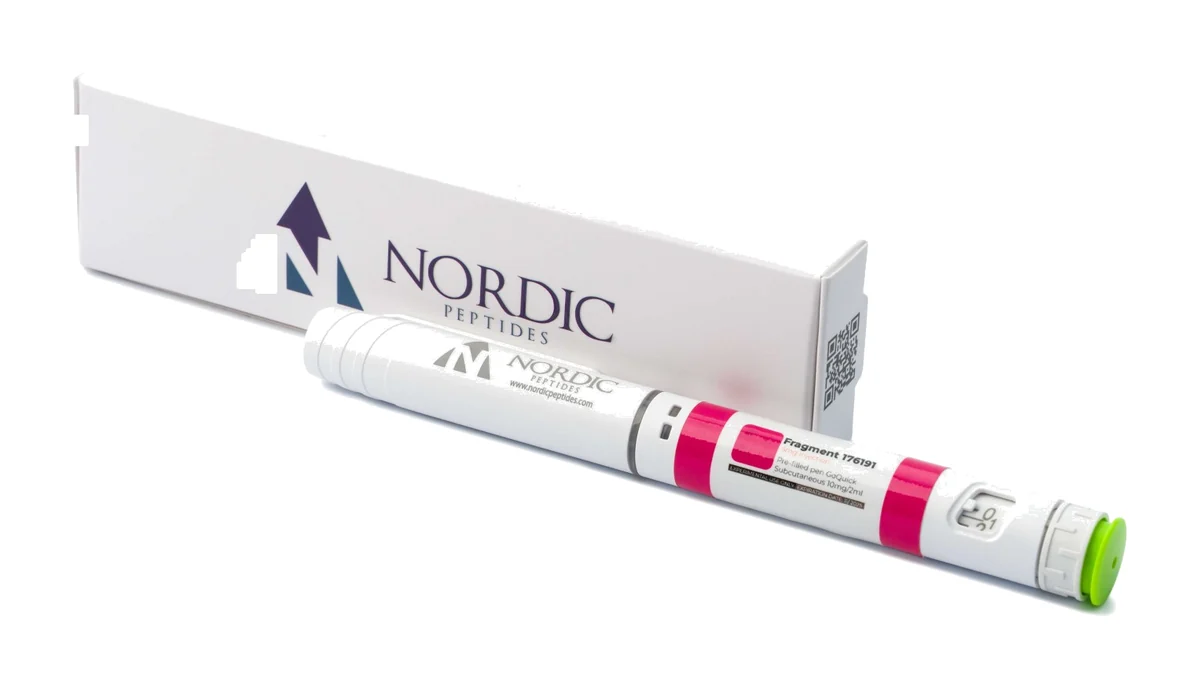 HGH Fragment (hgh frag 176-191) - 5mg
Growth hormone changes how the body handles fat, and it also raises blood glucose, suppresses insulin and drives cell proliferation. The premise behind this compound was that those effects live in different parts of the molecule, and that you could keep the first and discard the rest. It is a good premise, and a specific group in Melbourne spent a decade testing it.
It is also the opposite approach to everything else on the metabolic shelf. The GLP-1 line works through appetite and gut hormones; tesamorelin works by releasing growth hormone. This one skips the hormone and takes the fragment.
Name the molecule first
Three names circulate for what is effectively the same idea, and they are not identical peptides.
- hGH 177-191 is the synthetic C-terminal sequence Wu and Ng tested in 1993: Leu-Arg-Ile-Val-Gln-Cys-Arg-Val-Ser-Glu-Gly-Ser-Cys-Gly-Phe.
- AOD-9401 and AOD9604 are modified fragments built from that region — the Heffernan papers describe AOD9604 as “a modified C-terminal fragment” of hGH.
- hGH 176-191 is the name the market and the anti-doping code use. WADA lists “growth hormone fragments, e.g. AOD-9604 and hGH 176-191” together under S2.2.3.
The published lipid-metabolism work sits on the 177-191 sequence and on the AOD modifications. If you are designing work around those papers, write down which peptide you actually have.
What the 1993 paper found — and the direction people get backwards
Wu and Ng reported that synthetic hGH 177-191 had antilipogenic activity identical to intact growth hormone: it suppressed fat synthesis. In the same experiments they found no significant lipolytic effect as measured by glycerol release from rat epididymal fat pads.
That is worth sitting with, because the compound is marketed almost universally as a fat burner. The founding paper’s positive result was on the storage side, not the breakdown side.
The mouse programme
Heffernan et al. then ran the fragment through obese-mouse models three times, and the results were consistent.
- Oral, 30 days (2000): ob/ob mice given AOD-9401 by mouth gained significantly less weight than saline controls from day 16 onward, with no difference in food consumption. Adipose tissue examined afterwards showed reduced lipogenic and increased lipolytic activity, alongside an acute rise in energy expenditure and fat oxidation. The same directional effects appeared in isolated adipose tissue from obese rodents and from humans, in vitro.
- Continuous infusion, 14 days (2001): hGH and AOD9604 were delivered by mini-osmotic pump to ob/ob and lean C57BL/6J mice. Both reduced body-weight gain, raised in vivo fat oxidation and raised plasma glycerol. Unlike growth hormone, AOD9604 did not induce hyperglycaemia or reduce insulin secretion, did not compete for the hGH receptor, and did not induce cell proliferation.
- A companion paper extended the work to β3-adrenoceptor knockout mice.
Taken together this is a coherent body of work that supports the original premise: the fragment reproduces part of growth hormone’s effect on fat without engaging the growth hormone receptor.
Where it stops
At the species line, and more sharply than usual.
PubMed indexes 23 records mentioning AOD9604 or AOD-9604. Filter those to the randomised-controlled-trial and clinical-trial publication types and the count is zero. There is no peer-reviewed randomised human weight-loss trial of this compound in the indexed literature.
Human trials were run. The developer announced a 12-week result in 300 obese patients in 2004, and development was later discontinued — that history, with the numbers the company published and the reason they do not count as a peer-reviewed result, is set out on our metabolic pens page, which is where the compound also appears inside a blend.
The absence of a published trial from that programme is itself information, and it is the piece of the file most often skipped in favour of the mouse numbers.
The other frequently cited result, for joints rather than fat, is Kwon and Park: intra-articular AOD9604 with or without hyaluronic acid in a rabbit osteoarthritis model. That is the origin of the joint claims. It is one rabbit study.
Regulatory status
Prohibited in sport at all times. The Prohibited List names AOD-9604 and hGH 176-191 explicitly as examples under growth hormone fragments, so both the research name and the shelf name are covered. Neither is an approved medicine in the EU or the US.
Handling
AOD9604 is the one product in this catalog whose manufacturer asks for refrigeration — and only after reconstitution, at 4 °C or below. The sealed product follows the same room-temperature guidance as the rest of the Nordic range, which the handling page sets out in full. Follow the instruction printed on the product page, which is the manufacturer’s own.
What we supply
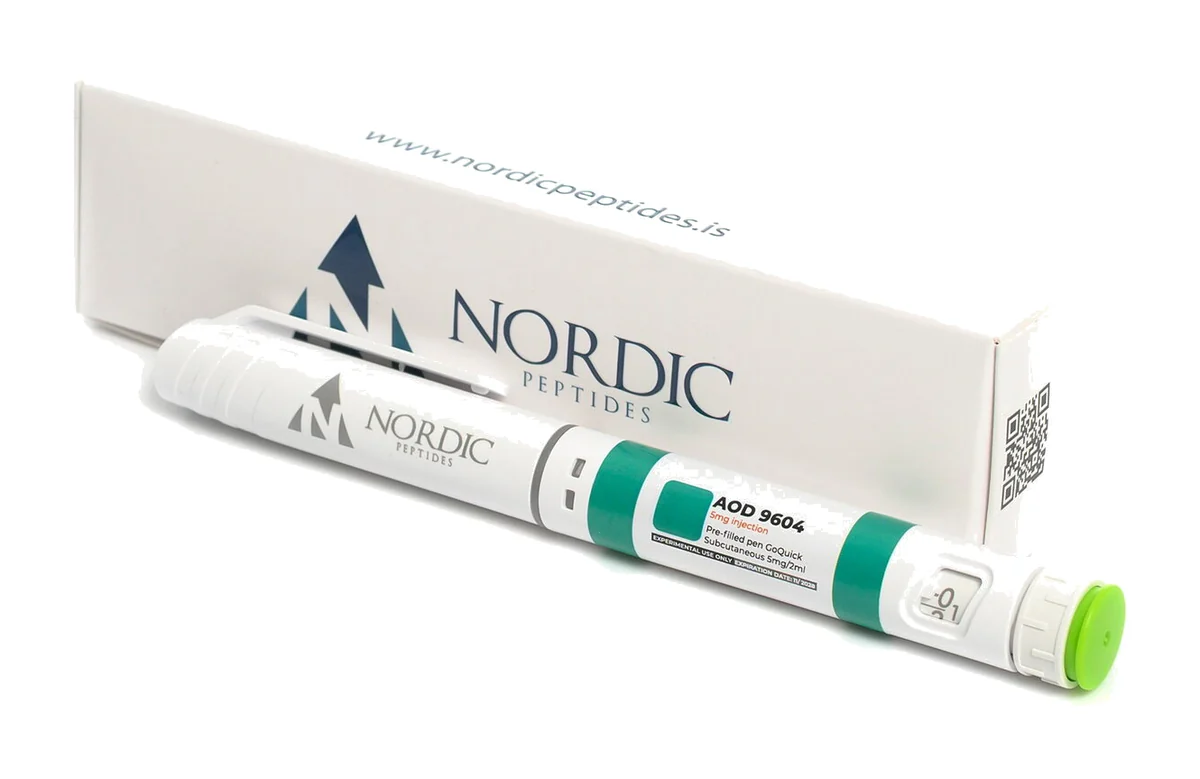
The HGH Fragment (hgh frag 176-191) and AOD9604, Nordic Peptides pens, shipped as supplied by the manufacturer, batch documentation on request. Research use only — not for human or veterinary use, and nothing here is medical advice.
References.
- Wu Z, Ng FM. Antilipogenic action of synthetic C-terminal sequence 177-191 of human growth hormone. Biochem Mol Biol Int 1993;30(1):187–196 (PMID 8358331).
- Heffernan MA, Jiang WJ, Thorburn AW, Ng FM. Effects of oral administration of a synthetic fragment of human growth hormone on lipid metabolism. Am J Physiol Endocrinol Metab 2000;279(3):E501–7 (PMID 10950816).
- Heffernan MA, Thorburn AW, Fam B, et al. Increase of fat oxidation and weight loss in obese mice caused by chronic treatment with human growth hormone or a modified C-terminal fragment. Int J Obes Relat Metab Disord 2001;25(10):1442–1449 (PMID 11673763).
- Heffernan M, Summers RJ, Thorburn A, et al. The effects of human GH and its lipolytic fragment (AOD9604) on lipid metabolism following chronic treatment in obese mice and beta(3)-AR knock-out mice. Endocrinology 2001;142(12):5182–5189 (PMID 11713213).
- Kwon DR, Park GY. Effect of Intra-articular Injection of AOD9604 with or without Hyaluronic Acid in Rabbit Osteoarthritis Model. Ann Clin Lab Sci 2015;45(4):426–432 (PMID 26275694).
- World Anti-Doping Agency — Prohibited List, S2.2.3: growth hormone fragments, e.g. AOD-9604 and hGH 176-191.