Tesamorelin: the one growth hormone peptide with an approval behind it
Of every GHRH-class compound sold as research material, exactly one has been through phase 3 and cleared by the FDA. Here is what that trial measured — and why the indication is narrower than the internet suggests.
19 August 2026 · 3 min read
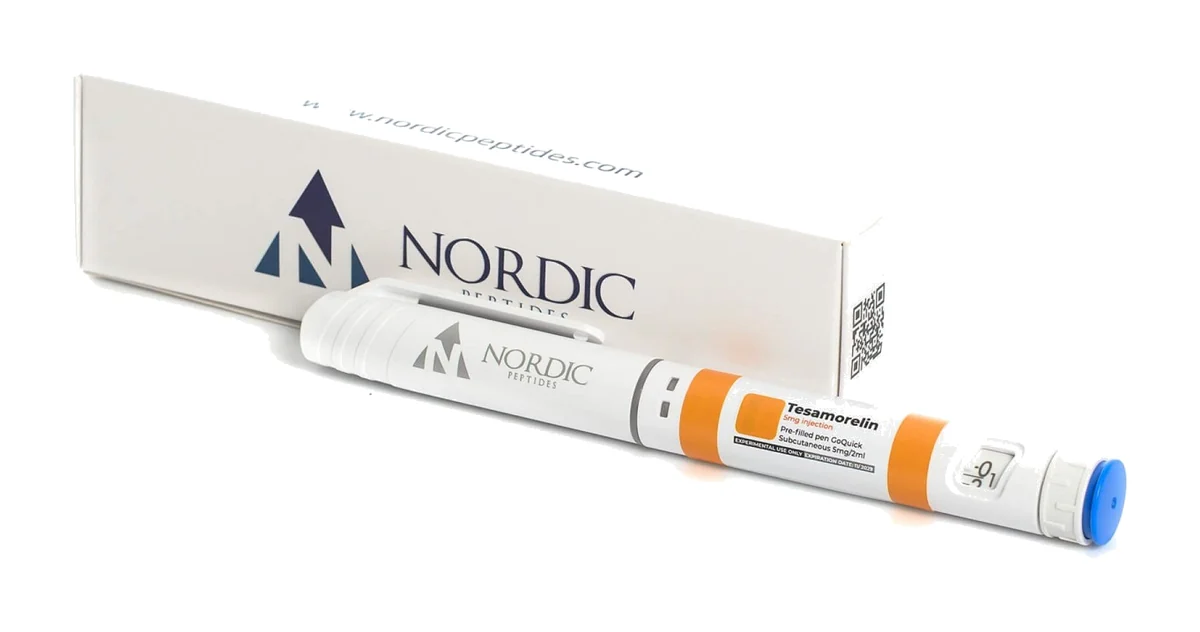 Tesamorelin - 5mg/2ml
Most of the growth-hormone-axis peptides in this catalog share a common evidence profile: interesting mechanism, animal data, a few small human studies, no regulatory approval anywhere. Tesamorelin is the exception, and that alone makes it worth a page.
What it is
Tesamorelin is a synthetic analogue of growth hormone-releasing factor (GHRH). Rather than supplying growth hormone directly, it acts on the pituitary to increase the body’s own pulsatile GH secretion — which is why the compounds in this class are described as secretagogues or releasing factors rather than as growth hormone.
The practical difference from exogenous GH is that the pituitary’s own feedback loops stay in the circuit. Whether that matters clinically depends entirely on what is being studied.
The trial that got it approved
The pivotal work was published in The New England Journal of Medicine in 2007 (Falutz et al.): 412 adults with HIV and central fat accumulation, randomised 2:1 to tesamorelin 2 mg subcutaneously daily or placebo for 26 weeks, with visceral adipose tissue measured by CT at the L4–L5 level as the primary endpoint.
Result: visceral adipose tissue fell 15.2% in the tesamorelin arm and rose about 5% on placebo. Triglycerides fell, and IGF-1 rose into the mid-normal range — the expected downstream marker of increased GH secretion.
A second phase 3 trial with a similar design followed, and the FDA approved tesamorelin (as EGRIFTA) in 2010 for reduction of excess abdominal fat in adults with HIV-associated lipodystrophy. It remains the only approved indication.
The part that is usually left out
Three things about that approval get skipped when the compound is discussed as a general fat-loss peptide:
- The population was specific. HIV-associated lipodystrophy is a particular metabolic condition, not general obesity. The trial says what tesamorelin did in that group over 26 weeks — not what it does in anyone else.
- The effect is on visceral fat, not weight. The endpoint was CT-measured VAT area. Subcutaneous fat and total body weight are different measurements and did not move the same way.
- The effect reverses. In the extension work, visceral fat returned toward baseline after treatment stopped. As with the GLP-1 drugs, the effect lasts as long as the treatment does.
Later research has looked at tesamorelin’s effect on liver fat in people with HIV, with reductions reported there too — an area that is still developing rather than settled.
Safety signal worth naming
Because the mechanism raises IGF-1, the label carries the cautions that go with the GH axis: injection-site reactions, arthralgia, peripheral oedema, glucose intolerance, and contraindications relating to active malignancy. GH-axis stimulation is not a benign lever, and an approved drug’s label is a more honest source on that than any vendor page.
Why it belongs in a research catalog
Tesamorelin is the reference compound for its class. If you are studying ipamorelin, CJC-1295 or any other secretagogue, tesamorelin is the one with a phase 3 dataset and a regulatory dossier to compare against — which makes it useful as a benchmark quite apart from anything it does on its own.
The same benchmark works one step further down the axis. IGF-1 LR3 and PEG MGF apply the downstream signal directly instead of asking the pituitary for it, and the gap between their evidence and tesamorelin’s is the clearest illustration in the catalog of what a regulatory dossier actually costs to assemble.
What we supply
Tesamorelin 5 mg/2 ml from Nordic Peptides, shipped as supplied by the manufacturer, batch documentation on request. Research use only. Nothing here is a recommendation to use it in people; the approved product exists, is prescribed, and that route is a physician’s, not ours.
References.
- Falutz J, Allas S, Blot K, et al. Metabolic Effects of a Growth Hormone–Releasing Factor in Patients with HIV. N Engl J Med 2007;357(23):2359–2370.
- EGRIFTA (tesamorelin for injection) — FDA prescribing information.
- Falutz J, et al. Reduction in visceral adiposity is associated with an improved metabolic profile in HIV-infected patients receiving tesamorelin. PubMed record (PMID 22495074).
- Tesamorelin Reduces Visceral Adipose Tissue and Liver Fat in INSTI-Treated Persons with HIV.