IGF-1 LR3 and PEG MGF: two names, and what is actually published under each
Recombinant IGF-1 is an approved drug with a registry behind it. The LR3 analogue is a cell-culture reagent. PEG MGF has no administration study at all — the human MGF papers measure a gene switching on, not a peptide going in.
1 September 2026 · 4 min read
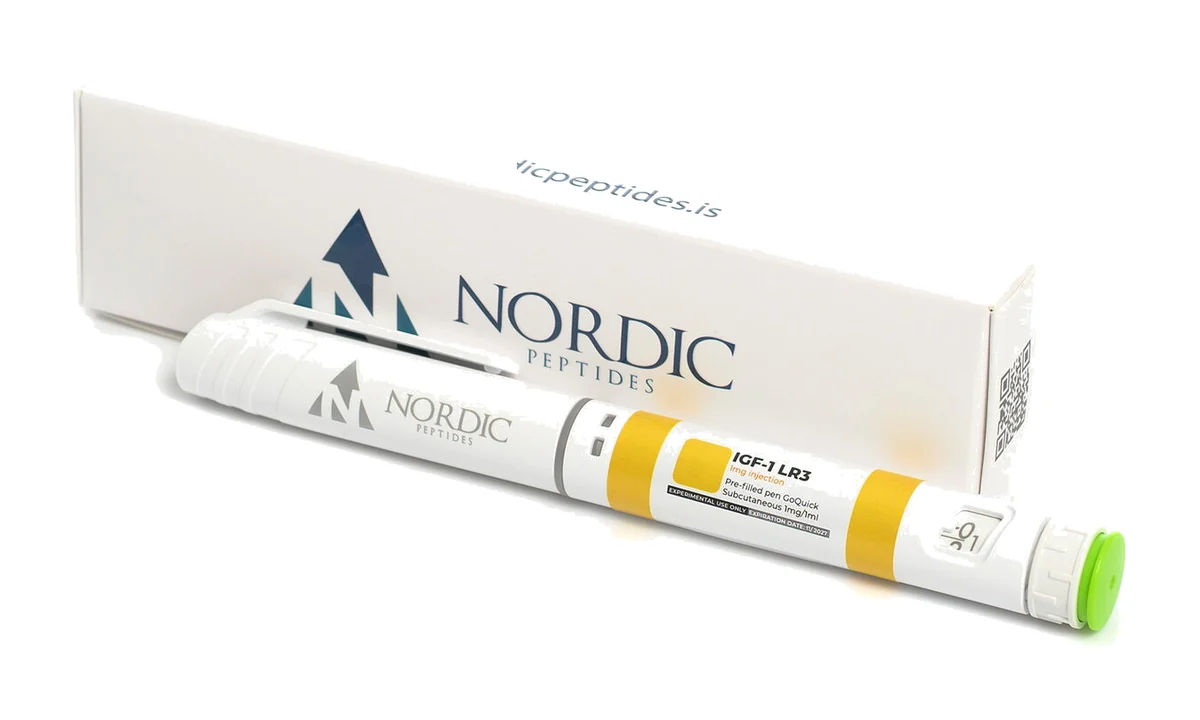 IGF-1 LR3 - 1mg
These two compounds are usually sold as a pair and described in the same breath. Their evidence files could hardly be less alike, and the difference is worth setting out before anything else.
They also sit at the far end of the GH axis from the secretagogues. CJC-1295 and ipamorelin ask the pituitary to release growth hormone; tesamorelin does the same with an approval behind it. IGF-1 skips that step and applies the downstream signal directly — which is why its risk profile is different, and why its literature is read differently.
IGF-1 is a real drug — as a paediatric growth medicine
Recombinant human IGF-1, mecasermin, is approved for severe primary IGF-1 deficiency. The European Increlex Growth Forum Database registry followed 242 children and adolescents across ten European countries between 2008 and 2017. In the treatment-naïve prepubertal cohort, 56% of the non-Laron subgroup met the growth-response threshold, and young age at baseline was an independent positive predictor.
The safety line from that registry is the one that matters here: 65.3% of patients had a treatment-emergent adverse event, and hypoglycaemia was the most common. That is the known hazard of putting IGF-1 into a person — not a theoretical one, a registry finding.
IGF-1 LR3 is not that molecule
The approved human file is on recombinant IGF-1. IGF-1 LR3 is an analogue engineered to escape the IGF binding proteins, and in the published literature it appears as a laboratory reagent — for example replacing insulin in the differentiation of embryonic stem cells. There is no clinical programme behind the analogue, no registry, no label.
That distinction gets lost constantly. A safety profile established for mecasermin in children with a growth disorder does not transfer to a binding-protein-resistant analogue used for a different purpose in adults.
The muscle paper everybody cites is a transgenic mouse
Musarò et al. is the origin of the “IGF-1 builds muscle” claim in this corner of the market. What they actually did was generate mice carrying a tissue-restricted transgene encoding a locally acting IGF-1 isoform. Those mice gained muscle mass and strength, escaped age-related atrophy, and retained a young regenerative response to injury.
That is genetic engineering producing continuous local expression in mouse muscle. It is not an injection, it is not systemic, and it is not a human. The result is real and it is frequently reported as though it were something it is not.
MGF: the human studies measure the gene, not the peptide
Mechano growth factor is IGF-1Ec, a splice variant of the IGF-1 gene with a distinct E domain produced by a reading-frame shift. Kandalla et al. tested the MGF-24aa-E peptide on primary human muscle cells and found it increased proliferative lifespan and delayed senescence in satellite cells from neonatal and young adult donors — but not from old adult muscle, which is the population the compound is usually pitched at.
That is cell culture. Search the human MGF literature and what you find are expression studies: MGF mRNA measured in muscle biopsies after resistance exercise, or after therapeutic ultrasound. Those studies establish that the gene responds to mechanical load. They do not administer the peptide to anybody.
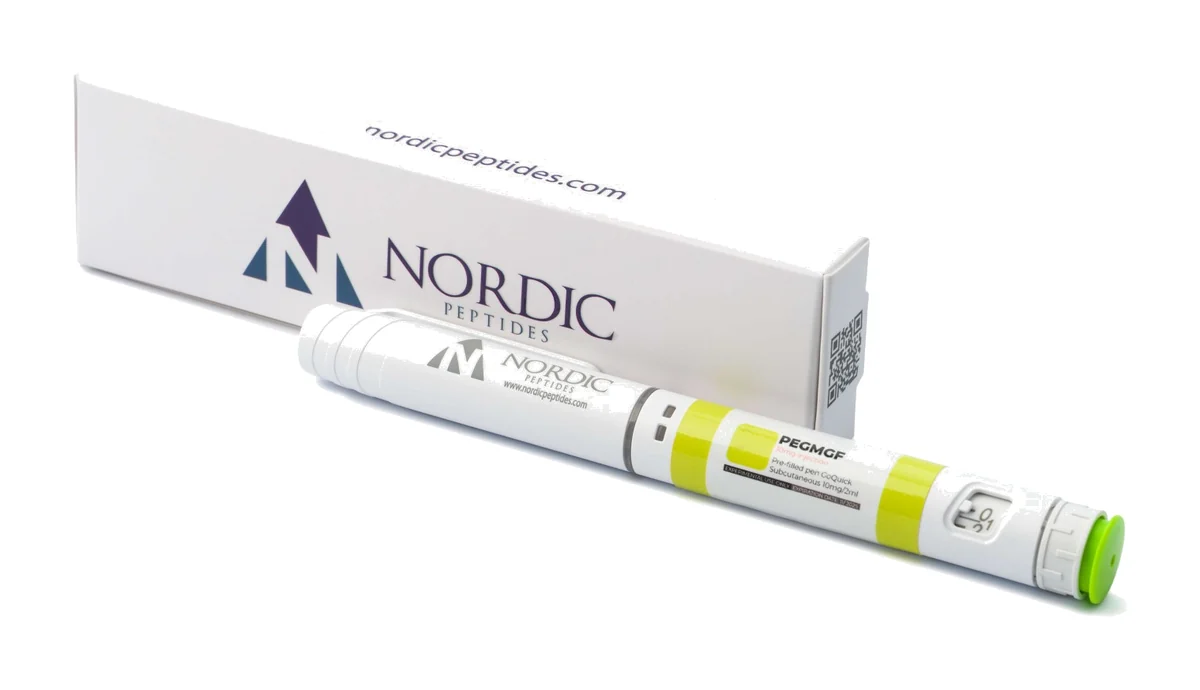
PEG MGF has no administration study anywhere
This one is simple, and it is checkable in a minute. A PubMed search for PEG-MGF or PEGylated mechano growth factor returns a handful of records, and none of them is a study of PEG MGF being given to an animal or a person — they are papers on PEGylated growth hormone, PEGylated IGF-I and general reviews.
What a real study of a PEGylated IGF looks like is Kletzl et al.: 62 healthy volunteers, randomised, double-blinded, placebo-controlled, single ascending dose. Half-life 140–200 hours, injection-site erythema the most frequent adverse event, no hypoglycaemia observed. That molecule is RO5046013, not MGF — but it demonstrates that first-in-man PEGylated-IGF work is possible, has been done, and has simply never been done for this compound.
The reason IGF-1 is not a casual molecule
Renehan et al. pooled 21 studies (26 datasets, 3,609 cases and 7,137 controls). Comparing the 75th with the 25th percentile of circulating IGF-I, the odds ratio was 1.49 (95% CI 1.14–1.95) for prostate cancer and 1.65 (1.26–2.08) for premenopausal breast cancer.
Those are observational associations with endogenous concentrations, not an effect of an administered analogue, and the authors called the associations modest and site-dependent. It is still the reason IGF-1 signalling is treated as a serious pharmacological lever rather than a supplement.
Regulatory status
The WADA Prohibited List names both, in the same section: S2.3 covers “insulin-like growth factor-1 (IGF-1, mecasermin) and its analogues” and “mechano growth factors (MGFs)”. Prohibited at all times.
The blend
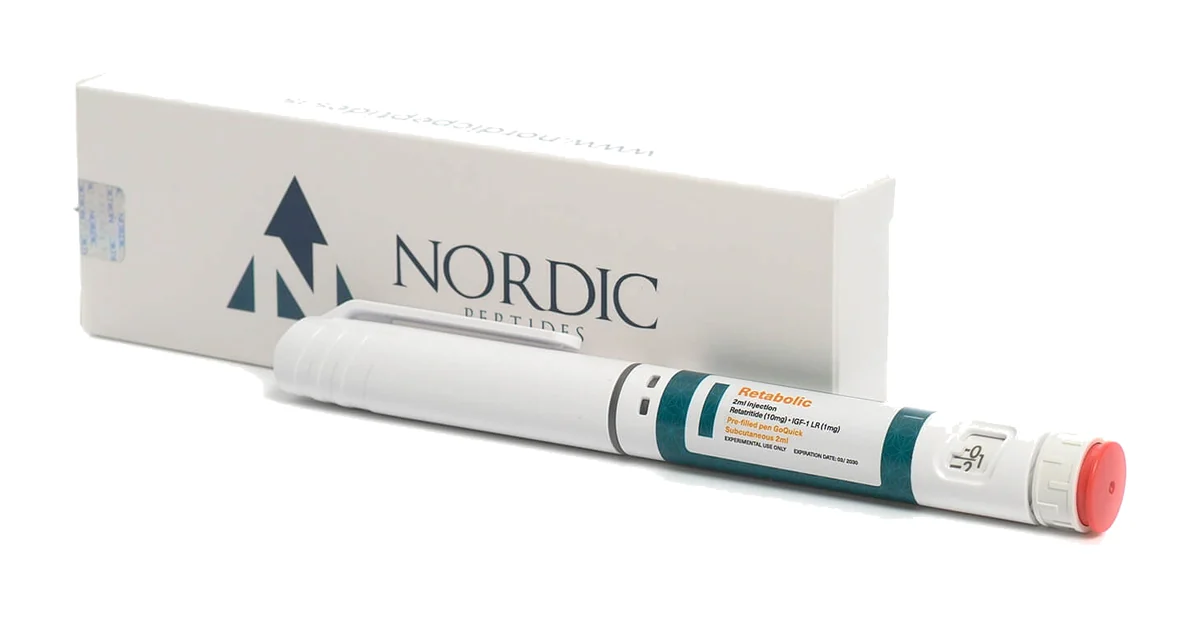
Retabolic combines retatrutide with IGF-1 LR3. Retatrutide has a published phase 2 dataset of its own; the LR3 component does not. A two-component preparation cannot attribute an outcome to either part, and here the two parts sit at opposite ends of the evidence scale. Our page on blends sets out that trade-off in general.
What we supply
IGF-1 LR3, PEG MGF and the Retabolic blend, Nordic Peptides pens, shipped as supplied by the manufacturer, batch documentation on request. Research use only — not for human or veterinary use, and nothing here is medical advice.
References.
- Bang P, Woelfle J, Perrot V, et al. Effectiveness and safety of rhIGF1 therapy in patients with or without Laron syndrome. Eur J Endocrinol 2021;184(2):267–276 (PMID 33434161).
- Musarò A, McCullagh K, Paul A, et al. Localized Igf-1 transgene expression sustains hypertrophy and regeneration in senescent skeletal muscle. Nat Genet 2001;27(2):195–200 (PMID 11175789).
- Kandalla PK, Goldspink G, Butler-Browne G, Mouly V. Mechano Growth Factor E peptide (MGF-E), derived from an isoform of IGF-1, activates human muscle progenitor cells. Mech Ageing Dev 2011;132(4):154–162 (PMID 21354439).
- Delgado-Diaz DC, Gordon BS, Dompier T, et al. Therapeutic ultrasound affects IGF-1 splice variant expression in human skeletal muscle. Am J Sports Med 2011;39(10):2233–2241 (PMID 21785002).
- Kletzl H, Guenther A, Höflich A, et al. First-in-man study with a novel PEGylated recombinant human insulin-like growth factor-I. Growth Horm IGF Res 2017;33:9–16 (PMID 28110155).
- Renehan AG, Zwahlen M, Minder C, et al. Insulin-like growth factor (IGF)-I, IGF binding protein-3, and cancer risk: systematic review and meta-regression analysis. Lancet 2004;363(9418):1346–1353 (PMID 15110491).
- World Anti-Doping Agency — Prohibited List, S2.3: IGF-1 (mecasermin) and its analogues, and mechano growth factors (MGFs).