Reconstituting peptides: sterile vs bacteriostatic water
What reconstitution physically does, what each diluent actually is, and the three in-vitro studies that compared them. No shelf-life numbers invented.
3 October 2026 · 8 min read
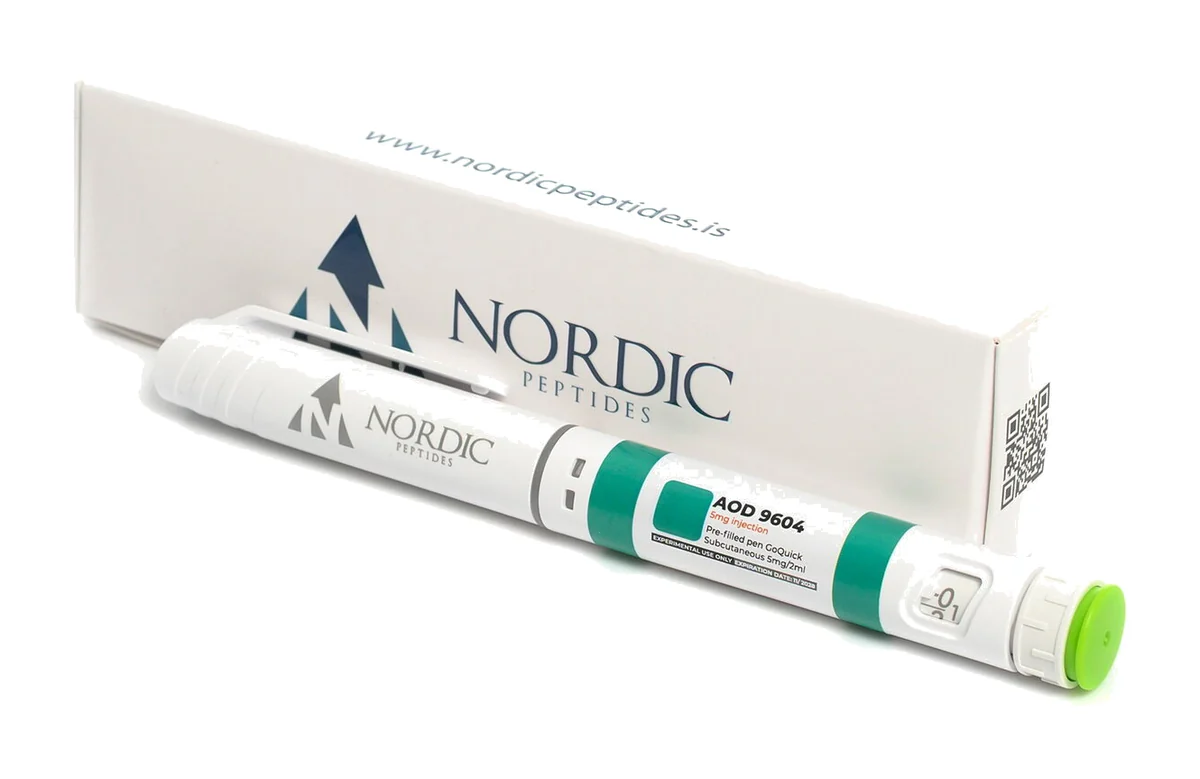 AOD9604 - 5mg
A lyophilised vial is a powder with one job left in it: it is waiting for water. Reconstitution is the step where that happens, and it is also the step nobody can check for you afterwards. The powder arrived with a certificate and a seal. The moment solvent goes in, the material becomes something no batch record covers, and every number you read afterwards about how long it “lasts” is a guess dressed up as data.
So this piece is about the process, not a table. What the two diluents are, what the manufacturer actually prints, and what the handful of in-vitro studies that compared them really did. Where the literature is thin, it is thin, and I would rather say that than fill the gap.
What reconstitution is, physically
Freeze-drying takes a solution and removes most of the water under vacuum. What is left is a dry, usually glassy cake, and dry is why the peptide survives: hydrolysis, oxidation and aggregation all need water to work. Add solvent and all three become possible again, at the concentration you chose, at the temperature the bench is at, handled by whoever was in a hurry.
The review literature on protein and peptide instability is blunt about what the recovered cake has to survive, and the list is not only about chemistry. pH, ionic strength and concentration, temperature, agitation, the interface between liquid and air, the interface between liquid and container wall, and lyophilization itself all appear as stressors. Preservatives appear on the other side, as one of the tools used to push back against them.
That list is why the diluent is not a trivial choice. It is one variable among several, and it is the one most people pick by accident.
Sterile water and bacteriostatic water are different products
They are not stronger and weaker versions of the same thing. They are two different fluids with two different jobs.
Sterile water for injection is water, sterilised, and nothing else. It carries no preservative. Whatever goes into it starts out at a low microbial count and stays that way only as long as the container stays closed, because there is nothing in the vial suppressing growth.
Bacteriostatic water for injection is the same base water with a preservative added, and the preservative in the standard formulation is benzyl alcohol at 0.9%. The bacteriostatic study on tenecteplase that actually compares the two diluents describes it exactly that way, and it is the reason the word exists in the name: the benzyl alcohol is there to slow microbial growth in a vial that will be opened more than once.
Here is the part that surprises people, and it comes straight out of the epoetin alfa work. The authors diluted a protein with bacteriostatic saline at two different ratios and then ran the USP preservative-effectiveness tests on both. Both batches of the mixture that ended up with the higher preservative concentration met the criteria for a preserved solution. Of the two batches carrying the lower final concentration, only one did. Same diluent, same bottle, different result, decided by what the final concentration ended up being after the protein went in.
Read that twice. “Which water is in the bottle” is not the question that decides whether a reconstituted solution counts as preserved. “What is in the bottle now” is.
What the manufacturer says
Here is where this market gets thin. Out of everything in our catalog, one product prints a diluent at all.
The AOD9604 documentation from the manufacturer says: keep the lyophilized vial in a cool, dry place, and after reconstitution with bacteriostatic water, refrigerate to 4 °C or below. That is the manufacturer’s own sentence, and it is on the product page in their words, not mine.
Everything else in the catalog either ships in a prefilled pen, where the diluent was chosen at manufacturing time by someone who had to justify it to a regulator, or arrives as a vial without a printed diluent instruction. We do not fill that gap with a forum answer. Where a maker specifies a diluent, we print it. Where a maker does not, we say they did not, and we have written the same rule in more detail in what actually degrades a peptide.
What the comparative literature actually is
Three studies carry most of the weight, and none of them is about a research peptide sold as a grey-market research chemical. That is not a quibble, it is the honest shape of the evidence.
Tenecteplase, sterile versus bacteriostatic, head to head (2011). A thrombolytic biologic was reconstituted with either sterile water for injection or bacteriostatic water for injection, then incubated in glass vials, access ports and catheters. Protein monomer, single-chain form and in-vitro bioactivity were measured every 24 hours for up to 96 hours. In glass vials the protein was compatible with both diluents for up to 72 hours. Samples made with the bacteriostatic water met the USP criteria for inhibition of microbial growth, with antimicrobial testing carried out to 28 days. So a head-to-head comparison does exist, and it says: a preserved diluent can do the antimicrobial job, and a 72-hour compatibility figure in one glass vial for one protein is what the experiment produced. It does not say anything about a different peptide, a different concentration or a different vial.
Epoetin alfa and the preservative question (1992). Already described above, and worth repeating for one more reason: the stability part is mundane and dull. The diluted protein stayed stable and potent for twelve weeks at 5 °C and at 30 °C. This is why nobody in the compounding world hands out a universal shelf life. In that paper the temperature range changed nothing at all — twelve weeks stable and potent at 5 °C and at 30 °C — and the preservative question was a separate axis with its own answer per dilution.
A lyophilised peptide, and what reconstitution did to it (2018). This is the closest anyone has come to your question, and it is one specific peptide in one specific vehicle. A fragment developed for inhaled delivery was formulated as a lyophilised cake with a buffer and various excipients. In solution it held above 95% for up to 48 hours at 5 °C and at 25 °C. The cakes themselves held above 96% for four weeks at room temperature, and after reconstitution at room temperature more than 98% of the peptide was still there at eight hours. Then the same cakes were put into 75% relative humidity: absorbed moisture went up, the excipients crystallised, and aggregates formed. A change in molar ratio of one excipient made the aggregates worse; another cut aggregate formation by as much as twenty times.
Three things in that paragraph are worth more than any generic stability chart. Specific peptide, specific buffer, specific numbers. Aggregation was reversible, and it was driven by moisture in the solid state, which is a different failure mode from anything happening in the liquid.
Filtration is not sterility
People treat a 0.22-micrometre filter as a spell. The outbreak investigation behind one of the better papers on the subject is worth knowing about, because it is a very good argument for not being casual.
The authors reproduced the filtering procedure from an outbreak of bloodstream infections in patients who had received compounded amino acid solutions, and they challenged the filters with the actual outbreak organism. Roughly one in every thousand starved cells of that organism passed through a 0.22-micrometre nominal pore-size filter, and about one in a million got through a 0.1-micrometre one. The recommended test organism passed neither. Breakthrough in the full-scale work happened only with 0.2-micrometre capsule filters, in amino acid solution, with no prefilter in front of them.
Two readings of that. A 0.22-micrometre filter is a real barrier in most conditions and not a guarantee in all of them, and a starved organism is a different animal from one grown overnight in broth. Which is a long way of saying that filtration is a step in a process, not a substitute for one. What matters after that is how the solution is handled, what the container is, and how many times the septum gets punctured.
Why there is no stability table here
Because no such table exists for these compounds in any published source I could find, and a table of last-useful-hours would be invented. I checked. The honest position is the one already written into what actually degrades a peptide: use the diluent the manufacturer specifies, follow that maker’s own post-reconstitution instruction, and treat a vial of unknown age as an uncontrolled variable. A reconstituted sample nobody can vouch for is a worse problem than a warm delivery, and the fix for it is provenance, not a colder box.
The COA guide covers the other half: what a batch document proves, and what it never covers.
If you are here because you have a lyophilised vial in front of you, this is where that step actually happens: the BPC-157 product page. The studies cited above did not test reconstitution practice, and this paragraph is not an instruction to reconstitute anything.
What the data do not show
None of the three comparative studies is about a research peptide sold by a research supplier. Two are about commercial biologics with regulatory dossiers, and one is about a therapeutic peptide fragment in a formulation developed for a specific device. None of them was designed to tell you how long a reconstituted vial of BPC-157, CJC-1295 or semaglutide keeps working in your lab.
There is no published comparison, to my knowledge, of reconstituted research peptides in sterile water against reconstituted research peptides in bacteriostatic water, and no data on what a preservative does to a peptide’s activity over time rather than to its microbial count. The 72-hour and twelve-week figures above belong to the proteins and buffers in those papers, not to your vial, and I am not going to transfer them.
What the data do support is narrow and worth having: the two diluents are different products with different jobs, the preservative’s effective concentration is decided by the final mixture, agitation and air interfaces and moisture are real stressors whether or not anyone measured them for your compound, and filtration is a step rather than a guarantee.
Everything else in this space is a rule of thumb passed along by someone who has never had it tested. Use what the manufacturer printed on your product. Where they printed nothing, the honest answer is that nobody knows, and the vial you reconstituted is yours to characterise or not to characterise.
References.
- Nordic Peptides, as printed on the AOD9604 product documentation: "Keep the lyophilized vial in a cool, dry place. After reconstitution with bacteriostatic water, refrigerate (≤4 °C)." Reproduced on our product page in the manufacturer's own words.
- Lentz YK, Joyce M, Lam X: In vitro stability and compatibility of tenecteplase in central venous access devices. Hemodial Int 2011;15(2):264-272. PMID 21414130 (reconstituted with sterile water for injection or bacteriostatic water for injection, 0.9% benzyl alcohol; assays at 24-hour intervals to 96 hours; antimicrobial testing to 28 days).
- Corbo DC, Suddith RL, Sharma B, Naso RB: Stability, potency, and preservative effectiveness of epoetin alfa after addition of a bacteriostatic diluent. Am J Hosp Pharm 1992;49(6):1455-1458. PMID 1529989 (two dilutions of bacteriostatic 0.9% sodium chloride; USP preservative-effectiveness testing; twelve weeks at 5 °C and 30 °C).
- Hengsawas Surasarang S, Florova G, Komissarov AA, Shetty S: Formulation for a novel inhaled peptide therapeutic for idiopathic pulmonary fibrosis. Drug Dev Ind Pharm 2018;44(2):184-198. PMID 28835128 (lyophilized peptide with DPBS; solution stability at 5 and 25 °C; reconstitution at room temperature; aggregate formation at high relative humidity.)
- Akbarian M, Chen SH: Instability Challenges and Stabilization Strategies of Pharmaceutical Proteins. Pharmaceutics 2022. PMID 36432723 (review: pH, ionic strength, concentration, agitation, air-liquid and air-solid interfaces, temperature, lyophilization, preservatives, container architecture.)
- Moulton-Meissner H, Noble-Wang J, Gupta N: Laboratory replication of filtration procedures associated with Serratia marcescens bloodstream infections in patients receiving compounded amino acid solutions. Am J Health Syst Pharm 2015. PMID 26195654 (0.22-micrometre and 0.2-micrometre nominal pore-size filters challenged with the outbreak strain and the USP-recommended challenge organism.)
Get 10% off your first order
Join the list for your welcome code plus early access to new research arrivals. No spam — unsubscribe anytime.