Semax: what the cognition record actually contains
Semax is a seven-residue ACTH(4-10) analogue. Its mechanism paper is a rat study with a printed dissociation constant, its best-numbered human studies are Russian-language journal reports with no figures in the abstract, and the modern mechanistic work is a 2025 mouse spinal-cord paper. The randomised evidence base in the indexed literature is thin.
23 October 2026 · 4 min read
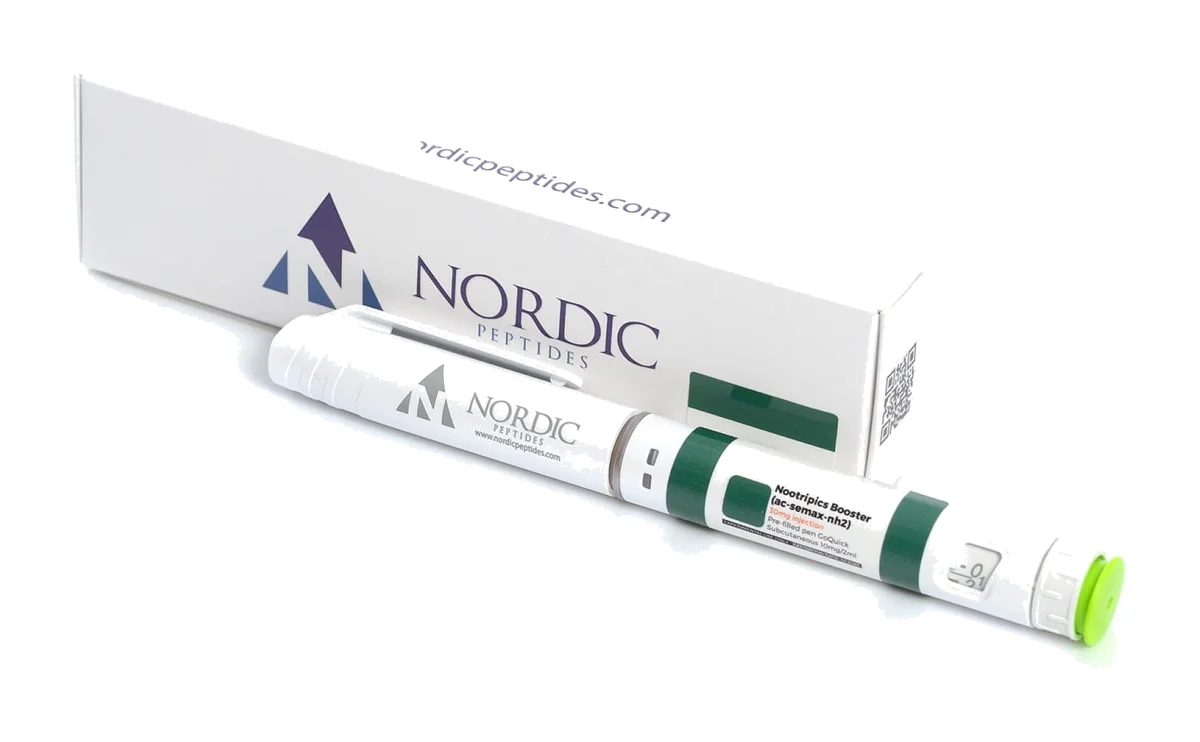 Nootropics Booster (ac-semax-nh2) - 30mg
Semax is a heptapeptide, Met-Glu-His-Phe-Pro-Gly-Pro: the ACTH(4-10) fragment with a C-terminal Pro-Gly-Pro tail. It is sold as a nootropic in Russia, where it has a registration history, and it appears in the indexed literature as a neuroprotective and neurotrophic agent. This page reports the numbers that the cited abstracts actually print, and marks the studies where no number is printed at all.
The one study with a printed binding constant
The 2006 J Neurochem paper is the anchor for mechanism, and it is a rat study. The authors applied the peptide intranasally and measured tritiated binding on cell membranes isolated from rat basal forebrain. They report that the binding was time dependent, specific and reversible; that it required calcium ions; and that it was characterised by a mean dissociation constant of 2.4 ± 1.0 nm and a BMAX of 33.5 ± 7.9 fmol/mg protein.
The same paper reports the functional readout. Semax applied intranasally at 50 and 250 microg/kg bodyweight produced a rapid increase in brain-derived neurotrophic factor levels after 3 hours in the basal forebrain, and not in the cerebellum. The authors conclude that the cognitive effects “might be associated, at least in part, with increased BDNF protein levels in this brain region” — note the hedge, which is theirs, not this page’s.
Every number in that paragraph is rodent. The species is named in the abstract; the brain region is named; the 3-hour window is named. What is not there is a human counterpart with the same measurements.
The human studies, and what their abstracts do not say
Two of the human records in the indexed literature are Russian-language journal reports whose PubMed abstracts carry no numbers at all.
The cerebrovascular insufficiency study examined 187 patients at different stages of cerebrovascular insufficiency, diagnosed on neurological and neuropsychological assessment, ultrasonic dopplerography, rheo- and encephalography, electrocardiography, brain MRI and fundoscopy. The abstract states that Semax treatment “resulted in significant clinical improvement, stabilization of the disease progress and reduced a risk of stroke and transitory ischemic attacks in the disease course,” and that the drug was well tolerated, including in older age groups. It prints no control arm description, no effect size, no p-value and no follow-up duration. The only count in the abstract is the 187 participants.
The glaucomatous optic neuropathy study reports that a neuroprotective complex including Semax showed “advantages of new therapy over traditional neuroprotective treatment” on electrophysiological and computer examination in glaucoma patients with normalised ophthalmic tone. It prints no numbers either.
Both records are indexed. Neither is a placebo-controlled trial with a readable outcome table in the abstract, so neither can be counted as evidence of a measured effect in the way the six-minute walk test or the Hamilton score can.
The one controlled human study
The 2020 Doklady Biological Sciences paper is the only controlled human study on this page. It used resting-state functional MRI in 52 healthy participants, taking images before, and 5 and 20 minutes after injection of Semax, Selank or placebo, with the amygdala and the dorsolateral prefrontal cortex defined as regions of interest. The authors report between-group and between-condition differences in functional connectivity between the right amygdala and regions of the right temporal and parahippocampal cortex, and describe the post hoc analysis as defining general and specific effects “for the first time.”
Read that carefully. The reported finding is a change in a connectivity readout. It is not a reported improvement in a cognitive test score, and the abstract prints no effect size.
The 2025 mechanistic paper
The most recent large mechanistic study is not human. The 2025 British Journal of Pharmacology paper used a spinal cord injury model in female C57BL/6 mice impacted at T9-T10, with functional recovery assessed by footprint analysis, Basso scores and inclined plane tests, alongside immunofluorescence, Western blot, RT-qPCR, transmission electron microscopy, RNA sequencing, network pharmacology and molecular docking. The authors report that Semax improved functional recovery and inhibited lysosomal membrane permeabilisation-related pyroptosis by decreasing oxidative stress; that RNA sequencing identified the ubiquitin specific protease USP18 as regulated; that USP18 knockdown confirmed the role; and that network pharmacology and docking revealed the μ-opioid receptor as a target. The proposed chain runs through USP18 to deubiquitination of the fat mass and obesity-associated protein (FTO).
This is a mouse mechanism paper. Its value here is that it is the most detailed current account of how the peptide may act. It is not evidence about effects in people.
The in-vitro amyloid work
A 2022 ACS Chemical Neuroscience paper studied Semax in artificial membrane models against copper-induced amyloid-β aggregation, using spectrofluorometry, calorimetry and MTT assays. The authors report that Semax prevents formation of the Aβ:Cu2+ complex and has anti-aggregating and protective properties, especially in the presence of Cu2+, and conclude that it inhibits fibre formation by interfering with the fibrillogenesis of the Aβ:Cu2+ complex. There is no human measurement in it.
What the data do not show
They do not show a placebo-controlled human trial of Semax with a printed cognitive outcome measure. The controlled human work cited here is an fMRI connectivity study in 52 healthy participants.
They do not show an effect size for the 187-patient cerebrovascular study or for the glaucoma study, because neither abstract prints one.
They do not separate the ACTH(4-10) fragment from the Pro-Gly-Pro tail, and they do not establish intranasal bioavailability in humans — the 50 and 250 microg/kg figures are rodent intranasal doses from a 2006 rat study.
They do not show a human spinal cord injury or stroke outcome trial, both of which are mechanistic findings in mice here.
Where this sits on the shelf
The compound as supplied by the manufacturer: Ac-Semax-NH2
What we supply
The Ac-Semax-NH2 preparation above, as supplied by the manufacturer, tracked, from inside the EU.
Research use only. This page summarises published studies for research reference. It is not medical advice, not a protocol, and not a suggestion for human use. Nothing we supply is for human or veterinary use.
References.
- Dolotov OV, Karpenko EA, Seredenina TS, et al. Semax, an analogue of adrenocorticotropin (4-10), binds specifically and increases levels of brain-derived neurotrophic factor protein in rat basal forebrain. J Neurochem 2006;97 Suppl 1:82-6.
- Gusev EI, Skvortsova VI, Chukanova EI. [Semax in prevention of disease progress and development of exacerbations in patients with cerebrovascular insufficiency]. Zh Nevrol Psikhiatr Im S S Korsakova 2005;105(2):35-40.
- Kurysheva NI, Shpak AA, Ioyleva EE, et al. [Semax in the treatment of glaucomatous optic neuropathy in patients with normalized ophthalmic tone]. Vestn Oftalmol 2001;117(4):5-8.
- Panikratova YR, Lebedeva IS, Sokolov OY, et al. Functional Connectomic Approach to Studying Selank and Semax Effects. Dokl Biol Sci 2020;490(1):9-11.
- Liu R, Chen Y, Huang H, et al. Semax peptide targets the μ opioid receptor gene Oprm1 to promote deubiquitination and functional recovery after spinal cord injury in female mice. Br J Pharmacol 2025;182(22):5489-5516.
- Sciacca MFM, Naletova I, Giuffrida ML, Attanasio F. Semax, a Synthetic Regulatory Peptide, Affects Copper-Induced Abeta Aggregation and Amyloid Formation in Artificial Membrane Models. ACS Chem Neurosci 2022;13(4):486-496.
10% off every product in your first order
Join the list for your welcome code plus early access to new research arrivals. No spam — unsubscribe anytime.