Tesamorelin and visceral fat: what the four HIV trials randomised
Tesamorelin is a GHRH(1-44) analogue and the only compound on this site with an approved indication — reducing excess abdominal fat in HIV-associated lipodystrophy. All four randomised trials cited here enrolled HIV patients on antiretroviral therapy, not people without HIV. The largest moved visceral adipose tissue by -15.2% against +5.0% on placebo over 26 weeks, and the effect reverses on stopping.
24 October 2026 · 4 min read
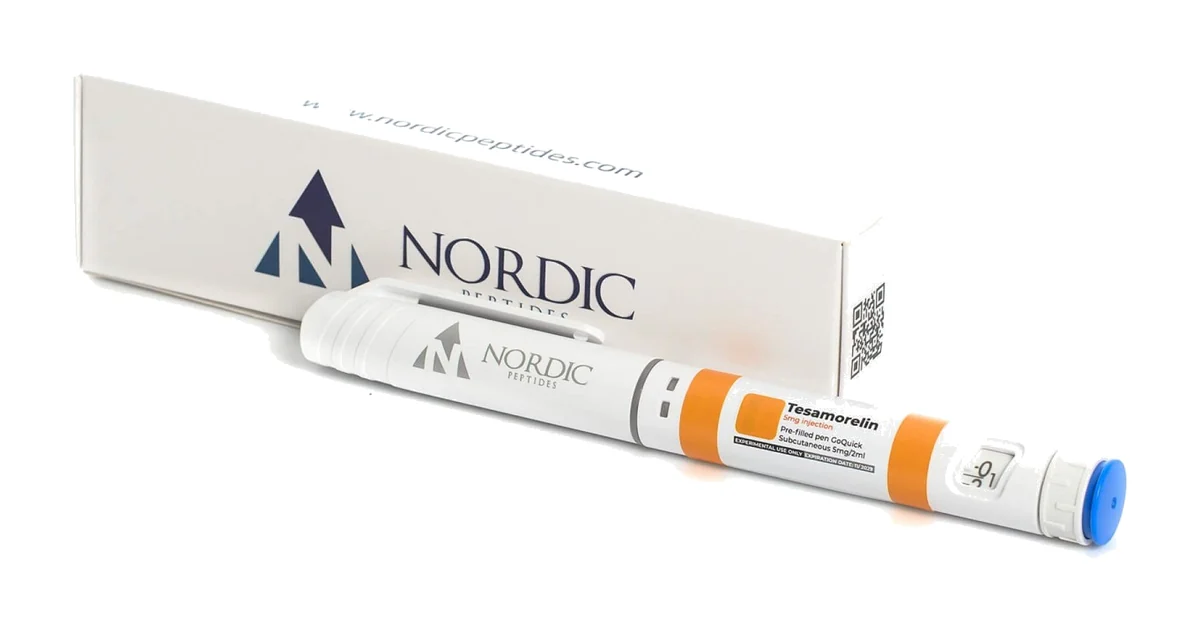 Tesamorelin - 5mg/2ml
Tesamorelin is a synthetic analogue of human growth hormone-releasing hormone, GHRH(1-44). It stimulates the synthesis and release of endogenous growth hormone. It is the first and, as the 2011 Drugs review puts it, so far only treatment indicated for the reduction of excess abdominal fat in patients with HIV-associated lipodystrophy.
That sentence sets the boundary for this entire page. Every randomised trial below enrolled HIV-infected patients on antiretroviral therapy who had developed central fat accumulation. No trial cited here enrolled a person without HIV.
The dose-ranging trial, 61 patients
The earliest of the four is a randomised, double-blind, placebo-controlled dose-ranging study in 61 HIV-infected patients with increased waist circumference and waist-to-hip ratio, randomised to placebo, 1 mg or 2 mg subcutaneous once daily for 12 weeks. The primary outcome was change in abdominal fat by dual energy X-ray absorptiometry and cross-sectional computed tomography.
IGF-I rose dose-relatedly: +48% on 1 mg and +65% on 2 mg against placebo (P < 0.01 for both). Trunk fat fell 0.8%, -4.6% and -9.2% on placebo, 1 mg and 2 mg respectively, with P = 0.014 for 2 mg against placebo. Visceral fat fell most in the 2 mg group, at -5.4%, -3.6% and -15.7% for placebo, 1 mg and 2 mg, but that change was not significant versus placebo — the trial says so in its own results section. Subcutaneous fat was preserved. Lean body mass and the VAT to SAT ratio improved significantly in both treatment groups against placebo.
The New England Journal trial, 412 patients
The 2007 NEJM paper randomised 412 patients with HIV, 86% of whom were men, to a daily subcutaneous injection of 2 mg tesamorelin or placebo for 26 weeks. The primary endpoint was percent change from baseline in visceral adipose tissue on computed tomography.
Visceral adipose tissue decreased by 15.2% in the tesamorelin group and increased by 5.0% in the placebo group. Triglycerides decreased by 50 mg per decilitre and increased by 9 mg per decilitre respectively, and the ratio of total cholesterol to HDL cholesterol decreased by 0.31 and increased by 0.21 respectively, with P<0.001 for all comparisons. Total cholesterol and HDL cholesterol also improved significantly in the tesamorelin group. IGF-I increased by 81.0% against a 5.0% decrease on placebo, P<0.001.
Two safety details are printed and both belong in any honest summary. Adverse events did not differ significantly between the groups, but more patients in the tesamorelin group withdrew from the study because of an adverse event. And no significant differences were observed in glycaemic measures.
The 404-patient extension
A 2010 JAIDS study randomised 404 HIV-infected patients with excess abdominal fat, in two sequential phases. In the primary efficacy phase, months 0-6, patients were randomised to tesamorelin 2 mg subcutaneous daily or placebo in a 2:1 ratio. In the extension phase, months 6-12, those on tesamorelin were rerandomised to continue or switch to placebo.
Visceral adipose tissue fell by -10.9% (-21 cm²) in the tesamorelin group against -0.6% (-1 cm²) on placebo, P < 0.0001. Trunk fat (P < 0.001), waist circumference (P = 0.02) and waist-to-hip ratio (P = 0.001) improved, with no change in limb or abdominal subcutaneous fat. IGF-I rose (P < 0.001) with no change in glucose parameters. Patient rating of belly appearance distress and physician rating of belly profile both improved at P = 0.02.
The durability data are the most useful part. Visceral fat was reduced by approximately 18% (P < 0.001) in patients continuing tesamorelin for 12 months, and the initial improvements over 6 months were rapidly lost in those switching from tesamorelin to placebo.
What the reviews add
The 2011 Drugs review states that subcutaneous tesamorelin was effective in reducing visceral adipose tissue but did not affect subcutaneous adipose tissue to a clinically significant extent in the two 26-week trials, that the reduction in visceral fat was maintained to week 52 in patients who continued treatment, and that discontinuation during that period resulted in reaccumulation. Treatment-emergent serious adverse events occurred in under 4% of patients during 26 weeks of therapy, most of them injection-site reactions or events known to be associated with growth hormone therapy — arthralgia, headache and peripheral oedema.
The 2011 HIV AIDS review makes the point this page exists to make explicit. The effect on central fat accumulation is transient, and its association with improved cardiovascular risk “remains unclear.”
What the data do not show
They do not show a visceral-fat or body-composition effect in people without HIV. Every randomised trial cited here is in antiretroviral-treated HIV patients with lipodystrophy.
They do not show a durable effect after stopping. The 404-patient trial reports that the improvements were rapidly lost on switching to placebo.
They do not show improved cardiovascular outcomes. The trials measured visceral fat, triglycerides and the cholesterol ratio; the 2011 review states the cardiovascular association is unclear.
They do not show a glucose or HbA1c effect. The 2007 trial found no significant differences in glycaemic measures and the 2010 trial no change in glucose parameters.
They do not show a significant visceral-fat effect at 1 mg over 12 weeks. The dose-ranging trial prints the visceral-fat change as not significant versus placebo.
Where this sits on the shelf
The compound as supplied by the manufacturer: Tesamorelin
What we supply
The tesamorelin preparation above, as supplied by the manufacturer, tracked, from inside the EU.
Research use only. This page summarises published studies for research reference. It is not medical advice, not a protocol, and not a suggestion for human use. Nothing we supply is for human or veterinary use.
References.
- Falutz J, Allas S, Blot K, et al. Metabolic effects of a growth hormone-releasing factor in patients with HIV. N Engl J Med 2007;357(23):2359-70.
- Falutz J, Potvin D, Mamputu JC, et al. Effects of tesamorelin, a growth hormone-releasing factor, in HIV-infected patients with abdominal fat accumulation: a randomized placebo-controlled trial with a safety extension. J Acquir Immune Defic Syndr 2010;53(3):311-22.
- Falutz J, Allas S, Kotler D, et al. A placebo-controlled, dose-ranging study of a growth hormone releasing factor in HIV-infected patients with abdominal fat accumulation. AIDS 2005;19(12):1279-87.
- Dhillon S. Tesamorelin: a review of its use in the management of HIV-associated lipodystrophy. Drugs 2011;71(8):1071-91.
- Bedimo R. Growth hormone and tesamorelin in the management of HIV-associated lipodystrophy. HIV AIDS (Auckl) 2011;3:69-79.
10% off every product in your first order
Join the list for your welcome code plus early access to new research arrivals. No spam — unsubscribe anytime.