Semaglutide: what the STEP programme showed — and what happened when people stopped
14.9% at 68 weeks made semaglutide famous. The trial extension, which gets far less attention, is the part that explains what the drug actually does.
19 August 2026 · 3 min read
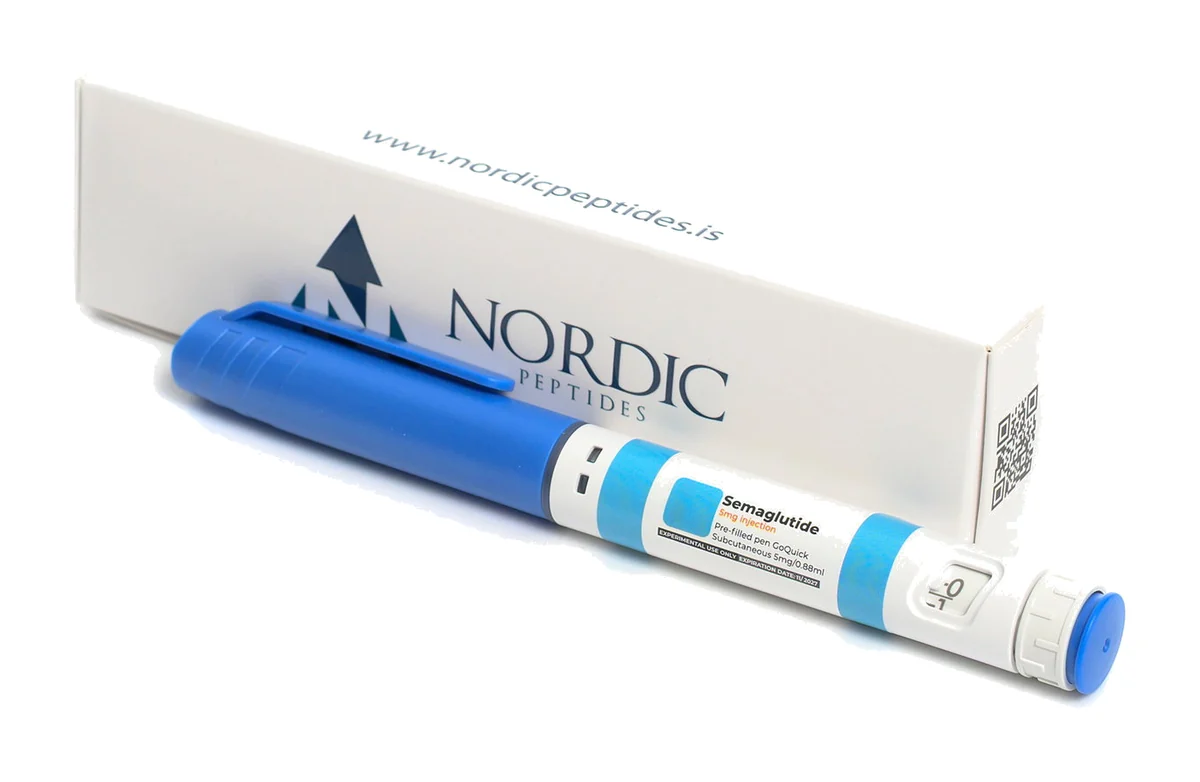 Semaglutide - 5mg
Semaglutide is the compound that turned GLP-1 agonism from a diabetes story into a metabolic one. It is also the most thoroughly studied peptide in our catalog by a wide margin — the STEP programme alone runs to eight phase 3 trials, and the cardiovascular outcomes trial that followed enrolled more than 17,000 people.
Which means there is no excuse for vague claims here. The numbers exist.
STEP 1: the trial everyone quotes
STEP 1 randomised 1,961 adults with overweight or obesity, without diabetes, to semaglutide 2.4 mg once weekly or placebo, both with lifestyle intervention, for 68 weeks. Published in The New England Journal of Medicine in March 2021.
Mean weight change: −14.9% on semaglutide against −2.4% on placebo. 86% of participants on the drug lost at least 5% of body weight; roughly a third lost 20% or more.
For a single agent, and at the time it was published, that was a step change — the previous generation of obesity drugs sat in the 5–10% range.
STEP 2: the same drug, a harder population
STEP 2 asked what happens in people who also have type 2 diabetes — a group that consistently loses less weight on any intervention. 1,210 adults, again 68 weeks, published in The Lancet in 2021.
Mean weight change: −9.6% on semaglutide 2.4 mg against −3.4% on placebo.
Lower than STEP 1, and that gap is the useful information. Diabetes changes the response; a trial result in one population does not transfer to another. Anyone quoting “15%” as a universal number for semaglutide is quoting the easier trial.
The extension nobody links to
Here is the part that matters most and gets cited least.
A subset of STEP 1 participants was followed for a year after the trial drug and lifestyle intervention stopped. Within that year, participants regained roughly two-thirds of the weight they had lost, and the improvements in cardiometabolic markers — blood pressure, lipids, HbA1c — moved back toward baseline along with it.
That result is not a failure of the drug. It is a description of what the drug is: a treatment that works while it is being given, on a condition that does not resolve when it stops. Whether that is worth knowing before starting is a question for a physician, not a supplier — but the data should not be hidden in a supplementary appendix.
SELECT: the outcomes trial
The 2023 SELECT trial answered a different question — not “does it reduce weight” but “does it reduce events”. 17,604 adults with established cardiovascular disease and overweight or obesity, without diabetes, followed for around 40 months.
Semaglutide 2.4 mg reduced the composite endpoint of cardiovascular death, non-fatal myocardial infarction and non-fatal stroke by 20% versus placebo. Mean weight change in the trial was −9.4% versus −0.9%.
This is the strongest evidence in the whole GLP-1 field, and the reason semaglutide occupies a different regulatory position from every other compound discussed on this site.
Adverse events
Gastrointestinal, dose-related, concentrated in the escalation phase: nausea, diarrhoea, vomiting, constipation. In the head-to-head trial against tirzepatide, gastrointestinal events led to discontinuation in 5.6% of semaglutide participants. Serious adverse events were not increased over placebo in SELECT.
Where it sits against the newer molecules
Semaglutide targets one receptor. Tirzepatide adds GIP and reached −20.2% against semaglutide’s −13.7% in the only head-to-head trial. Retatrutide adds a third receptor and reached 24.2% in phase 2.
But semaglutide is the only one of the three with a completed cardiovascular outcomes trial behind it. Newer is not the same as better-evidenced.
What we supply
Semaglutide 5 mg pens from Nordic Peptides, shipped as supplied by the manufacturer, batch documentation on request. Research use only — not for human or veterinary use.
References.
- Wilding JPH, Batterham RL, Calanna S, et al. Once-Weekly Semaglutide in Adults with Overweight or Obesity (STEP 1). N Engl J Med 2021;384(11):989–1002.
- Davies M, Færch L, Jeppesen OK, et al. Semaglutide 2·4 mg once a week in adults with overweight or obesity, and type 2 diabetes (STEP 2). Lancet 2021;397(10278):971–984.
- Wilding JPH, Batterham RL, Davies M, et al. Weight regain and cardiometabolic effects after withdrawal of semaglutide: the STEP 1 trial extension. Diabetes Obes Metab 2022.
- Lincoff AM, Brown-Frandsen K, Colhoun HM, et al. Semaglutide and Cardiovascular Outcomes in Obesity without Diabetes (SELECT). N Engl J Med 2023.