BPC-157 and the gut barrier: what has been shown
The gut evidence is entirely rat models. The human record is a 12-patient case series on knees, a two-person pharmacokinetic pilot, and nothing else.
9 October 2026 · 6 min read
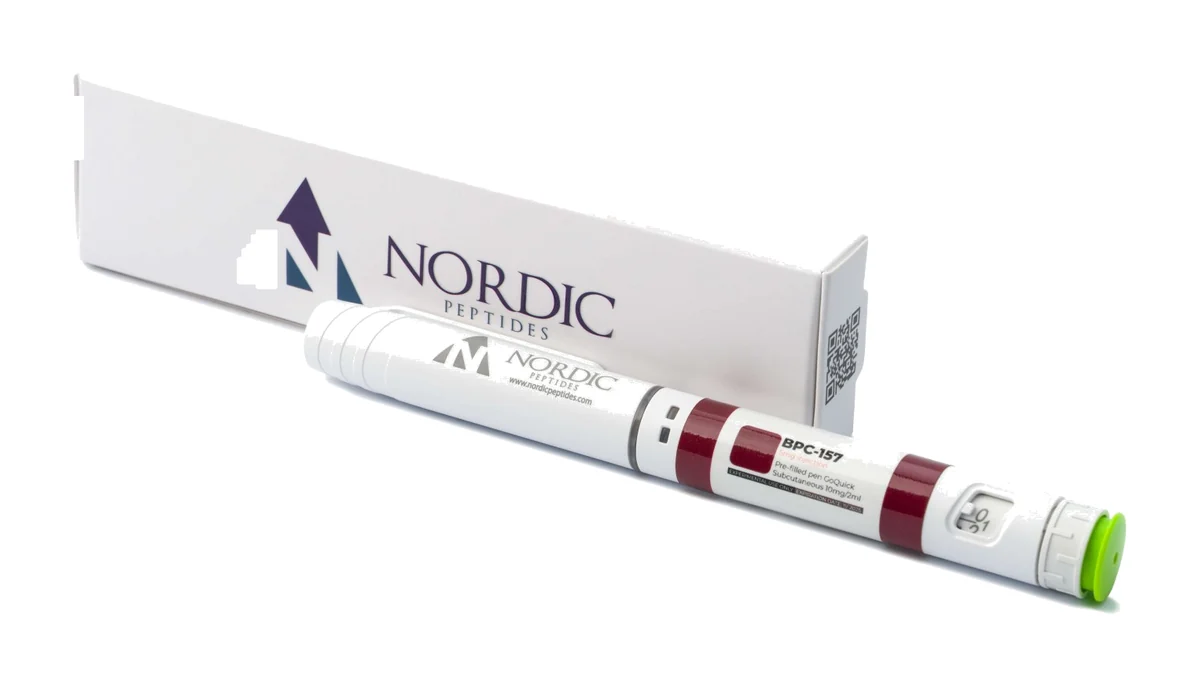 BPC-157 - 5mg
BPC-157 is the peptide with the widest gap between what is said about it and what has been measured in people. The gap is not subtle and it is not a matter of degrees: for the gut, the entire human-side record is small enough to print in a paragraph, and most of it does not involve the gut at all.
The human record, in full
The most recent review to address the translational question directly is a 2026 narrative review in Pharmaceutics, and it puts the number in a sentence rather than hiding it in a paragraph. Available clinical data derive from fewer than 30 subjects across three uncontrolled pilot studies, none of which employed standardized pharmaceutical preparations. The same abstract notes that there is no approved formulation, no validated regimen and no completed Phase II clinical trial.
Even smaller than that headline number is the human pharmacokinetic data. The review states that a sub-30-minute plasma half-life is confirmed preclinically and in a preliminary two-subject human pilot. Two people. That is the entire human pharmacokinetic dataset, and it is worth naming because most of the internet’s confidence about this compound’s behaviour comes from pretending it is larger.
The orthopaedic systematic review counted the literature precisely. Of 544 articles identified between 1993 and 2024, 36 were included: 35 preclinical studies and 1 clinical study. That single clinical study was a retrospective series on intra-articular injection for unspecified chronic knee pain, in which 7 of 12 patients reported relief for more than six months. Twelve people, no comparator, retrospective, an unspecified indication, and a self-reported outcome. The review’s own safety line is blunt: no clinical safety data were found.
The 2026 primer in the American Journal of Sports Medicine reaches the same place from the other side. It says the findings are largely unvalidated in human trials, that a single human case series reported pain improvement after intra-articular knee injections, and that significant methodological flaws and a lack of controls limit its applicability and reliability. It also states that the indications, the amounts, the frequency and the duration of treatment remain unknown.
Note what the one clinical study is about: knees. Not gut. The only human outcome data this molecule has involves an intra-articular injection into a joint for unspecified chronic pain.
The gut evidence is entirely rodent
Everything said about the gastrointestinal tract comes from rats, and mostly from one laboratory’s series. The wound-healing review enumerates the models: cutaneous, incisional and excisional wounds, deep burns, diabetic ulcers and alkali burns, plus colocutaneous, gastrocutaneous, oesophagocutaneous, duodenocutaneous, vesicovaginal and rectovaginal fistulas. Every one of them is a rat. The paper’s own framing is that these findings may be generalised to other tissues, which is a proposal about biology, not a measurement in people.
The muscular and tendon review, which is the most-cited summary of the healing literature, states the situation in one line: the majority of studies have been performed on small rodent models and the efficacy of BPC 157 is yet to be confirmed in humans. It adds that over the past two decades only a handful of research groups have performed in-depth studies on this peptide. Concentration of a literature in a small number of laboratories is a reason to read each paper closely, not a reason to discount it, and it is also a reason not to count papers as independent replications.
What the animal papers actually print
This matters, because the percentages that circulate in the supplement trade do not come from the animal papers either. The tendon study that is most often cited measured rats with the Achilles tendon transected 5 mm proximal to its calcaneal insertion, with the peptide given at 10 micrograms, 10 nanograms or 10 picograms per kilogram intraperitoneally once daily, the first application 30 minutes after surgery and the last 24 hours before autopsy, assessed on days 1, 4, 7, 10 and 14.
The endpoints were the Achilles functional index, load of failure, load of failure per area, Young’s modulus of elasticity, mononuclear and granulocyte counts, fibroblast, reticulin and collagen formation, and the size and depth of the tendon defect. Those are real measurements and the results were favourable. None of them is a percentage of recovery time. There is no figure in that abstract of the form that gets quoted in marketing, and the same is true of the muscle paper, which followed quadriceps transected 1.0 cm proximal to the patella over a 72-day period and reported increased load of failure, walking recovery and extensor postural thrust returning toward normal, absent gap between the stumps, and desmin positivity for ongoing regeneration.
So the honest version of the story: the animal literature reports functional indices and mechanical endpoints in rats, and the widely repeated percentage figures for healing speed in people have no indexed primary source that this page can point to.
The mechanism, and the one experiment that is worth reading
The angiogenesis work is the most interesting of the animal papers because it shows how much of the argument depends on the living system. In cell culture there was no direct angiogenic effect of BPC 157. In vivo, immunohistochemistry for VEGF, CD34 and factor VIII in crushed and transected muscle and tendon showed adequately modulated angiogenesis in treated animals. The same molecule, the same paper, no effect in the dish and an effect in the animal. That is a genuine biological observation and it is also a warning: a compound whose measurable behaviour requires an intact organism is the compound where in vitro substitution is least safe.
The pharmacokinetics reinforce it. The preclinical ADME work confirms a sub-30-minute plasma half-life with linear exposure proportionality, and intramuscular bioavailability of 14 to 51 % depending on species. A molecule that is gone from plasma in under half an hour while producing biological effects that last hours to days creates exactly the disconnect the review describes, and the review’s conclusion is that this has significant implications for regimen design and formulation design.
What the safety literature does and does not contain
Two things are true at once and they are easy to confuse. The preclinical safety record is clean: the reviews report no adverse reactions across several organ systems in animal models. And the human safety record is empty: the HSS systematic review says outright that no clinical safety data were found, and adds that adverse effects are possible because of unregulated manufacturing, contamination or unknown clinical safety. Absence of a finding is not a finding of absence, and a clean rodent toxicology package is not a human safety assessment.
The synthesis point is the sentence both 2026 reviews land on. The primary barrier to clinical translation, the Pharmaceutics abstract says, is not the absence of biological activity, it is the absence of fundamental pharmaceutical science: characterized formulations, validated pharmacokinetics and a coherent development strategy.
Where this sits on the shelf
The BPC-157 pen is the compound on this page. The other three pages on it are worth reading in this order: what the evidence says for the general shape of the literature, the rat tendon studies for the musculoskeletal models in detail, and the recovery stack for the combination. None of them is about the gut, which is why this page exists.
What the data do not show
They do not show a gastrointestinal measurement in a human being, because no indexed study reports one. They do not show a human half-life beyond the two-subject pilot, and they do not show the distribution of that number, because two subjects cannot give one. They do not show a percentage improvement in healing speed, because the rodent papers print functional indices and load to failure instead. They do not show human safety data, because the systematic review found none. And they do not show that the gut findings replicate outside one laboratory’s rat series, because the reviews describe a small number of groups doing in-depth work over two decades.
What we supply
The BPC-157 pen above, as supplied by the manufacturer, tracked, from inside the EU.
Research use only. This page summarises published studies for research reference. It is not medical advice, not a protocol, and not a suggestion for human use. Nothing we supply is for human or veterinary use.
References.
- Mateescu DM, Gavrilescu DM, Constantinescu FE, Oancea C. BPC-157 as an Investigational Peptide Therapeutic: Biopharmaceutical Challenges, Formulation Strategies, and Translational Development Barriers. Pharmaceutics 2026;18(5):625.
- Vasireddi N, Hahamyan H, Salata MJ, Karns M, et al. Emerging Use of BPC-157 in Orthopaedic Sports Medicine: A Systematic Review. HSS J 2025;21(4):485-495.
- Mayfield CK, Bolia IK, Feingold CL, Lin EH, et al. Injectable Peptide Therapy: A Primer for Orthopaedic and Sports Medicine Physicians. Am J Sports Med 2026;54(1):223-229.
- Gwyer D, Wragg NM, Wilson SL, et al. Gastric pentadecapeptide body protection compound BPC 157 and its role in accelerating musculoskeletal soft tissue healing. Cell Tissue Res 2019;377(2):153-159.
- Staresinic M, Sebecic B, Patrlj L, Jadrijevic S, et al. Gastric pentadecapeptide BPC 157 accelerates healing of transected rat Achilles tendon and in vitro stimulates tendocytes growth. J Orthop Res 2003;21(6):976-983.
- Staresinic M, Petrovic I, Novinscak T, Jukic I, et al. Effective therapy of transected quadriceps muscle in rat: Gastric pentadecapeptide BPC 157. J Orthop Res 2006;24(5):1109-1117.
- Brcic L, Brcic I, Staresinic M, Novinscak T, et al. Modulatory effect of gastric pentadecapeptide BPC 157 on angiogenesis in muscle and tendon healing. J Physiol Pharmacol 2009;60 Suppl 7:191-196.
- Seiwerth S, Milavic M, Vukojevic J, Gojkovic S, et al. Stable Gastric Pentadecapeptide BPC 157 and Wound Healing. Front Pharmacol 2021;12:627533.
10% off every product in your first order
Join the list for your welcome code plus early access to new research arrivals. No spam — unsubscribe anytime.