Ipamorelin and CJC-1295: the GH-axis pairing labs ask for by name
Two doors into the same output, in one pre-filled pen. Why this combination became the default in growth-hormone research, what the human data covers, and the label detail almost every shop gets wrong.
27 August 2026 · 4 min read
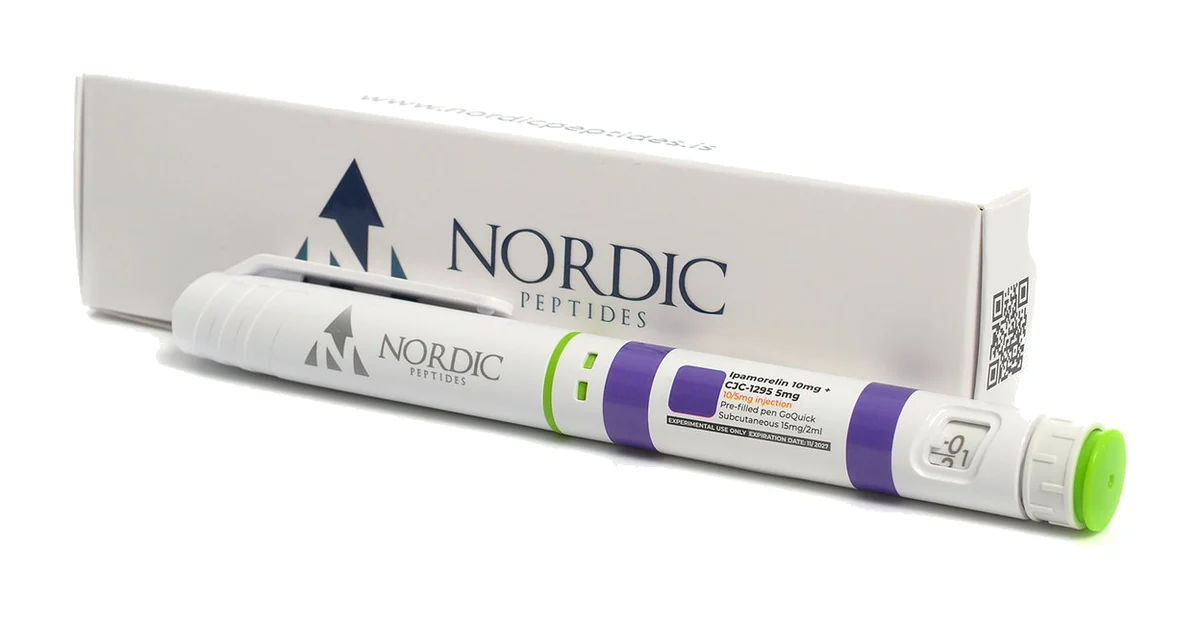 Ipamorelin and CJC-1295 No DAC (Blend) - 10/5mg
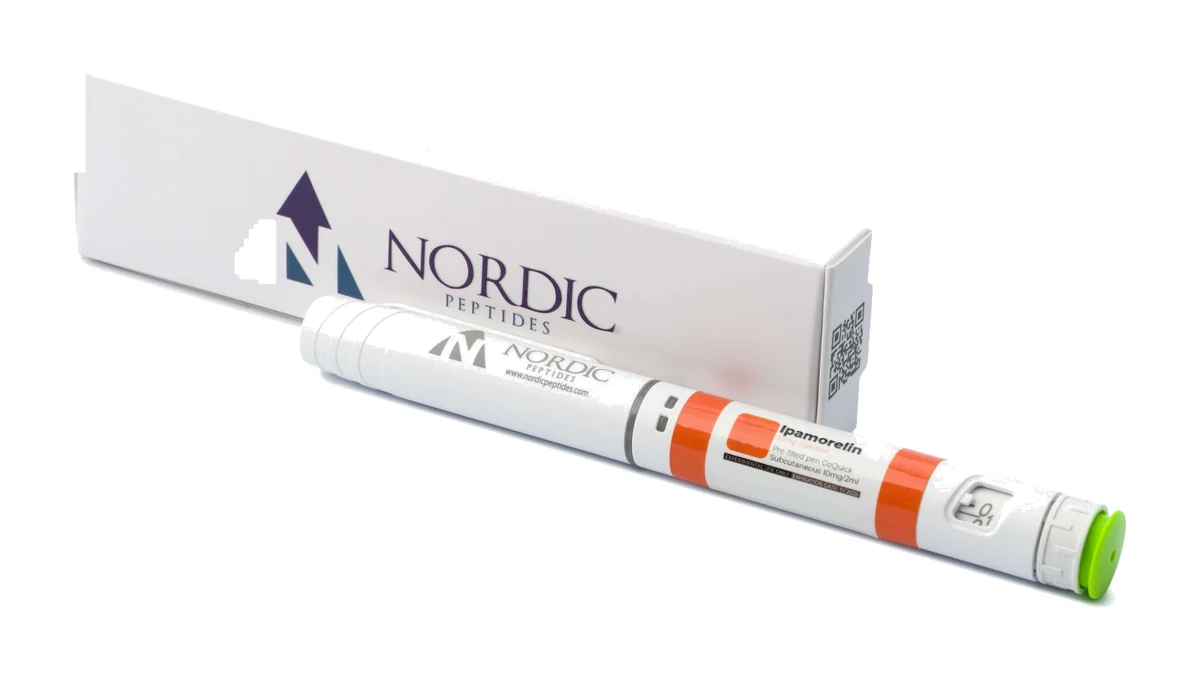
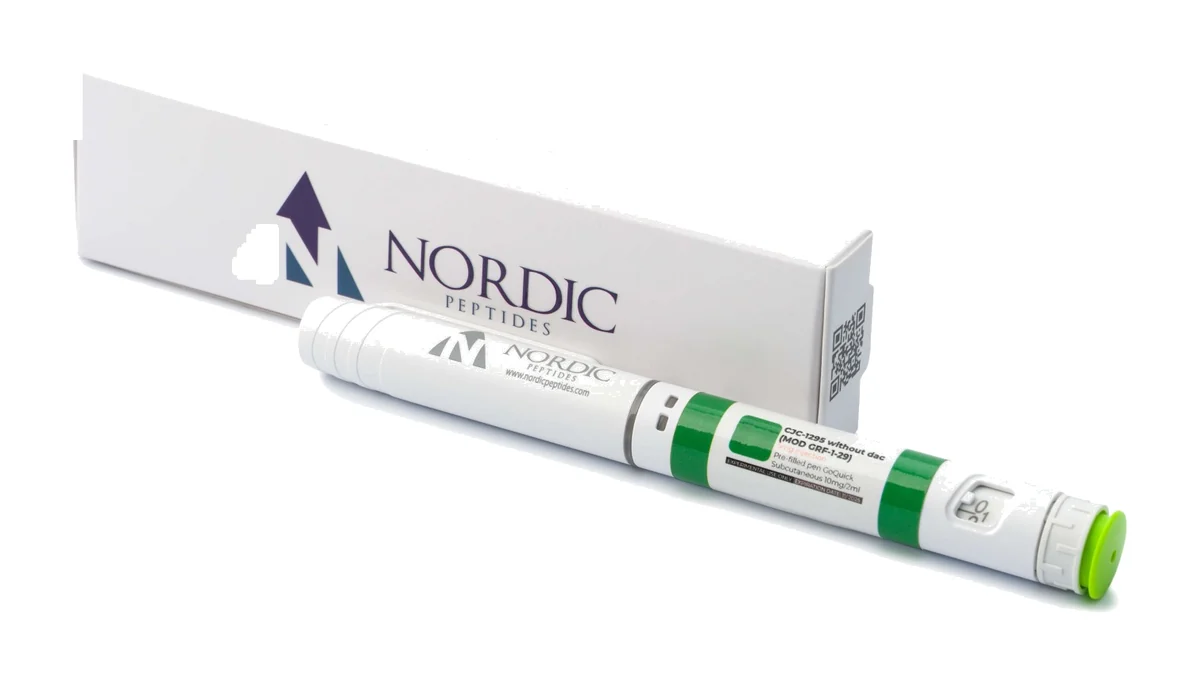
Ask anyone working on the growth-hormone axis what they are running and you will hear the same two names together. Ipamorelin with CJC-1295 has been the default pairing in this category for the better part of a decade, and Nordic Peptides sell it as a single pre-filled pen for the same reason it became the default: it is two levers on one system, and running them from one cartridge is simply easier.
Why two peptides instead of a bigger dose of one
There are two independent inputs into growth hormone release, and this pairing uses one each.
CJC-1295 is an analogue of growth hormone-releasing hormone. It works on the GHRH receptor — the same door tesamorelin knocks on, and tesamorelin is the one compound in this family with an FDA approval and a phase 3 behind it.
Ipamorelin is a pentapeptide that works on the ghrelin receptor — the other pathway entirely.
Two inputs, one output. That is a different proposition from doubling either peptide on its own, and it is the reason the combination has stayed popular while individual compounds have come and gone.
Ipamorelin’s actual selling point: what it does not do
The older growth-hormone secretagogues work, and they bring passengers. GHRP-6 drives appetite hard. GHRP-2 sits in between. Raun et al. described ipamorelin in 1998 as the first selective GH secretagogue, and selectivity is the entire point of the molecule: in that work it released GH without raising ACTH or cortisol beyond what GHRH stimulation itself produced.
For a research setting that is worth real money. A compound that moves one variable is a compound whose results you can interpret. If you want the side-by-side across all three ghrelin-receptor peptides, we compared them here.
The label detail almost nobody checks
The 2006 paper everyone cites for “CJC-1295” tested the version with DAC — a Drug Affinity Complex that binds the peptide to albumin and stretches its half-life to days. In healthy adults, a single injection produced dose-dependent increases in mean plasma GH of 2- to 10-fold for six days or more, and IGF-1 of 1.5- to 3-fold for 9–11 days.
What is sold across this market as “CJC-1295 no DAC” is a different molecule: modified GRF (1-29), half-life in minutes. Both versions are legitimate — a short-acting analogue gives you a pulse, a long-acting one a plateau — but a study on one is not evidence for the other.
Our label says no DAC because that is what is in the pen. A shop quoting six-day figures next to a no-DAC cartridge is either careless or counting on you not to check. The full untangling is here.
What the manufacturer says, and what the evidence covers
Nordic Peptides describe the blend as designed to stimulate GH release from the pituitary while “minimizing potential side effects associated with the use of each component separately”, and list muscle growth, repair, fat metabolism, sleep and anti-aging support among its intended research applications. That is their text, published in full on the product page, and it is theirs — we neither wrote it nor endorse it.
What the published record supports is narrower and worth stating plainly: the mechanism is well described, the pharmacokinetics of the DAC version are documented in humans, and the efficacy question — does any of this change an outcome in a healthy person — has not been answered by a trial for either compound. Tesamorelin is the only molecule in this family that got that far, and its approval is for a narrow indication.
That is the honest frame. Within it, this is one of the best-characterised pairings we sell.
Why the blend pen sells better than the singles
One pen, one dial, fixed ratio. 10 mg ipamorelin and 5 mg CJC-1295 no DAC in a factory-filled cartridge, mixed by the manufacturer. Every unit identical to the last — which is the point of a pen.
No reconstitution. No bacteriostatic water, no dilution arithmetic, no second septum to puncture. The most common source of error in this category is removed before it starts.
One order, one shipment, one shelf slot. Our delivery fee is flat and per order, so a stack that arrives in one cartridge is the cheapest way to run it.
And the same honest caveat as every blend: it cannot tell you which peptide produced which effect. For attribution, buy ipamorelin and CJC-1295 separately. For convenience, the blend wins. IGF-1 is the readable output either way — GH itself is pulsatile and awkward to measure.
What we supply
The ipamorelin + CJC-1295 no DAC blend (10/5 mg), both compounds on their own, and the GHRP-6 + CJC-1295 blend for the appetite-driven variant — all Nordic Peptides pre-filled pens, shipped as supplied, tracked, from inside the EU, in a plain box.
The rest of the GH-axis shelf is in the catalog, and the front page is the short way in.
Research use only. Not for human or veterinary use, and nothing on this page is medical advice.
References.
- Teichman SL, Neale A, Lawrence B, et al. Prolonged stimulation of growth hormone (GH) and insulin-like growth factor I secretion by CJC-1295, a long-acting analog of GH-releasing hormone, in healthy adults. J Clin Endocrinol Metab 2006;91(3):799–805.
- Raun K, Hansen BS, Johansen NL, et al. Ipamorelin, the first selective growth hormone secretagogue. Eur J Endocrinol 1998;139(5):552–561.
- Falutz J, Allas S, Blot K, et al. Metabolic Effects of a Growth Hormone–Releasing Factor in Patients with HIV. N Engl J Med 2007;357(23):2359–2370.