KPV: three amino acids off the end of α-MSH, and where its evidence actually sits
The mechanism is unusually well worked out — KPV enters cells through PepT1, a transporter that is upregulated exactly where gut inflammation is. Every efficacy result is a mouse or a cell line, and the colitis work was oral, not injected.
1 September 2026 · 4 min read
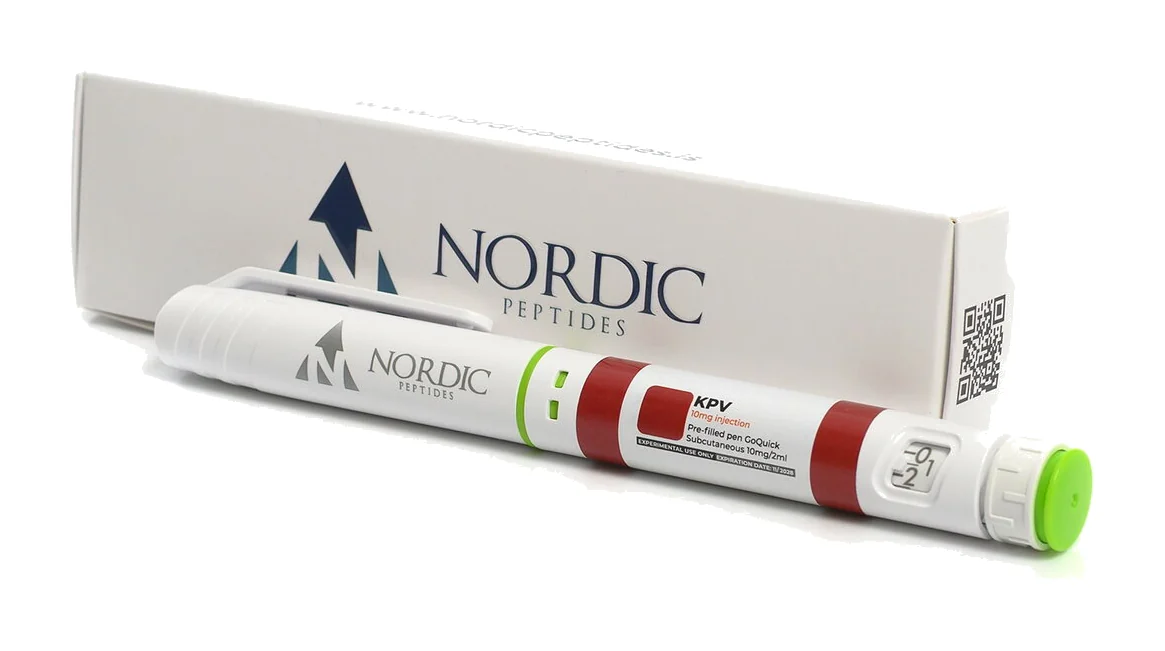 KPV Peptide - 10mg
KPV is the shortest compound in this catalog — three residues, Lys-Pro-Val — and it comes off the C-terminal end of α-melanocyte-stimulating hormone, where it is also written α-MSH(11-13). Short peptides are usually short on evidence too. This one is an exception on mechanism and a very ordinary case on outcomes, and separating those two is the whole point of the page.
KPV sits on the same repair shelf as BPC-157 and TB-500, and it is worth saying up front how it differs: those two are read for tendon, muscle and wound models, while KPV’s file is almost entirely about inflammation in the gut.
The mechanism is genuinely well characterised
Dalmasso et al. did the work that gave the compound its reputation, and they did it properly.
In human intestinal epithelial cells (Caco2-BBE, HT29-Cl.19A) and human T cells (Jurkat) stimulated with pro-inflammatory cytokines, nanomolar concentrations of KPV inhibited activation of the NF-κB and MAP kinase signalling pathways and reduced pro-inflammatory cytokine secretion. Using radiolabelled peptide and competition experiments, they then established how it gets in: through PepT1, the di/tripeptide transporter — not through a melanocortin receptor.
That detail is the interesting one commercially as well as scientifically. PepT1 is normally expressed in the small intestine and is induced in the colon during inflammatory bowel disease. The transport route concentrates the peptide where the inflammation already is. In mice, oral KPV added to drinking water reduced the incidence of both DSS- and TNBS-induced colitis, with lower pro-inflammatory cytokine expression.
And it was reproduced independently
Kannengiesser et al., working separately, tested KPV in two mouse colitis models. In DSS colitis, treated animals recovered earlier and regained significantly more body weight, with significantly fewer inflammatory infiltrates on histology and significantly reduced myeloperoxidase activity in colonic tissue. The same pattern appeared in CD45RB-high transfer colitis.
They also ran it in mice carrying a non-functional melanocortin-1 receptor, and KPV rescued every animal in the treatment group from death during DSS colitis. Two independent groups, two mechanisms of entry examined, one consistent conclusion: the anti-inflammatory effect is at least partly independent of MC1R.
For a three-residue peptide, that is a stronger mechanistic file than most of the shelf.
Where it stops
There are no clinical trials. Not few — none. Filter a PubMed search for KPV to the randomised-controlled-trial and clinical-trial publication types and the result is zero records.
Every efficacy result above is a mouse. Every result in human material is a cell line in a dish. Nobody has established a human dose, a human safety profile or a human effect size, and no regulator anywhere has approved a KPV product.
The route question matters more here than usual
This is the part most often skipped. The colitis work that makes KPV interesting was oral — peptide in drinking water, absorbed through an intestinal transporter that inflammation had upregulated. The pharmacology of that experiment is inseparable from the route.
An injected tripeptide is a different question entirely, and the published literature does not answer it. Anyone citing Dalmasso or Kannengiesser in support of a systemic protocol is citing an oral study for a parenteral claim.
The formulation literature that followed makes the same point from the other direction: the subsequent papers are largely about holding KPV at the target site — mucoadhesive hydrogels for oral mucositis, double-network hydrogels for the inflamed colon, nanoparticle carriers. The field has spent the years since Dalmasso on delivery precisely because getting a three-residue peptide to stay where it is useful is the hard part.
The skin and eye line
The other family of results is topical, and it is the strongest single outcome in the file. Bonfiglio et al. abraded the entire corneal epithelium in rabbits and treated with KPV drops four times daily for four days. At 60 hours, eight out of eight corneas treated with KPV were completely re-epithelialised, while none of the placebo corneas were (P<0.05). Pre-treatment with the nitric oxide synthase inhibitor L-NAME blocked the effect, which is how the paper places nitric oxide in the pathway.
That is a clean, well-controlled result — topically applied, in rabbits, on an eye. As with GHK-Cu, a topical result in an epithelium is not evidence for a systemic effect elsewhere.
What the data does not show
No human trial of any kind. No established human dose or safety profile. No approval. No evidence for the injected route, which is how the compound is normally supplied. And no direct comparison against anything already used for the conditions the mouse models represent.
What it does show is a specific, reproducible, independently confirmed anti-inflammatory mechanism in murine colitis and human cell lines, with an unusually clear account of how the peptide gets into a cell.
What we supply
KPV Peptide, Nordic Peptides pen, shipped as supplied by the manufacturer, batch documentation on request. Storage as printed by the manufacturer on the product page. Research use only — not for human or veterinary use, and nothing here is medical advice.
References.
- Dalmasso G, Charrier-Hisamuddin L, Nguyen HT, et al. PepT1-mediated tripeptide KPV uptake reduces intestinal inflammation. Gastroenterology 2008;134(1):166–178 (PMID 18061177).
- Kannengiesser K, Maaser C, Heidemann J, et al. Melanocortin-derived tripeptide KPV has anti-inflammatory potential in murine models of inflammatory bowel disease. Inflamm Bowel Dis 2008;14(3):324–331 (PMID 18092346).
- Bonfiglio V, Camillieri G, Avitabile T, et al. Effects of the COOH-terminal tripeptide alpha-MSH(11-13) on corneal epithelial wound healing: role of nitric oxide. Exp Eye Res 2006;83(6):1366–1372 (PMID 16965771).
- Shao W, Chen R, Lin G, et al. In situ mucoadhesive hydrogel capturing tripeptide KPV: the anti-inflammatory, antibacterial and repairing effect on chemotherapy-induced oral mucositis. Biomater Sci 2021;10(1):227–242 (PMID 34846053).
- Zhao Y, Xue P, Lin G, et al. A KPV-binding double-network hydrogel restores gut mucosal barrier in an inflamed colon. Acta Biomater 2022;143:233–252 (PMID 35245681).