Tesofensine: a phase 2 result that never became a phase 3 paper
The 2008 Lancet trial is real, and the numbers in it are large. What followed is the part nobody quotes — an Expression of Concern from the journal, no published phase 3 anywhere in the indexed literature, and no approval in the EU or the US.
4 September 2026 · 6 min read
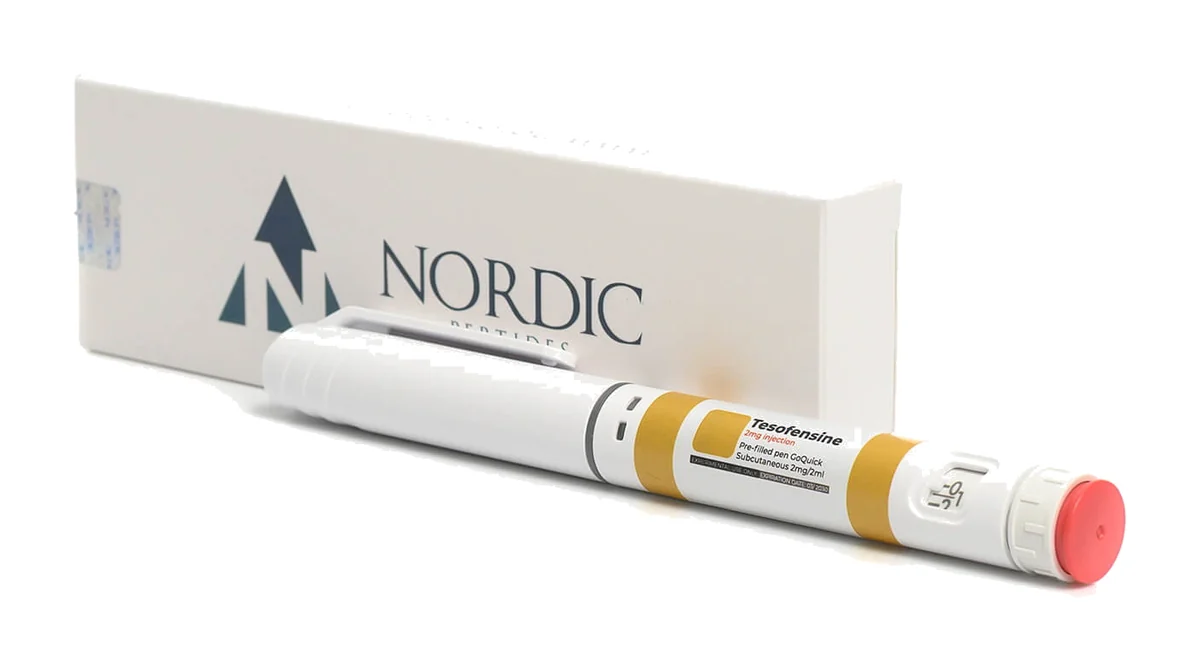 Tesofensine - 2mg/2ml
Almost every compound on the metabolic shelf is a peptide. Tesofensine is not. It is a small molecule that blocks the presynaptic reuptake of noradrenaline, dopamine and serotonin — a triple monoamine reuptake inhibitor — and it works on appetite from the brain rather than from the gut hormone system that semaglutide and tirzepatide exploit.
It also has one of the most-quoted and least-read files in this catalog.
It was not designed for weight
Tesofensine was developed by NeuroSearch, initially with Boehringer Ingelheim, for neurodegenerative conditions. It was ineffective there. What the neurology programme did produce was a signal nobody was looking for: a notable occurrence of unintended weight loss in treated participants. The obesity programme is a repurposing of a failed drug, which is a perfectly respectable origin — but it means the compound’s first properly powered obesity trial is also, in effect, its first real hypothesis test.
The trial everyone cites
Astrup et al., Lancet, 2008. A phase 2, randomised, double-blind, placebo-controlled trial across five Danish obesity management centres. 203 patients with a BMI of 30–40 kg/m² were put on an energy-restricted diet and randomised to tesofensine 0.25 mg (n=52), 0.5 mg (n=50), 1.0 mg (n=49) or placebo (n=52), once daily for 24 weeks. 161 participants (79%) completed.
The primary outcome was percentage change in bodyweight. After 24 weeks:
- diet and placebo: 2.0% (SE 0.60)
- tesofensine 0.25 mg and diet: 4.5% (0.87)
- tesofensine 0.5 mg and diet: 9.2% (0.91)
- tesofensine 1.0 mg and diet: 10.6% (0.84)
all greater than diet and placebo, p<0.0001. The authors’ own conclusion was measured: tesofensine 0.5 mg “might have the potential to produce a weight loss twice that of currently approved drugs” — followed immediately by the sentence that gets left out of every product page quoting this trial — “However, these findings of efficacy and safety need confirmation in phase III trials.”
The most common adverse events attributed to the drug were dry mouth, nausea, constipation, hard stools, diarrhoea and insomnia. At 24 weeks the 0.25 mg and 0.5 mg groups showed no significant increase in systolic or diastolic blood pressure against placebo — but heart rate rose by 7.4 beats per minute in the 0.5 mg group (p=0.0001).
Then the journal published an Expression of Concern
This is the part that separates a sourced page from a marketing page. In April 2013, The Lancet published an Expression of Concern about that 2008 paper (Lancet 2013;381(9873):1167). The authors replied in July of the same year in a letter titled, plainly, “Under-reporting of adverse effects of tesofensine” (Lancet 2013;382(9887):127).
The paper has not been retracted and the efficacy numbers above still stand as published. But a reader deciding what this compound’s file is worth should know that the adverse-event reporting in its landmark trial was formally questioned by the journal that printed it, and that the correspondence is a matter of record.
The appetite effect faded inside the trial
Gilbert et al. followed the same phase 2 population for appetite specifically. Tesofensine produced a dose-dependent increase in a composite satiety score at week 12, and that increase correlated with weight loss over 24 weeks (r=0.36, P<0.0001).
The satiety score then diminished as the trial went on. In the 1.0 mg group it ran 52 ± 17 mm at baseline, 64 ± 13 mm at week 12 and 55 ± 13 mm at week 24. After the drug was withdrawn, the composite satiety score returned to baseline values across the whole sample — despite participants sitting 7.2 ± 6.7 kg lighter than when they started. Reintroducing the drug raised it again.
The authors were explicit that they could not tell whether that fade is the reduced-weight state fighting back or the drug’s appetite effect wearing off. Either way, the appetite signal did not hold flat across 24 weeks, and no published data extends the question further.
The abuse-liability question was actually asked
Given the pharmacology — dopamine reuptake inhibition — it is a reasonable worry, and it was tested properly. Schoedel et al. ran a single-dose, randomised, double-blind crossover study in 52 recreational stimulant users, against placebo, D-amphetamine 30 mg as a positive control, and bupropion and atomoxetine as unscheduled controls. Tesofensine’s subjective effects were not significantly different from placebo and were lower than D-amphetamine on all primary and most secondary measures. The authors concluded its abuse potential is no greater than bupropion or atomoxetine.
That is a genuine point in the compound’s favour, and it is the kind of result that rarely appears in the marketing because it is boring.
Where the phase 3 is
Search PubMed for tesofensine and you get roughly four dozen records: the phase 2 programme, its secondary publications, the correspondence, a large pile of reviews, animal pharmacology, and one 2022 randomised trial. There is no phase 3 obesity publication in the indexed literature.
There is a phase 3 programme. The compound’s originator states on its own pipeline page that a phase 3 study was run by its Mexican partner Medix and that in February 2023 the technical committee of the Mexican regulator COFEPRIS expressed a favourable opinion on tesofensine for obesity. That is a company disclosure about a regulatory step, not a peer-reviewed dataset, and the two are not interchangeable.
As of this writing there is no EU or US marketing authorisation for tesofensine, and no phase 3 result a reader can open and check.
The 2022 trial that did get published
Huynh et al. tested Tesomet — 0.5 mg tesofensine combined with 50 mg metoprolol, the beta-blocker included specifically to hold down the heart-rate effect — in 21 adults with hypothalamic obesity, over 24 weeks. Eighteen completed.
Against placebo, Tesomet produced an additional mean weight change of −6.3% (95% CI −11.3 to −1.3; P=0.017), and more patients reached ≥5% weight loss (8 of 13 vs 1 of 8; P=0.046). No significant differences in heart rate or blood pressure between groups. The adverse events were mostly mild but not rare: sleep disturbances 50% on Tesomet vs 13% on placebo, dry mouth 43% vs 0%, headache 36% vs 0%. One patient had a treatment-related serious adverse event — exacerbation of pre-existing anxiety — and stopped.
Twenty-one patients is a pilot. It is also the most recent peer-reviewed randomised evidence this compound has, and it is in a rare, specific population, not general obesity.
What the data does not show
No published phase 3. No EU or US approval. No head-to-head against any GLP-1 receptor agonist. No published data past 24 weeks of continuous dosing except the open-label extension inside the phase 2 appetite paper. No evidence in the general obesity population since 2012, and no dosing protocol here — every number above is a trial arm, not an instruction.
The heart-rate signal at 0.5 mg is real and was significant, and the fact that the follow-up product had a beta-blocker bolted onto it tells you the developers took it seriously too.
One thing athletes need to know
Tesofensine is on the WADA Prohibited List. It is named in S6.B, Specified Stimulants — prohibited in-competition. Anyone subject to anti-doping testing should treat this compound as a positive test waiting to happen.
What we supply
Tesofensine, Nordic Peptides, shipped as supplied by the manufacturer, batch documentation on request. Storage and presentation as printed by the manufacturer on the product page. If you want the shelf where the phase 3 trials actually exist and were published, that is the GLP-1 line.
Research use only — not for human or veterinary use, and nothing here is medical advice.
References.
- Astrup A, Madsbad S, Breum L, Jensen TJ, Kroustrup JP, Larsen TM. Effect of tesofensine on bodyweight loss, body composition, and quality of life in obese patients: a randomised, double-blind, placebo-controlled trial. Lancet 2008;372(9653):1906–1913 (PMID 18950853).
- Expression of concern — effect of tesofensine on bodyweight loss, body composition, and quality of life in obese patients. Lancet 2013;381(9873):1167 (PMID 23561987).
- Astrup A, Madsbad S, Breum L, et al. Under-reporting of adverse effects of tesofensine. Lancet 2013;382(9887):127 (PMID 23849924).
- Gilbert JA, Gasteyger C, Raben A, Meier DH, Astrup A, Sjödin A. The effect of tesofensine on appetite sensations. Obesity (Silver Spring) 2012;20(3):553–561 (PMID 21720440).
- Bello NT, Zahner MR. Tesofensine, a monoamine reuptake inhibitor for the treatment of obesity. Curr Opin Investig Drugs 2009;10(10):1105–1116 (PMID 19777399).
- Schoedel KA, Meier D, Chakraborty B, Manniche PM, Sellers EM. Subjective and objective effects of the novel triple reuptake inhibitor tesofensine in recreational stimulant users. Clin Pharmacol Ther 2010;88(1):69–78 (PMID 20520602).
- Huynh K, Klose M, Krogsgaard K, et al. Randomized controlled trial of Tesomet for weight loss in hypothalamic obesity. Eur J Endocrinol 2022;186(6):687–700 (PMID 35294397).
- WADA 2026 Prohibited List, International Standard, in force 1 January 2026 — S6 Stimulants, S6.B Specified Stimulants.