ARA-290 (cibinetide): four human trials, and the endpoints they missed
This is one of the very few compounds on the repair shelf with real randomised human data — four published trials, including a 64-subject phase 2b. Read them closely and the nerve-regeneration endpoint separates from placebo while the pain endpoint mostly does not.
4 September 2026 · 6 min read
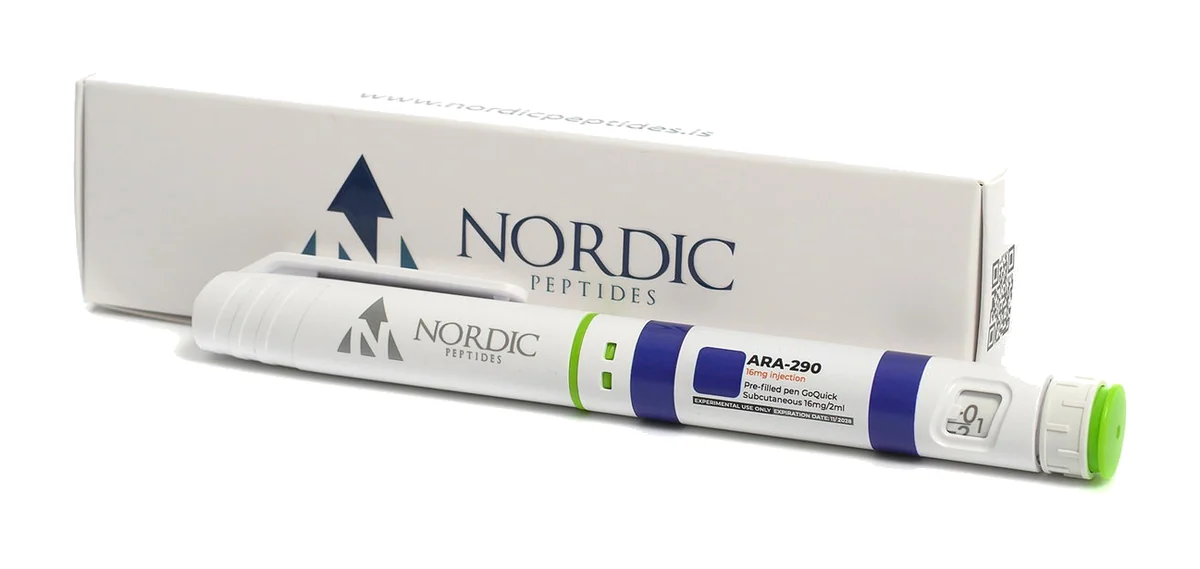 ARA-290 - 16mg
Most of the repair shelf runs on rodents. BPC-157 has no clinical trials. TB-500 has no clinical trials in the form it is sold. KPV has none at all.
ARA-290 is the exception, and it is worth being precise about what the exception consists of: five published human studies, four of them randomised and placebo-controlled, in real patient populations, run by academic anaesthesiology departments in Leiden and the Cleveland Clinic alongside the sponsor. That is more human evidence than anything else on this shelf.
It is also a compound whose best-designed trial missed the endpoint most buyers care about.
What it is, mechanically
ARA-290 — the pharmaceutical name is cibinetide — is an 11-amino-acid linear peptide engineered from the three-dimensional structure of helix B of erythropoietin. Erythropoietin protects tissue in injury models, but it also does what its name says: it drives red-cell production, which at therapeutic doses means thrombosis risk. That side effect is what stopped EPO being used as a tissue-protective drug.
Cibinetide was built to keep one half and drop the other. It engages the innate repair receptor — a heteromeric complex of the EPO receptor with the common beta receptor, CD131 — and does not engage the classical homodimeric EPO receptor that drives erythropoiesis. That is a genuinely elegant piece of design, and unlike most mechanism stories on peptide sites it was carried into the clinic rather than left in a review paper.
Trial one: the 22-patient pilot
Heij et al., 2012. Twenty-two patients with sarcoidosis and symptoms of small fibre neuropathy, entry requirement a spontaneous pain score ≥5 on the Brief Pain Inventory. Double-blind, placebo-controlled: ARA 290 2 mg intravenously three times weekly (n=12) or placebo (n=10), for four weeks.
The result was mixed in an informative way. The Small Fiber Neuropathy Screening List score improved significantly against placebo at week 4 (Δ −11.5 ± 3.04 vs Δ −2.9 ± 3.34, standard error of the mean, p<0.05), and the pain and physical functioning dimensions of the SF-36 changed significantly from baseline in the treated group.
But the Brief Pain Inventory and the Fatigue Assessment Scale improved significantly and equivalently in both groups, and the depressive-symptom inventory did not move at all. In other words, the headline pain measure did not separate from placebo. No safety concerns were raised on clinical or laboratory assessment.
Trial two: nerve fibres, not just symptoms
Dahan et al., 2013, same disease, blinded and placebo-controlled, 28 days of daily subcutaneous dosing. This one added objective structural measurement and found the interesting part: alongside improved neuropathic symptoms, treatment was associated with a significant increase in corneal small nerve fibre density, changes in cutaneous temperature sensitivity, and increased exercise capacity on the six-minute walk test.
Corneal confocal microscopy is a real, validated way to count small nerve fibres in a living person without a biopsy. A peptide that increases that count is doing something structural, not just shifting a questionnaire.
(The paper carries an erratum, Mol Med 2016;22:674.)
Trial three: type 2 diabetes
Brines et al., 2015. A phase 2 study in subjects with type 2 diabetes and painful neuropathy: ARA 290 4 mg self-administered subcutaneously daily for 28 days, then a further month of observation with no treatment.
Over the 56-day observation period, treated subjects showed improvement in HbA1c and in lipid profiles. Neuropathic symptoms on the PainDetect questionnaire improved significantly. Corneal nerve fibre density is the nuanced one: the subgroup whose mean CNFD was more than one standard deviation below normal showed a significant increase, against no change in placebo. No potential safety issues were identified.
Note what that CNFD result is and is not. It is a significant change in a pre-specified subgroup defined by how damaged they were at baseline — not in everyone.
Trial four: the phase 2b, and the endpoint it missed
Culver et al., 2017, is the largest and best-powered study of this compound: 64 subjects with sarcoidosis-associated small nerve fibre loss and neuropathic pain, cibinetide at 1, 4 or 8 mg/day against placebo for 28 days. The primary endpoint was change in corneal nerve fibre area at day 28.
Placebo-corrected mean change in CNFA (μm²):
- 1 mg: 109 (95% CI −429 to 647)
- 4 mg: 697 (95% CI 159 to 1236; P = 0.012)
- 8 mg: 431 (95% CI −130 to 992)
Regenerating intraepidermal GAP-43+ fibres increased in the 4 mg group (P=0.035). Change in corneal nerve fibre area correlated with change in GAP-43+ fibres (ρ=0.575; P=0.025) and with the six-minute walk test (ρ=0.645; P=0.009).
Two things follow, and both matter.
First, the structural signal is real and it replicated across three studies now. Second, the dose response is not monotonic — 4 mg beat placebo, 8 mg did not. That is a pattern you want explained before anyone assumes more is better.
And then the pain result. Pain improved significantly in all groups, placebo included. In the subgroup with moderate-to-severe pain, the 4 mg group reported a clinically meaningful placebo-corrected decrease in pain intensity — at P = 0.157. The authors describe that honestly as clinically meaningful; statistically, it did not reach significance. A page that quotes this trial for pain relief and does not print that number is not quoting the trial.
The trial that found nothing
Cerit et al., 2015, took 36 healthy participants and gave 2 mg of ARA290 or placebo in a neuropsychological model used to detect antidepressant action, assessing effects a week later. There were some shifts in emotional processing — lower neural response to happy faces in the fusiform gyrus, faster categorisation of positive words, increased attention to positive images — and no effects on mood or affective symptoms. The authors’ own conclusion is that the direction and strength of the effects do not unequivocally support an antidepressant-like profile.
It belongs in this article because the marketing for this compound reaches for mood and cognition, and the only human study that looked found no mood effect.
What the data does not show
No phase 3. No approval by any regulator, anywhere. Every trial above ran for 28 days — there is no published data on longer administration. Every population studied was a patient population with a diagnosed neuropathy; there is no trial in healthy adults, in athletes, in tendon or muscle injury, or in any of the recovery contexts this compound is usually marketed for. The largest trial’s pain endpoint did not reach significance, and the dose response in that trial was not monotonic.
What the data does show, and this is not nothing: a purpose-engineered peptide that repeatedly increased objectively measured small nerve fibre density in humans, across three separate randomised studies, without safety signals over four weeks.
One thing athletes need to know
Cibinetide is not named in any specific class of the WADA Prohibited List — but that is not the same as permitted. S0, Non-approved substances, prohibits at all times “any pharmacological substance which is not addressed by any of the subsequent sections of the List and with no current approval by any governmental regulatory health authority for human therapeutic use (e.g. drugs under pre-clinical or clinical development or discontinued…)”. Cibinetide has no such approval. Anyone subject to anti-doping testing should treat it as prohibited.
What we supply
ARA-290, Nordic Peptides, shipped as supplied by the manufacturer, batch documentation on request. Storage and presentation as printed by the manufacturer on the product page. If you are reading around the repair shelf, the honest comparison set is BPC-157 and TB-500 — more popular, far less human evidence.
Research use only — not for human or veterinary use, and nothing here is medical advice.
References.
- Heij L, Niesters M, Swartjes M, et al. Safety and efficacy of ARA 290 in sarcoidosis patients with symptoms of small fiber neuropathy: a randomized, double-blind pilot study. Mol Med 2012;18(1):1430–1436 (PMID 23168581).
- Dahan A, Dunne A, Swartjes M, et al. ARA 290 improves symptoms in patients with sarcoidosis-associated small nerve fiber loss and increases corneal nerve fiber density. Mol Med 2013;19(1):334–345 (PMID 24136731).
- Brines M, Dunne AN, van Velzen M, et al. ARA 290, a nonerythropoietic peptide engineered from erythropoietin, improves metabolic control and neuropathic symptoms in patients with type 2 diabetes. Mol Med 2015;20(1):658–666 (PMID 25387363).
- Culver DA, Dahan A, Bajorunas D, et al. Cibinetide improves corneal nerve fiber abundance in patients with sarcoidosis-associated small nerve fiber loss and neuropathic pain. Invest Ophthalmol Vis Sci 2017;58(6):BIO52–BIO60 (PMID 28475703).
- Cerit H, Veer IM, Dahan A, et al. Testing the antidepressant properties of the peptide ARA290 in a human neuropsychological model of drug action. Eur Neuropsychopharmacol 2015;25(12):2289–2299 (PMID 26431906).
- WADA 2026 Prohibited List, International Standard, in force 1 January 2026 — S0 Non-approved substances.